
Agri Environment Climate Scheme (AECS) - Livestock Unit Calculator
Several AECS management options require stocking density to be recorded in the management diary as part of the “activities” within a land parcel.
This section provides information on how to correctly calculate the stocking density.
The number of livestock units should be calculated using the information below:
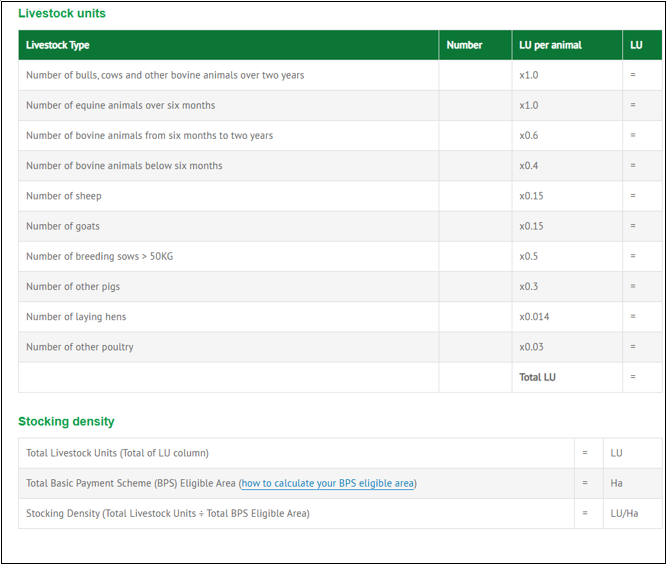
All livestock maintained on the area in question, including other stock, should be included in the calculation.
The stocking density is arrived at by dividing the total number of livestock units by the eligible area (in hectares).
So, for example, if a land parcel has 23 eligible Ha and contains: 50 ewes, 10 cows, 6 heifers (26 months old) and 10 calves (8 months old), then the following calculations apply:
50 ewes * 0.15 LU = 7.5
10 Cows * 1.0 LU = 10
6 heifers (26 months old) * 1.0 LU = 6
10 calves (8 months old) * 0.6 LU = 6
Then the stocking density of the land parcel is
(7.5+10+6+6)/23 Ha = 1.28 LU/Ha
This stocking density should be within the range stated in the grazing plan. Any time stock are added or removed from the land parcel, the event should be recorded (indicating what livestock was moved) and the new stocking density should be calculated.
LFASS
Applicants should note that the livestock units applied under AECS differs from those under the Less Favoured Area Support Scheme (LFASS). Details of the livestock units used for LFASS can be found on the Rural Payments website here, under Annex A. (www.ruralpayments.org/topics/all-schemes/lfass/less-favoured-area-support-scheme-full-guidance/).
Sign up to the FAS newsletter
Receive updates on news, events and publications from Scotland’s Farm Advisory Service