
Business and Policy May 2026 – Arable
Market overview
Nearly eight weeks after the onset of conflict, markets are increasingly factoring in the possibility of a diplomatic resolution. This shift has eased some of the extreme risk premium, particularly in energy markets, with oil falling back towards $90/barrel from highs near $120. However, this still leaves oil values more than 30% above late-February levels, meaning the impact on fertiliser and fuel will continue to be felt at farm level for some time.. As reported on last month, costing in current fertiliser and fuel values is adding a further £15/t to the cost of growing a ton of grain and £30/t to the cost of growing a ton of oilseed rape.
With geopolitics becoming slightly less dominant, attention is turning back to seasonal fundamentals – planting progress, crop conditions and, critically, weather. As we move through into May, these factors are likely to drive volatility, particularly given the already tight margins and sensitivity to input costs.
A key risk remains the Strait of Hormuz. While tensions wax and wane, any disruption would quickly reverse recent declines in oil prices and push fertiliser markets higher again. The geopolitical premium has reduced but not disappeared, and with negotiations between Iran and the US ongoing, uncertainty remains embedded in the market.
Wheat markets have reflected this mix of geopolitical and production risks. UK May 2026 LIFFE feed wheat futures are currently around £177.75/t, up from £165.60/t in mid-February. November 2026 futures have similarly risen to £183.25/t from £172.10/t. (Fig1.)
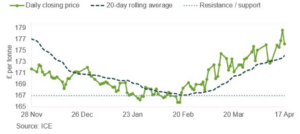
Figure 1. UK feed wheat futures prices, May-26 contract (£/tonne)
Planting Trends and Input Pressures
Elevated fertiliser and energy costs are already influencing cropping decisions globally. Farmers are actively reassessing rotations, with a shift away from input-heavy crops such as wheat and maize towards soya and sunflowers becoming more evident.
The data supports this trend. In Argentina, only around 20% of wheat fertiliser requirements have been secured, raising clear risks for both area and yield. Brazil is expected to reduce wheat plantings by approximately 15%, while fertiliser delivery issues are being reported in Australia. These are not short-term changes. If confirmed, they could tighten global grain balances, particularly if input constraints persist for “weeks rather than days,” as suggested by ongoing risks to maritime trade routes.
Weather Back in Focus
Weather risks are once again coming back into play. In the US Plains, winter wheat conditions remain a major concern, with only 34% of the crop rated good to excellent combined with the lowest planted area on record at 18.2 million hectares. Drought is particularly severe in key states. Texas wheat is rated just 14% good/excellent (down from 26% last year), while Oklahoma stands at 13% (versus 33% last year). Around 62% of the region is experiencing severe drought, with temperatures reaching as high as 32°C, placing further stress on crops. Elsewhere, excessive rainfall is slowing US maize and soya planting and delaying Argentina’s harvest. In Europe, conditions are more favourable overall, although the notably dry spring means that rainfall through May will be critical for yield potential.
Wheat
Prices recently reached their highest levels since early August last year before easing slightly as oil values retreated. The underlying constraints, however, remain clear: high energy costs and tightening supply concerns, particularly in the US. The US wheat area, noted earlier, is the smallest since records began in 1919 and combined with poor crop conditions, this has been a key bullish driver.
In contrast, the picture in Europe and the Black Sea region is far more positive. French wheat is rated 84% ‘good to excellent’, while the UK stands at 82%, a significant improvement from 67% at the same time last year and the best rating since 2023. Russia is reporting an exceptional 97% ‘good’ condition rating, the highest since 2017 and their exports remain strong, with 4.5 million tonnes shipped in March, around 300,000 tonnes above earlier estimates. Production for 2026 is now forecast at 88.7 million tonnes, with yields improving to 4.04 t/ha (up from 3.93 t/ha last year).
EU exports have reached 17.48 million tonnes so far this season, ahead of last year’s 16.39 million tonnes, although a significant increase in pace will still be required to meet overall targets.
Barley
The UK feed barley market remains supported by tight old crop availability. This relatively firm pricing reflects limited supply rather than strong demand. Markets are slightly higher week on week, largely driven by slow procurement from farm with stocks now running tight. Following strength in wheat prices, barley is now trading at a much more attractive level relatively, which could support demand. Export markets are still tricky and buying interest is difficult to come by at competitive levels.
Malting Barley
The malting barley market continues to show very limited activity. There are currently no meaningful bids from maltsters and minimal farmer selling, reflecting a broader lack of engagement. High stocks and reduced demand are central to this. Usage by brewers, maltsters and distillers is down 18.7% year-on-year, leading to more barley being diverted into feed markets and putting pressure on premiums. Despite this, new crop plantings are looking positive and spring sowing has progressed well under favourable conditions in all areas except the far north and Ayrshire where wetter conditions have prevailed.
Oilseed Rape
Oilseed rape markets have tracked movements in crude oil closely. Following news of a ceasefire, prices eased, with delivered Erith values for May quoted at £460/t (down £8.50 week-on-week) and November at £424.50/t (down £10.50).
However, as negotiations faltered, oil prices rebounded to above $100/barrel, highlighting the ongoing volatility in this sector. UK crops are in excellent condition, with 84% rated good to excellent, the highest since AHDB records began in 2019. This reflects strong establishment and favourable spring weather, pointing towards good yield potential. On the demand side, EU rapeseed imports are down 33% year-on-year, while Ukraine has reduced its export forecast to 2.6 million tonnes due to increased domestic crushing demand.
Oats
The oat market remains relatively subdued. Most millers are waiting for a renewed surge in retail demand before committing to further purchases, resulting in limited old crop and new crop activity. Unlike other grains, oats have not fully participated in the recent commodity rally. Buyers continue to focus on oat-specific supply and demand rather than broader wheat market movements. However, economics are becoming a concern, high fertiliser and fuel costs, combined with relatively low oat prices, are expected to reduce planted area in key exporting regions such as the UK and Scandinavia. This increases reliance on achieving strong yields from a smaller crop.
Trade
UK trade flows reflect shifting dynamics. Wheat imports for the season to date (July–February) stand at 1.69 million tonnes, down 22% year-on-year, while maize imports are 24% lower at 1.52 million tonnes. In contrast, rapeseed imports have increased by 3% to 665,000 tonnes. Barley exports have reached 306,800 tonnes but remain behind last year’s 379,100 tonnes. Oat exports are a notable exception, with 73,400 tonnes shipped so far, already exceeding the full 2024/25 total of 64,000 tonnes with four months still remaining in the season.
Mark Bowsher-Gibbs, mark.bowsher-gibbs@sac.co.uk
| £ per tonne | April‘26 | Aug ’26 | Nov ‘26 | May ‘27 | |
|---|---|---|---|---|---|
| Wheat | Ex farm Scot April. May/Nov 26 Futures | 173 | 175 | 186 | 192 |
| Feed Barley | Ex farm Scot April. | 150 | - | ||
| Beans | Ex farm | 215 | - | - | |
| Milling Oats | Ex farm | 136 | |||
| Oilseed Rape | Del Montrose | 420 | 426 |
Indicative grain prices 22nd April 2026 (Source: SAC//United oilseeds/AHDB/Hectare)





Sign up to the FAS newsletter
Receive updates on news, events and publications from Scotland’s Farm Advisory Service