
Boosting Resilience and Efficiency On a Tenant Farm
Graham and Kirsty Kerr farm the tenanted unit of Kirklands, a 400-acre dairy farm close to the village of Dunsyre, South Lanarkshire. The herd comprises 250 Holstein Friesian cows, housed all year round, with all milk sold through Grahams Dairies. Grass silage is produced from 170 acres over 4-5 cuts, with a further 120 acres of arable silage taken.
To boost resilience and efficiency, the business recently completed a significant investment program. Over the past decade, every livestock shed has been renewed, refurbished, or renovated to address limitations with size, layout, and cow movement, ultimately saving valuable time.
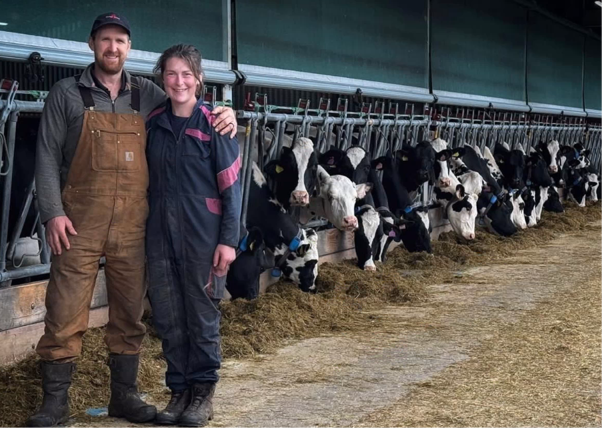
Investments In Housing & Automation
Initial capital was invested in two new cubicle sheds to support herd expansion. However, this new housing did not immediately deliver the yield increases and profit expected by the business and its lenders.
To improve time management and animal health and welfare, the couple turned to automation, investing in slurry robots, feed pushers, and Merlin robotic milkers. The robotic milkers successfully increased herd yields and helped the farm meet its financial repayments. However, it quickly became clear that increasing milk production alone would not be enough to secure long-term profitability. The three principal expenses of Feed, Fertiliser and Fuel were then scrutinised to identify savings and help maintain farm viability.
The three F’s of cost cutting
Feed
The business employed an independent nutritional advisor and feed broker to scrutinise rations and identify potential savings. This, alongside frequent lime applications and reseeding silage pastures every five years, ensures most of the dry matter requirements can be met from home-produced forage.
Fertiliser
The business made full use of funding available through the Preparing for Sustainable Farming Scheme (PFS) to analyse their soils to improve nutrient planning and management. Slurry was also analysed, while precision technology and variable-rate spreading have helped inform decisions on the requirement for purchased inorganic fertiliser. This has resulted in at least a 10-Tonne annual reduction in grassland fertiliser purchased.
Fuel
Although the business had previously secured a good electricity contract, this ended just as the Russia-Ukraine War began. The significant and alarming increase in electricity contract prices prompted the business to investigate renewable energy.
Introducing Renewables
The attraction of renewables was the opportunity to reduce the businesses reliance on expensive imported energy and its vulnerability to fluctuating electricity costs.
Following attendance at a local farm-scale renewables meeting, along with further research at AgriScot and discussions with fellow farmers, the couple invested in green energy. They installed a 280kW solar array alongside a 122kWh battery storage system with CK Energy.
The installation has not been without its challenges, particularly in securing a grid connection to export surplus renewable energy. However, financially it has been a major success. Payments received for surplus energy exported to the grid during summer more than balance the limited requirement to import electricity during winter. Having greater control over electricity costs means that the business is less exposed to shocks in the energy market, while also allowing for more accurate budgeting of farm expenses and prediction of farm income.
Continued Refinement
Having addressed the ‘low hanging fruit’ the couple are now making small refinements, primarily focused on improving animal welfare. They firmly believe that if you look after your workforce (the cows) they will look after you!
Their most recent investments include fans in the milking and dry cow accommodation to combat summer heat stress, which was impacting yields.
Calves previously housed in hutches have also been moved into a Buitelaar High Health Unit. This modular system is bolted onto a concrete base, allowing calves to be grouped at a younger age while reducing the time-consuming nature of feeding calves in individual hutches.
Tips For Others
The couple are continually looking for ways to improve and drive the business forward. Their top tips for those starting their own investment journey are: -
- Visit Farms and speak to fellow farmers to gain insight into what works.
- Talk to Finance providers early and be open and honest about what you are trying to achieve. Don’t be tempted by Variable rate lending agreements.
- Keep track of Costs. Review budget at least monthly to ensure costs are not getting out of hand.

Sign up to the FAS newsletter
Receive updates on news, events and publications from Scotland’s Farm Advisory Service