
Business and Policy July 2026 – Potato Markets and Optical Grading Technology
The legacy of the 2025 potato season will be one to remember, but for all the wrong reasons. A large oversupply and limited demand across the UK and Europe have resulted in surpluses up and down the supply chain. It’s even got to the stage that anaerobic digestion plants are closing their doors on spuds and stock feed merchants are offering zero payment for potatoes delivered. Growers with unsold stock in cold storage are in a precarious position; rack up the energy bills by keeping potatoes sprout free for limited or no recompense or switch them off, save some money on electricity but struggle to find a home and lose potentially thousands of tonnes of produce. There will be a few holes dug this season.
Unfortunately, stocks with poor or even average skin finish quality without a sales contract, will struggle to find a home, especially as new crop works its way into the market. It’s difficult to calculate what volume has been disposed of so far and what is still likely to be leftover; it’s not something that many wish to disclose. It’s possible the figures could be in the tens of thousands of tonnes already discarded across the UK. Although of little consolation, the situation is worse on the Continent, figures for unsold crop are into the millions of tonnes and, in some countries, growers are paying around €25 per tonne to get rid of it. It’s devastating for growers to dump perfectly good, edible crop. More significantly, it is financially disastrous. The problem has been compounded by higher-than-normal input costs for planting the 2026 crop.
So how have we got ourselves into this position? Over the previous two seasons, prior to 2025, potato markets experienced strong demand and prices. Both domestic trade and export were profitable across seed and ware sectors so the temptation for many was to plant more acres. This led to a significant increase in seeded area in 2025. Underperforming arable markets deepened the problem, and influenced decision making. Consumer habits have changed too; many households eat far fewer fresh spuds than they used to. Despite a recent rise in demand for processed potatoes, crisps sales for example, still fall short of peak levels experienced during the 1990’s.
Nonetheless, agriculture is a resilient industry, and many farming enterprises will have lived through countless market peaks and troughs over the years. Many have planned this year’s potato production with attention to detail, considering ways to increase efficiency across production. To this end, the cost of production will be monitored more closely than ever before and contracts seen as essential. Some growers and merchants have reduced their potato planting this season, but as other crops remain unattractive prospects, landlords were open to negotiation on additional tattie rents. Judging by the number of potato fields scattered across the countryside, I fear we’re in for another rollercoaster ride.
Sourcing and training good, reliable labour is a challenge. Sorting and grading potatoes may seem simple, but anyone who’s done it knows how tricky it can be. While human pickers are skilled at spotting defects, it’s a slow, labour-intensive job and mistakes are easy to make when millions of tubers move across the line each day. Using optical grading machines can greatly improve productivity, working faster and more consistently, providing consistent quality of product.
Optical potato grading machines have become popular, reliable, and readily available. Maybe they are part of the jigsaw puzzle to help solve some market woes.
Investing in optical grading
Investment is challenging during times of market depression. However, across the sector many have moved towards machine solutions which help deliver precision whilst optimising workloads. The development, progress and expansion of robotic technology, especially optical potato grading, has boomed in recent years. Specifically, optical graders which can be integrated on farm to sort and separate unwashed crop. Growers are keen to understand this technology and how it might deliver higher marketable yields, consistent product quality and skin finish whilst potentially reducing labour.
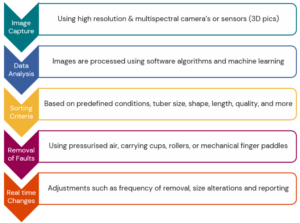
So how do they work? Optical graders are machines that use advanced imaging systems, sensors, and machine learning technology (Artificial Intelligence). These machines can sort unwashed potatoes, either by sizing tubers, removing skin blemish defects, damaged or rotten tubers, foreign objects, or everything in between all at once, providing immediate profitability gains. Optical machines come in different shapes and sizes; each perform tasks in different ways depending on the type of hardware and software installed. Although most follow a similar process (below):
Funding your investment
Investment in optical sorting solutions requires large capital investment and it’s wise to investigate grant funding opportunities, if available. Optical machines range in price from £100k to £500k+, however, pay-back could be relative to labour savings, improved grading accuracy, higher saleable yields, fewer rejections and improved seed health. For instance, installing a quality selecting optical machine might result in two less people required on the picking table, offering a reduced staffing cost. In addition, optical graders can work for as long as necessary, decreasing the barrier of natural human fatigue during repetitive tasks over long periods of time. Optical machines can also work past normal working hours, which is essential during peak delivery periods.
Considerations and limitations
The cleaner a box or sample is, the more confident the optical unit will be at correctly identifying the object or issue. Therefore, reducing stone content, haulm, lumps of earth or adhering soil on tubers is wise, and most growers deploy pickers on harvesters to help. Effectively, the more presentable a stock is, the more accurate the frequency of removal will be. Machine work rate can range from 6 to 60 tonnes per hour, depending on the type of grader.
As potatoes are a naturally perishable product, optical sorters have their limitations too. Although they are highly advanced, and always strive for 100% accuracy, it is likely they will seldom achieve this. Most run at 80-95% accuracy, nonetheless, this is still impressive precision, especially when considering manual selection involves human perception, which can be subjective and prone to errors. What one picker might consider a defect, another might not, leading to inconsistency of fault removal.
Optical grading technology is continually improving. Hardware on machinery is unlikely to change much in the future, but the software will. Most companies expect payment of annual software subscriptions to help continue and improve machine learning, which means the technology is advancing substantially every year. This helps improve accuracy, capacity, and decision-making speed.
Gavin Prentice, 07392 127 981


Related articles
Potatoes

Sign up to the FAS newsletter
Receive updates on news, events and publications from Scotland’s Farm Advisory Service