
Business and Policy June 2026 – Arable
Market overview
Wheat
The May WASDE1 report points to a wheat market that is gradually tightening and forecasts a decline in world production of 24.8Mt to 819.1Mt. Although this still ranks as the second largest world crop on record, it’s the biggest global fall in output since 2018/19.
U.S. wheat production estimates have been particularly impacted by severe drought and frost and are forecast to fall sharply in 2026/27 to 42.5Mt; their lowest output since 1972. 70% of the U.S. winter wheat area is currently impacted by drought (compared to the 2016-25 historical average of 25-30%) and the consequential drop in output more than offsets slightly higher opening stocks, leaving total U.S. supplies 21% lower than the previous seasons output of 54Mt
This tightening supply backdrop has been reflected in recent markets. Wheat futures have remained volatile, influenced not only by crop fundamentals but also by shifting trade discussions and speculative positioning. Kansas wheat has found support from drought stress in the U.S. Plains, while Chicago wheat has swung sharply as traders react to broader commodity flows and uncertainty around export demand.
Despite tighter U.S. fundamentals, their domestic demand is not strengthening significantly. Food use remains steady, reflecting stable consumer demand, while feed use is expected to decline as higher prices and reduced availability make wheat less competitive in livestock rations. Export demand is also forecast lower due to reduced U.S. supply and weaker competitiveness on the global market.
Globally, wheat production is also expected to decline from last year’s record, with major exporters including the European Union, Argentina and Australia all producing smaller crops. However, the global picture is less one-sided than in the U.S., as improved crop conditions in parts of Europe and the Black Sea region have helped limit upside price momentum. Better rainfall and more favourable development across France, Germany and surrounding regions have eased earlier concerns, and European futures have repeatedly struggled to break higher.
The USDA also forecast EU wheat stocks down by 2.3Mt in 2026/27 to 14.5Mt and for UK wheat stocks a fall of 100Kt to 2.6Mt which would still leave them above the 10-year average of 2.2Mt.
The contrast between tighter U.S. supply and improving conditions elsewhere has contributed to a broadly rangebound but volatile global wheat market. Traders remain highly sensitive to weather developments, geopolitical signals and trade expectations, particularly regarding China. Periodic reports of potential increases in Chinese agricultural purchases have supported sentiment, but firm demand commitments have yet to materialise, keeping markets cautious.
Global wheat ending stocks are expected to fall modestly, reinforcing the view that the market is tightening, though not entering a severe supply shortage.
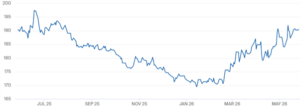
Grain markets rose last week due to the trade agreement between the US and China and a further decline in US winter wheat conditions. Nov-26 UK feed wheat futures gained £6/t since 8th May, currently now at £190.50/t (Fig 1) and back to where they last peaked at the end of April. Wheat has been tested at this level more than once over the last month and it seems unlikely to break through higher unless new ‘market news’ comes into play.
Fig 1. ICE Futures Europe UK Nov ‘26 feed wheat futures – £ / tonne (Jun ’25 – May ’26)
Source : ICE = Intercontinental Exchange.
Oilseeds
The soybean and wider oilseed complex present a very different picture. In the United States, soybean production is expected to increase due to higher harvested area and trend yields, resulting in a larger crop and improved overall supply. However, unlike wheat, demand growth is strong enough to absorb much of this increase.
A key driver is domestic crushing activity, which is expanding significantly on the back of strong margins and rapidly growing demand for soybean oil in renewable diesel and biofuel production. Policy support through renewable fuel mandates continues to underpin this trend, making biofuel demand one of the most important structural factors in the soybean market.
Soybean exports are also expected to recover following previous disruptions linked to trade tariffs and reduced shipments to China. However, competition from South America remains strong, particularly from Brazil and Argentina, where production continues to expand. Even with rising global supply, U.S. ending stocks are expected to decline slightly as domestic demand growth offsets production gains. The tightening stocks position supports firmer soybean values, despite the larger crop.
Globally, oilseed markets remain comparatively well supplied. Production is expected to rise across soybeans, sunflower seed and rapeseed, with significant contributions from South America, Eastern Europe and the Black Sea region. At the same time, global crush demand continues to expand, driven by steady growth in vegetable oil consumption and protein meal demand.
Barley and Oats
Barley markets sit between the wheat and oilseed stories. In the UK and Europe, recent rainfall has improved winter crop prospects, although spring barley areas continue to face earlier drought impacts, mainly in England and to a lesser extent across Scotland. Feed barley markets remain subdued, with limited trading activity reflecting low confidence across the supply chain. Malting barley remains more sensitive to weather-driven production uncertainty, but weak demand has so far limited upward price movement.
The oat market has also remained subdued, with very limited buying and selling activity as the season approaches its final stages. Trade conditions are thin, reflecting a lack of urgency on both sides of the market. Feed barley strength continues to provide some underlying support to oat values, but this has not translated into stronger demand. Short-term values have shown slight firmness due to nearby supply tightness, but overall confidence remains low. The market is largely waiting for clearer production signals before taking stronger positions, leaving oats broadly rangebound. Longer term, weak pricing relative to competing crops raises the risk of acreage switching, which could eventually constrain supply in future seasons if returns do not improve.
Mark Bowsher-Gibbs, mark.bowsher-gibbs@sac.co.uk
| £ per tonne | June‘26 | Aug ’26 | Nov ‘26 | May ‘27 | |
|---|---|---|---|---|---|
| Wheat | Ex farm June /Nov’26/May‘27 Futures | 190 | 180 | 190 | 194 |
| Feed Barley | Ex Scot June | 166 | - | ||
| Beans | Ex farm | 215 | - | - | |
| Feed Oats | Ex farm | 125 | |||
| Oilseed Rape | Del Montrose | 432 | 438 |
Indicative grain prices on 27th May 2026 (Source: SAC//United oilseeds/AHDB)
1 World Agricultural Supply and Demand Estimates







Sign up to the FAS newsletter
Receive updates on news, events and publications from Scotland’s Farm Advisory Service