
Business and Policy January 2026 – Arable
Grain markets in 2025: a year in review
Grain markets in 2025 were defined overwhelmingly by supply. Large harvests across the Northern Hemisphere, favourable weather in South America, and intense export competition combined to keep prices under sustained pressure. For UK farmers, this translated into another difficult year, with weak returns at the farmgate set against firm consumer food prices, further highlighting the growing disconnect between agricultural commodity markets and retail inflation.
On the supply side, 2025 delivered record or near-record output in many key exporting regions. Global wheat supplies rose to all-time highs, with world stocks up year on year and production in top exporting countries increasing by close to 50Mt. Canada harvested a record wheat crop, Australia produced its second-largest winter crop on record, and Argentina and Russia also delivered large volumes despite some regional variability in crop conditions. The EU crop was revised higher again, supported by excellent growing conditions in France and across much of northern Europe.
Demand, however, failed to keep pace. Global wheat consumption grew only modestly, leaving balance sheets comfortably supplied. Black Sea exporters continued to dominate international trade, using aggressive pricing to clear surplus stocks; while Argentina’s export tax cuts added further pressure to global values. Currency movements amplified these dynamics: a relatively strong euro and sterling reduced European export competitiveness, while a softer US dollar briefly supported American shipments.
Maize presented a contrasting picture. While the US harvested a very large crop, production downgrades elsewhere – notably in the EU and Ukraine – tightened global stocks. Demand remained robust, driven by strong export flows from the US and rising bioethanol use in both the Americas and Brazil. As a result, maize fundamentals improved through the year, lending periodic support to wider grain markets and preventing wheat prices from falling further.
Oilseed rape and the wider oilseed complex were pressured by record soya and rapeseed supplies from Canada and Australia. While EU imports from Ukraine fell due to increased domestic crushing there, global availability remained ample, capping rallies despite supportive biofuel demand.
UK market experience in 2025
In the UK, these global forces translated into persistently weak prices. Feed wheat values fell to around £157/t ex-farm during early summer, briefly lifted during harvest before drifting lower again into autumn. Milling premiums too, continued to erode, compounding the pressure.
Regional supply-and-demand dynamics still mattered with price differentials very much in evidence across the country and demonstrated in ex-farm prices collated by Hectare Trading (Fig 1).
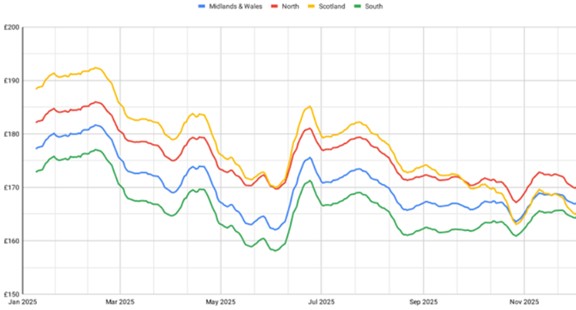
Fig 1. Spot ex-farm feed wheat moving averages through 2025 for the UK regions. (Source Hectare Trading)
However, variable yields and low prices left farmers with little margin. Pre-harvest forward selling was cautious, reflecting limited confidence in prices, but post-harvest selling increased as growers opted to buy in to forward values rather than wait for a rally that failed to materialise.
Oilseed rape stood out as a relative success. Firmer prices and improved yields supported margins, and this has driven a significant increase in planting intentions for harvest 2026, up 30% nationally. Yet even here, the risk of oversupply looms if expanded acreage meets a heavy global oilseed balance sheet.
Factors driving price movements
Throughout 2025, price movements were driven less by demand surges and more by shifts in supply expectations, currency moves and logistics. USDA report revisions repeatedly reinforced the message of abundant wheat, while maize markets reacted to tighter stocks and strong usage. Weather remained a background risk rather than a realised threat, and geopolitical tensions, particularly in the Black Sea, added only short-lived volatility.
Outlook for 2026
Looking ahead, the outlook for 2026 remains challenging. Early indicators suggest another year of strong global production potential, with good crop conditions across Europe and large planted areas elsewhere.
Wheat fundamentals remain decisively bearish, and any rallies are likely to be met with selling. Maize offers the most potential support, particularly if the weather in South America deteriorates or demand continues to outperform expectations.
Oilseeds may benefit from biofuel policy support but expanded acreage and large global stocks will likely limit upside.
For UK growers, 2026 is shaping up as a year where success will depend less on outright price recovery and more on marketing timings, regional premiums awareness and risk-management. Without a sustained improvement in returns, the economic case for maintaining current levels of domestic grain production is going to remain under serious strain.
| £ per tonne | Jan ‘26 | May ’26 | Nov ‘26 | |
|---|---|---|---|---|
| Wheat | Ex farm Scot Jan. May/Nov 26 Futures | 164 | 169 | 173 |
| Feed Barley | Ex farm Scot Dec. | 146 | - | |
| Malting Barley | Ex farm contracted price | 175 | - | - |
| Milling Oats | Ex farm | 120-160 | ||
| Oilseed Rape | Del Montrose | 405 | 406 | 385 |
Indicative grain prices 17th December 2025 (Source: SAC//United oilseeds/AHDB/Hectare)
Mark Bowsher-Gibbs, SAC Consulting






Sign up to the FAS newsletter
Receive updates on news, events and publications from Scotland’s Farm Advisory Service