
Creep Feeding Spring Born Suckler Calves
This article was updated on 9th July 2026.
This is part of the FAS Beef Technical Toolkit series, designed to give farmers practical timely advice to aid decision-making throughout the year.
Introduction
Decisions on if/when to creep feed will depend on several factors such as cow condition and milk production, grass quality in front of cows and calves, and what the calves are destined for. It is well established that the main reasons for creep feeding are to make the most of good conversion of feed to meat at this age, to get calves used to feed prior to housing and to help with the transition post weaning. It must be noted that creep feeding directly will substitute grass intakes and calves can still do very well on grass alone without creep feed if conditions allow (i.e. weather, cow condition and good grass quality and availability).
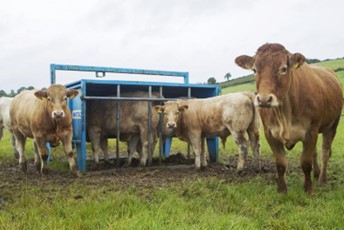
When a calf is four months of age half of its nutritional requirements should be met by forage and concentrates rather than milk. Supplying creep feed before weaning can help smooth the transition from pre- to post-weaning and the extra source of nutrients can compensate for the reduction in milk yield as lactation progresses.
Benefits of creep feeding
- Weaning weights can be increased by around 25kg.
- Weaning check is lowered through less stress from weaning – familiar with concentrate feed and rumen microbes are adapted for a change in diet.
- When there is less stress at weaning there is a reduced incidence of pneumonia.
- Most efficient age for converting feed to kilos.
Creep feeding is extremely efficient owing to the calf’s high potential growth rate. Since the rest of the calf’s diet (i.e. milk and forage) already more than meets the requirement for maintenance, all the nutrients from the creep are used for growth. This means that the conversion of creep to live weight gain is efficient at around 4kg feed/kg gain and is economically worthwhile.
When to start creep feeding
Timing will depend on calf age, growth potential of calves and grass availability. Normally creep feeding would normally start between 6-10 weeks prior to weaning but bulls to be finished on ad-lib cereal diets should start being creep fed earlier, around 12 weeks before weaning. With very milky cows or in situations where it is tricky to creep feed, starting 4-6 weeks before weaning will still help limit the weaning check. As a rough guide allow 100-150kg of creep feed per calf for a 6-12 week creep feeding period.
If suckler cows are in poorer condition than normal, creep feeding will improve calf performance and take pressure off the mothers. If grass supplies are limited, then creep feeding will improve the performance of the calves. However, care should be taken to monitor intakes to prevent risk of over consumption if other feed sources are limited.
What to feed
In summer, calves will be consuming milk and grass so on average a creep feed with 14-16% crude protein (as fed) and 12.5MJ metabolisable energy/kgDM should be adequate. If feeding with a creep hopper then feed is available ad-lib so care is required to prevent rumen acidosis. Initially diluting higher starch creep feed with a digestible fibre source such as sugar beet pulp or soya hulls will help, which can be gradually reduced over time. If buying a proprietary feed this may not be necessary as normally these will contain less cereals than used in home mixes (less than 50%) which is good for safety in creep feeding, however, check that ingredients are of good quality to encourage good intakes. Forward creep grazing calves can save money on using concentrates if grass quality and availability allow. See: Creep grazing beef cattle.
Top tips
- Initially starting with a high protein content (around 16-18%) will reduce the risk of acidosis and over a few weeks reduce this to 14-16% crude protein.
- Cereals should be lightly processed (the grain should be just cracked open) otherwise the rate of fermentation in the rumen will be very high and the microbes will produce an excess of acids if cereals are too finely ground.
- There are several combinations that can be used for home mixes – seek advice on formulations using feeds are available on farm to minimise additional spend and ensure the creep is well balanced.
- Alkaline treated cereals (urea treatment plus an enzyme activator) are a good addition to creep feeds (in calves over 3 months old) to help lower acid loading, however, also remember that although the cereals are alkaline, they are still a very starchy feed so the same cautions should be applied as when feeding untreated barley.
- When home mixing use a general-purpose cattle mineral added at 25kg/tonne (or per manufacturers instruction) to supply 25g of mineral per 1kg of feed consumed. If using proprietary feeds check whether it is mineralised for the purpose of creep feeding calves.
Cautions
Think about positioning of the creep feeder. If the cattle are spread out over a large area cows and calves may only come to the creep feeder once a day increasing the risk of calves gorging feed. The risk of gorging increases later in the season when grazing is poor. If grass availability is poor this may increase creep intakes resulting in higher costs as well as higher risk – a good forage supply is essential to accompany milk and creep feed. Never let the creep feeder run empty.
Examples of home mixed creep feeds
Combinations of straights can be used, always seek advice from a nutritionist.
Examples: 1/3 of each wheat/maize dark grains, barley and sugar beet pulp, gradually reducing the sugar beet pulp to around 15% replacing with barley over time. Or a mix of 60% barley, 25% sugar beet pulp, 15% soya and mineral supplement (normally a bag to a tonne 25kg) again it may be possible to reduce the beet pulp inclusion gradually to around 15% over time.
A good quality protein source, such as soya bean meal or protected rapemeal is particularly useful as it is a source of undegradable protein. This will assist the transition to a weaned diet until there is enough microbial protein produced by the developed rumen. If a proprietary feed is used, choose one with good quality, high energy, palatable ingredients.
If calves are introduced to creep early, some producers have been successful at using high levels of cereals, as calves take in low levels to start with and get accustomed to it. However, if it is introduced later when calves are more reliant on other feed sources, starchy feeds should be introduced gradually over the space of a few weeks.
To maximise intake, feed must be kept clean, fresh, and available so check the trough every day and clean it out if necessary to prevent bridging. It is also essential that calves can get good access to clean, fresh water.
Written by Karen Stewart & updated by Lorna Shaw.
Sign up to the FAS newsletter
Receive updates on news, events and publications from Scotland’s Farm Advisory Service