
Enhanced Greening for Corn Buntings
Since 2015, farmers in Scotland have had to put a proportion of their arable land into Ecological Focus Areas (or EFAs) as part of the greening requirements of the Basic Payment Scheme. In 2026 there was a significant change to the EFA rules, referred to as enhanced greening, which introduced requirements to establish specific sward mixes for some of the EFA options. From 2027, the EFA requirement is 7% of the arable area, although some EFA options are weighted so that they count as more or less than their actual area, towards the 7% total.
Many of the EFA options available under enhanced greening provide general biodiversity benefits, for example by providing a nectar source for pollinating insects and enhancing soil health. However, with some thought and forward planning, there is also the potential to tailor the use of enhanced greening to deliver specific environmental objectives.
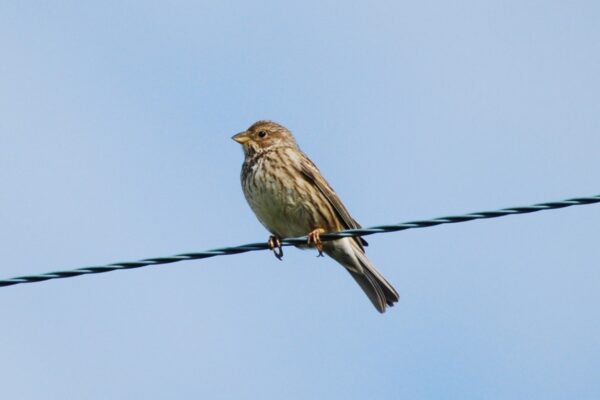
One such example is the way it could be used to benefit one of Scotland’s most endangered farmland birds, the Corn Bunting.
What Does the Corn Bunting Need?
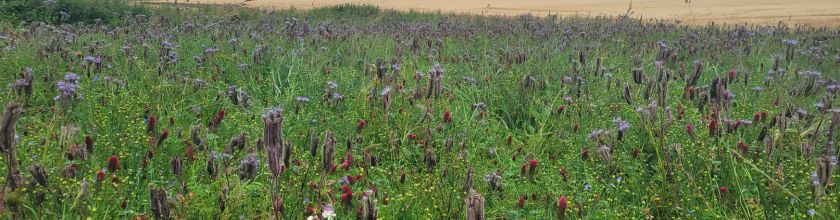
The Corn Bunting (Emberiza calandra) has been brought close to the brink of extinction in Scotland due to changes in the way that farmland is managed. The species nests on the ground in fields quite late in the spring and they find silage fields more attractive than cereal crops. This results in many nests being destroyed by cutting before they can hatch. Research by RSPB Scotland found that green manure crops are very attractive to nesting Corn Buntings, but they need to be well established and dense by late May and this is more easily achieved if they are sown the previous autumn rather than in spring, which is the more typical approach.
There have been positive responses to agri-environment measures, however. For example, in Fife, the population has increased from fewer than 100 to nearly 500 territories over a period of 15 years. This is thanks to the collaborative efforts of farmers in the area to provide wild bird seed mixes, as a shortage of seed food in winter was the primary cause for their original decline in that part of the country.
In north-east Scotland, reversing the decline has been more challenging because of that late spring nesting. However, there are still opportunities for farmers to help corn buntings while still making the most of their EFA options.
Making The Most of EFA Options for Corn Buntings
Thoughtful use of EFA options over a two-year period could be used to benefit this species. The two key EFA options that could be combined are EFA Green Cover, which is sown after harvest (and by 1 November at the latest), and EFA Fallow, which is managed over the period 15 January to 15 July and must be established by 1 May at the latest (Table 1). Crucially, these dates are the minimum requirement: EFA Green Cover does not have to be ploughed in immediately after 31 December and EFA Fallow can be established any time before 1 May (and can be an existing sward). If the correct seed mix is sown in the autumn, it can be used as EFA Green Cover in year one and then retained to be used as EFA Fallow in year two.
Table 1: Dates and weighting for EFA Green Cover and Fallow
| EFA Green Cover (EFAGC) | EFA Fallow Land (EFAFAL) | |
|---|---|---|
| Dates | Must be established by 1 November and maintained until at least 31 December | Must be sown by 1 May and retained until at least 15 July |
| Weighting (contribution towards 7% EFA) | 1 ha EFAGC = 0.3ha EFA contribution | 1ha EFAFAL= 1ha EFA contribution |
The autumn-sown green manure mixes trialled by RSPB Scotland for Corn Buntings included vetches, red clover, crimson clover, phacelia, ryegrass, oats and barley. Table 2 shows the compatibility of this type of mix with EFA Green Cover and Fallow options. Essentially, provided the mix includes at least three flowering species, and at least two of the eligible species for EFA green cover, it can be used for both options over the two-year period.
Table 2: Compatibility of RSPB’s autumn-sown green manure mix for Corn Buntings with EFA Green Cover and Fallow rules
| . | EFA Green Cover (EFAGC) | EFA Fallow Land (EFAFAL) | |||
|---|---|---|---|---|---|
| . | Diverse Mix Temporary Grassland | Wild Flower Mix | Wild Bird Seed Mix | Soil Conditioning Crop | |
| . | Must include at least 2 eligible crops | Must include at least 3 flowering species | Must be a mix of flowering species | Must include at least 2 eligible crops | Can be mixed or single stands |
| Vetch | Yes | Yes | Yes | ||
| Red Clover | Yes | Yes | Yes | ||
| Crimson Clover | Yes | Yes | Yes | ||
| Phacelia | Yes | Yes | |||
| Italian Ryegrass | Yes* | ||||
| Perennial Ryegrass | Yes* | ||||
| Oats | Yes | Yes | |||
| Barley | Yes | Yes | |||
*Ryegrass is an important component of diverse mix temporary grassland but doesn’t count towards the requirement for at least three flowering species.
Practical Management Within the Farming System
The best way to combine these two options for Corn Buntings would be to rotate the green manure around the farm, and this will also improve soil organic matter, reducing fertiliser requirements for the following crop. Once such a rotation is up and running, there will be two areas of green manure contributing to the EFA requirement in each year:
- EFA Fallow retained from the previous year’s EFA Green Cover
- EFA Green Cover sown after harvest (to be used as EFA Fallow the following year)
If these two options are the only EFA options on the farm, then at least 5.4% of the arable area would need to be sown as green manure each year as the EFA Fallow sown the previous year would contribute 5.4% (1 x multiplier for EFA contribution) and the new EFA Green Cover sown after harvest would contribute 1.62% (0.3 x multiplier for EFA contribution), making just over the minimum requirement of 7% in total.
In practice, there may be other EFA options in use on the farm which would reduce the required area, but one advantage of the combined use of EFA Green Cover and EFA Fallow rotating around the farm, is that in any one year, just over 5% of the arable area is being taken out of production but delivering the 7% EFA requirement.
Other Considerations
Other EFA options that are beneficial to Corn Buntings include EFA Margins and EFA Fallow wild bird seed mix. However, on farms with a significant proportion of spring sown crops, it is possible to include some cereal crops, such as oats, barley and triticale, within a green manure mix. If the EFA fallow can be left over much of the following winter, it will also provide seed food in a similar way to wild bird seed mix. In this situation, a single EFA green manure crop could deliver benefits over three years:
Year 1 – Sow EFA Green Cover (including some winter cereals) as soon after harvest as possible.
Year 2 – Retain the sward as EFA Fallow throughout the year.
Year 3 – Plough in the green manure in late winter/early spring before sowing.
If the green manure is to be followed by a winter crop, it is ideal if the green manure can be retained for as long as possible in the summer of Year 2, as Corn Buntings can still be nesting into August. Although the EFA Fallow period ends on 15 July, delaying ploughing down until 15 August is best (although the practicality of this may depend on what the following crop is).
Another important consideration is the type of landscape preferred by Corn Buntings: they prefer open fields, so avoiding sowing green manures in fields that are enclosed by woodland or forestry is preferable. However, Corn Buntings like to have elevated songposts such as overhead wires close to their nest sites, so these can be useful features to consider when choosing fields.
Summary
- Autumn-sown green manure crops provide an attractive and safe nesting habitat for Corn Buntings.
- EFA options can be used to establish the green manure as EFA Green Cover in the autumn of one year and retain it as EFA Fallow in the following year.
- Rotating the option around the farm means that a new area can be established in the autumn of each year.
- Seed mixes must be checked to ensure that they meet the requirements of both EFA options.
- Green manures should be retained until 15 August after the EFA Fallow period has ended, if possible.
- If the following crop is spring sown, retaining the EFA Fallow over the winter can also provide winter food, if some cereals have been included in the green manure mix.
- This management should avoid fields that are enclosed by woodlands or forestry as these are generally less attractive to Corn Buntings.
Related Links











Sign up to the FAS newsletter
Receive updates on news, events and publications from Scotland’s Farm Advisory Service