
Importance of Potash in Grassland
Potash (K₂O) contains potassium (K) - a major nutrient which is pivotal to the health, growth and quality of grass plants. Potassium regulates many physiological processes within plants, from the roots to the leaf tips, improving the ability to cope with stresses such as disease and drought. A stable potassium supply also assists with nutrient uptake.
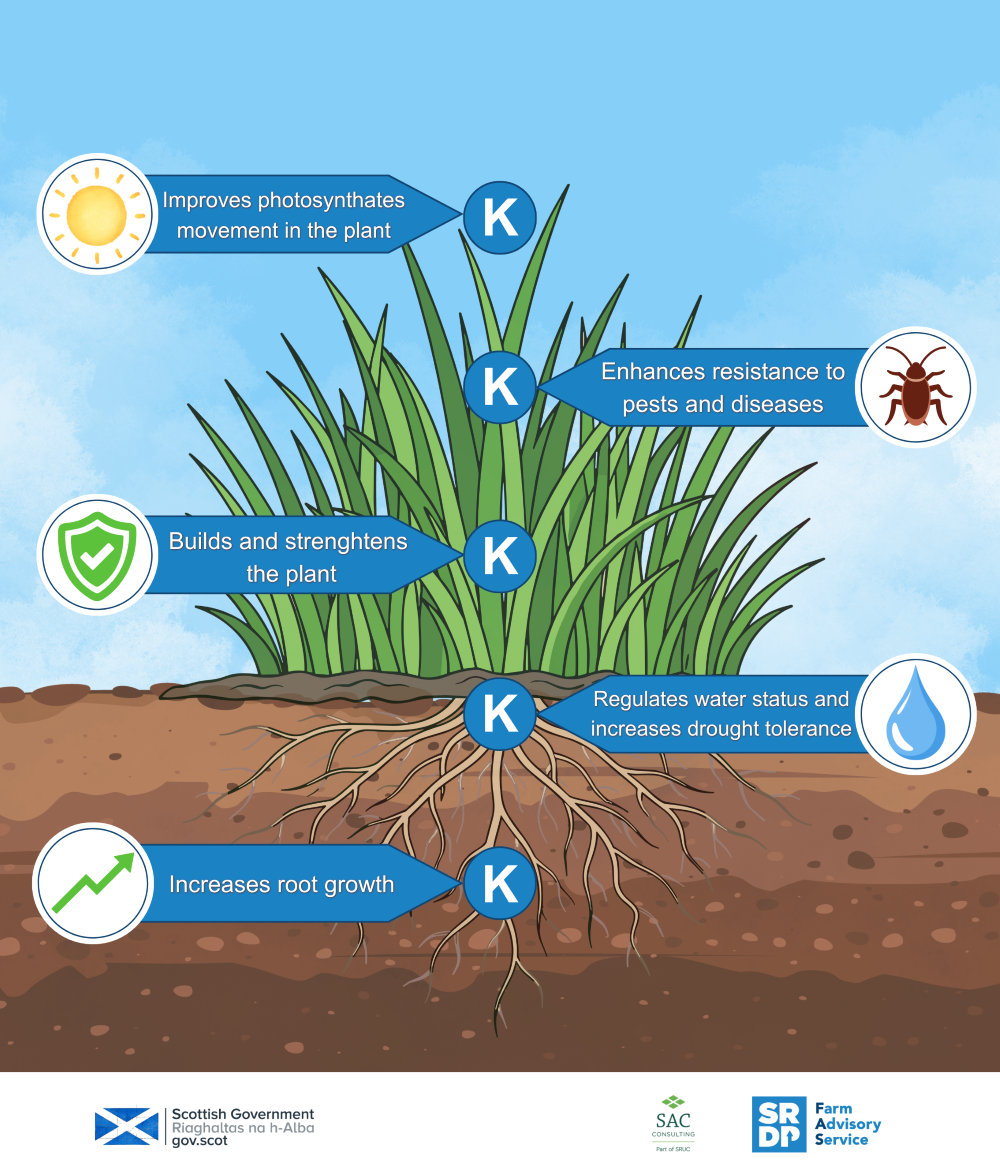
What Potash does in a Grass Plant
Potassium regulates the opening and closing of stomata through its movement in and out of guard cells surrounding pores.
This helps plants to respond to changing environmental conditions, improving the plant’s ability to use water, regulating transpiration and helping to cool leaf surfaces which will reduce wilting and improving rates of photosynthesis.
Potassium regulates water movement through the plant tissues.
This helps to strengthen the plant structures and move photosynthates through the plant.
Potassium improves the activity of the enzymes which convert nitrate into ammonium, allowing plants to incorporate this into amino acids.
When supply is sufficient, plants can absorb nitrogen more effectively from the soil, convert it into plant-available forms and move it to the areas of active growth.
This reduces the risk of environmental pollution which can occur when potassium levels are low. As plant uptake slows, nitrogen is more likely to be leached.
Importance of a Potash Reserve
Plant demands for potassium will vary throughout their growing season. Crop resilience, yields and quality are affected if potassium is not available at the time it is required. Soils should be maintained at moderate status to ensure there is sufficient potassium available when required by plants. There is no benefit to yield to build indices above moderate status.
The potassium removed from crop offtakes should be replaced after harvest to ensure levels are replenished and continuity of supply is maintained for that crop. Grass has a constant requirement for potassium, but its need is greatest when growth is at its peak, typically in late May. Crops of silage will remove large amounts of potassium, with around 7kg of K₂O for every 1 tonne of fresh grass removed. In an intensive 3-cut system, this could amount to 280-340kg K₂O per ha. Silage crops’ yields should be monitored to ensure that sufficient levels of potassium are being returned to the soil reserves.
Grazing livestock are continuously recycling nutrients back to soil reserves from their dung and urine. 90% of potash applied from livestock grazing will be returned to soil reserves so potash requirements on grazing land are often low.
Soils with depleted potassium levels will impact on crop vigour, resilience, yield and quality. Some of the effects of potassium deficiency include:
- Reduced yield.
- Lower response to applied Nitrogen.
- Deterioration of sward composition.
- Reduced fixation of Nitrogen by legumes.
- Less vigorous clover and grass growth.
- Increased susceptibility to frost, disease and drought.
- Slower recovery after grazing or cutting.
- Slow spring growth.
- Reduced protein levels in forage.
- Compromised silage fermentation.
How to Address Deficiencies
Visual diagnosis of potassium deficiencies can be hard to identify due to symptoms being similar to other grassland issues. Regular soil sampling is the most reliable way to identify a deficiency.
There are some conditions or soils which can be at a greater risk of developing potassium deficiency and so should be monitored through soil analysis more frequently.
High risk for deficiency:
- Fields where silage or hay is removed due to the volume of potassium removed with each tonne of fresh grass.
- Increased silage yields or dry matter content where more potassium will have been removed than initially budgeted for.
- Shallow sandy soils can see an increase in potash losses as their coarse texture, with larger pore spaces allows water to permeate more readily. Soluble nutrients can be lost with water.
- Fertiliser and organic manures should not be applied to water-logged land, very dry, cracked land and frozen land as this can increase the rate potash is lost, mostly by run off.
- Losses of potash also occur in manure heaps and silage effluent. Up to 50% of potash can be lost in an uncovered store due to potash being freely soluble. Sampling of organic manures can ensure the correct amount of nutrient is being accounted for in applications.
When to Apply Potash
Soil should be sampled ever 3-5 years as part of a nutrient management plan. Potash can be applied throughout the growing season, but consideration should be made to ensure:
- No more than 15kg K₂O/ha is applied to grazing land in spring to avoid nutritional imbalances in livestock. This is best applied as a nitrogen product with low P&K content.
- A maximum application of 90kg/ha is made before each cut of silage. Balances required could be applied over winter or early spring for the following season.
- Ground conditions are suitable to travel.
- Ground is not water-logged or very dry and soil cracked.
- Autumn and winter applications are avoided if heavy rainfall is forecast in the following 3-4 days.
- Any potassium in organic manures is accounted for and deducted from the balance required.
Regular soil sampling, especially for higher-yielding or higher-risk soil types is the most reliable way to monitor the effectiveness of nutrients being supplied from organic manures and fertilisers. When up-to-date soil results are used to prepare a nutrient management plan, the balance between optimising yield, minimising environmental losses and an efficient use of the fertiliser budget can be struck.
Lorna Galloway, SAC Consulting



Sign up to the FAS newsletter
Receive updates on news, events and publications from Scotland’s Farm Advisory Service