
El Niño – Why a Pacific Weather Pattern Matters to UK Grain Markets
As harvest approaches, grain market analysts are once again paying close attention to developments in the Pacific Ocean. The reason is El Niño, a naturally occurring weather pattern that, despite originating thousands of miles away, can have a significant influence on global grain markets and ultimately farmgate prices here in the UK.
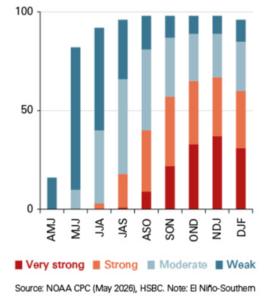
El Niño occurs when sea surface temperatures in the central and eastern Pacific Ocean become warmer than normal, disrupting global weather systems. Forecasts for the 2026/27 season suggest a ‘strong’ to potentially ‘very strong’ El Niño event could develop during the autumn and winter months.
Expected severity of El Niño by 2026/27 (3-month periods: April 2026 to February 2027)
For UK growers, the important point is that El Niño does not usually have a major direct impact on our own weather. Unlike North and South America or Australia, UK crop yields are generally influenced far more by local weather patterns in the North Atlantic and Europe.
The indirect effects, however, can be significant. Australia is one of the world’s largest wheat and barley exporters and strong El Niño events frequently bring hotter and drier conditions across key grain-producing regions. Lower Australian production can quickly tighten export supplies into Asian markets and support world grain prices.
Argentina, another major exporter of maize, wheat and soybeans, can also experience reduced yields during El Niño years, while parts of southern Africa often suffer lower maize production. Even where production losses are relatively modest, the market tends to build a weather premium into prices as traders assess the risk to global supply.
This is particularly relevant at present because global grain stocks are already forecast to tighten slightly during 2026/27. USDA projections suggest world grain production could fall by around 52 million tonnes year-on-year while consumption continues to rise, reducing global stocks-to-use cover by approximately 5%.
That remains comfortable by historical standards, but it leaves the market more sensitive to weather disruptions than it was only a few years ago.
For UK growers, El Niño is unlikely to determine yields here, but it could still influence the value of the crop in the shed. In an increasingly connected global grain market, weather on the other side of the world can quickly find its way onto a British grain merchant’s price sheet.
Mark Bowsher-Gibbs, SAC Consulting
Sign up to the FAS newsletter
Receive updates on news, events and publications from Scotland’s Farm Advisory Service