
Scotland’s Terrestrial and Aquatic Mammals
3 May 2024Thanks for subscribing! Please check your email for further instructions.
With 69% of Scotland being used for agriculture, farmland has a vital role to play in ensuring that our native mammals have sufficient connected habitat to reach stable populations and to adapt to environmental change.
Which species could you find on your farm, and what tips and funding options could you deploy to make your farm more accessible to them?
Background
Scotland hosts 49 wild native species of terrestrial mammals. Ranging from the red deer to the wildcat, these species are often the focal point when discussing Scotland’s biodiversity as well as its cultural identity. While mammals might not boast the diversity in species of other groups of animals (beetles having 2,600 species for example), they are often the main drivers of ecosystem health, through regulating vegetation, seed dispersal, predation of insects and other mammals, and introducing elements of disturbance. As such, mammals shape ecosystems, with their presence or absence impacting a range of other species.
As human society developed in Scotland, the impacts to our native mammals has varied from species to species. Where red deer dominate, wildcats have diminished. As such, some of our species have been awarded protection and recognition, to safeguard them against human activities and prevent them from being driven to extinction. They take prime place in the Scottish Biodiversity List - a list of animals, plants, fungi and habitats considered to be of principle importance for biodiversity in Scotland, including 22 species of terrestrial mammals.
With 69% of Scotland being used for agriculture, farmland has a vital role to play in ensuring that our native mammals have sufficient connected habitat to reach stable populations and to adapt to environmental change. Knowing which of these species you have on your farm can be tricky without knowing the field signs to look for. However, websites such as the NBN Scotland Atlas can play a massive role in informing landowners of the species found on their land and neighbouring areas. The Atlas provides open access biodiversity data in a user-friendly way, to display what species have been found all over Scotland.
Here we highlight some of the mammals from the Scottish Biodiversity List that you could find on your farm, and actions you can take to make your farm more accessible to these species.
Click to expand:
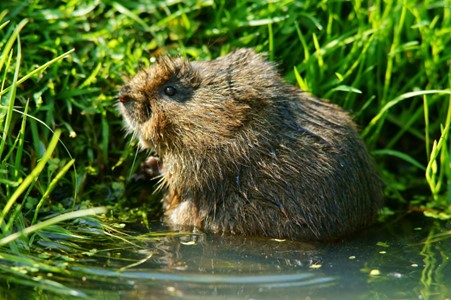
Water Voles (Arvicola amphibius)
Image credit: Peter Trimming at Flickr.com
Habitats: Rivers, streams, ditches, around water bodies, and wetlands.
Check your farm location for records!
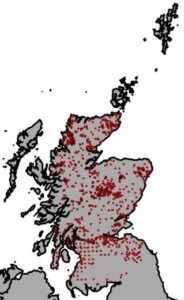
NBN Atlas occurrence download at https://nbnatlas.org accessed on 15 April 2024
Actions to take to promote water voles:
- Install fenced-off buffer strips
Fencing off watercourses protects water vole burrows from trampling. Water voles require dense vegetation for shelter and food, and allowing grass to grow tall and dense within this fenced off area is a great way to promote the right conditions for them. Funding options to fence off water margins and manage them in a way sympathetic to water voles is available to farmers through the Scottish Governments Agri-Environmental and Climate Schemes (AECS).
- Restore or create wetland habitat
Wetland habitats offer valuable foraging and sheltering habitat for water voles across the farmed landscape. Some wetland creation options are available to farmers across Scotland through AECS.
- Control of American mink
Non-native American mink have been devastating water voles for decades in the UK and are one of their main sources of decline. If you have spotted American mink, or signs of their presence, in water courses on your farm, report it to the Scottish Invasive Species Initiative to arrange installing traps to eradicate them.
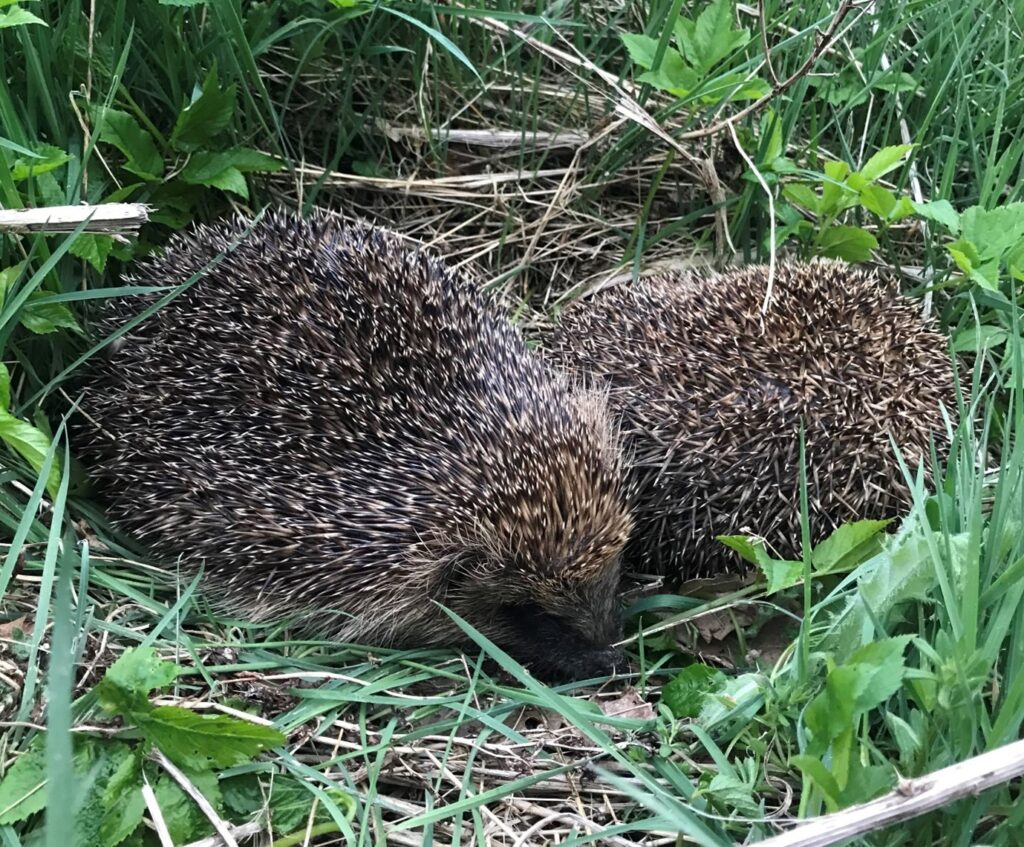
Hedgehog (Erinaceus europaeous)
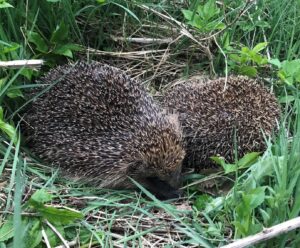
Image credit: Harry Fisher, SAC Consulting
Habitats: Urban and gardens, grassland, mixed woodland, heathland and arable land.
Check your farm location for records!
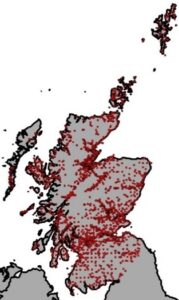
NBN Atlas occurrence download at https://nbnatlas.org accessed on 15 April 2024
Actions to take to promote hedgehogs:
- Hedgerow management
Increasing the number of hedgerows, and the width, height and length of existing hedgerows on your farm will provide invertebrates and berries vital for hedgehogs. Hedgehogs really benefit from hedgerows that are dense at the base giving good coverage. Hedgerow species such as bramble and rose also provide more coverage, important for hedgehogs to nest in. Funding options are available to farmers in parts of Scotland for the creation and management of existing hedgerows.
- Field margin management
By maintaining a grassy field margin of at least 2m around the edge of arable fields, you are providing habitat that has been scientifically proven to benefit foraging hedgehogs. Pairing this with beetle banks across large arable fields will improve food availability throughout the year in addition to pest control services. Funding options for creating grass margins are available to farmers in some areas of Scotland through AECS.
- Scrub creation and management
Through creating and retaining areas of dense scrub, such as holly and hawthorn, you are providing hedgehogs with cover and leaf litter that is used for nest building. Try and ensure that old leaves are left and not disturbed over winter where they could be supporting hibernating hedgehogs.
Otter (Lutra lutra)
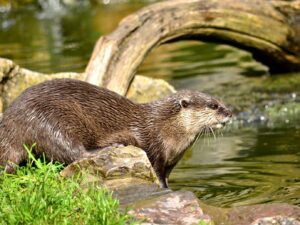
Image credit: Alison Day at Flickr
Habitats: Rivers, wetlands, coastal, marshlands, standing water.
Check your farm location for records!

NBN Atlas occurrence download at https://nbnatlas.org accessed on 15 April 2024
Deterrents and things to avoid:
As the quality of our watercourses improved, otters are once again thriving in Scotland. Otters will traverse up and down river networks, making use of the adjacent habitat to rest in. To encourage otters to make their home on your farm they will require the following:
- Food – Including fish and eels from fresh water sources. Watercourses therefore have to have little pollution to ensure healthy fish populations.
- Shelter – Long grass, woodland or scrub, so long as it can give them some shelter from the elements during colder periods.
- Little disturbance – otters are mostly nocturnal, and so need limited disturbance during the day.
- Connected habitat – Otters use rivers to travel, and so need good quality watercourses throughout the countryside to ensure there is opportunity for individuals and populations to spread and grow.
Actions to take to promote otters:
- Improve watercourses by creating fenced off buffer strips
Through fencing off watercourses, multiple benefits to otter and other aquatic and semi-aquatic species can be achieved. By reducing grazing around the watercourse, buffers increase vegetation and reduce poaching, improving water quality for fish and providing more prey for otters. The longer vegetation will provide shade and shelter for resting otters. Funding options to fence off water margins and manage them in a way sympathetic for otters is available to farmers through AECS.
- Create or restore wetland habitats on your farm
Otters will make use of other wetland habitats other than just watercourses, specifically for the rearing of young. Female otters will seek out ponds to teach their young how to swim and catch food. Often, they will look for water bodies that are a good distance from watercourses, to ensure that the pups are not harmed by aggressive male otters. Funding to achieve this can be covered through pond creation options in AECS.
- Creation of woodland near watercourses for breeding habitat
Similarly, female otters will require sheltered habitat to safely raise their pups which is offset from the watercourse. Woodlands with dense understories located near watercourses will provide great shelter for the female to raise her family. Riparian trees will also create burrows with their roots that are used by female and male otters to shelter. Funding options for woodland creation on farmland is covered within the forestry grant schemes.
Pine Martens (Martes martes)
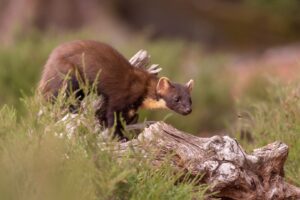
Image credit: Caroline Legg at Flickr
Habitats: Coniferous woodland, deciduous woodland, mixed woodland.
Check your farm location for records!
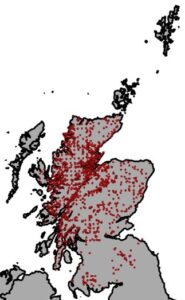
NBN Atlas occurrence download at https://nbnatlas.org accessed on 15 April 2024
Action to promote pine martens on your farm:
- Woodland creation to connect woodland patches
To ensure pine marten populations can grow and spread, it is important that isolated patches of woodland are connected through carefully targeting the creation of new woodland. Check the NBN Atlas to see if any woodlands near your farm have recent records of pine martens and if your farm could expand this range. Woodland comprising of a mix of native species and varying age classes will benefit pine martens the most. Funding options for woodland creation are available through the forestry grant scheme.
- Avoid clear felling of existing woodlands
Clear felling removes all shelter and food for pine martens within a very short time period, either removing their only habitat or potentially forcing them into another pine marten’s territory.
- Keep deadwood
Existing deadwood and trees with cavities provide extra habitat complexity that boosts woodland biodiversity. For pine martens this provides greater foraging and shelter potential.
Red squirrel (Sciurus vulgaris)
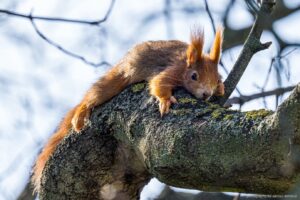
Image credit: Sandor Somkuti at Flickr
Habitats: Coniferous woodland, deciduous woodland, mixed woodland.
Check your farm location for records!
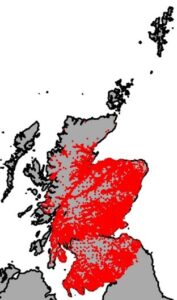
NBN Atlas occurrence download at https://nbnatlas.org accessed on 15 April 2024
Actions to take to promote red squirrels:
- Connect woodland
Red squirrel populations will also grow and spread where woodland is connected. Where isolated patches of woodland exist, it means red squirrel populations will struggle to disperse. Creating new woodland to join up two woodland patches not only offers benefits from the new woodland creation itself, but also means species like red squirrel can now access woodland that previously would have been difficult or dangerous to access. Use the NBN portal to look for some recent red squirrel records in woodland in your area - could woodland creation on your farm expand this range? Funding for woodland creation is available through the forestry grant scheme.
- Manage existing woodlands to benefit red squirrels
Enhancing the diversity of tree species and age structure of woodlands will provide a dependable supply of seeds. There is evidence that red squirrels particularly benefit from the seeds of pine cones, and that including Scots Pine in planting regimes could give red squirrels a competitive advantage over grey squirrels. Current felling plans should be reviewed to ensure suitable habitat provisions are maintained. Financial support is available to landowners under the Scottish Rural Development Programme (SRDP) through grants such as the woodland improvement grants. Explore funding options to improve woodland for red squirrels.
- Control and report grey squirrels
Grey squirrels have had a hugely detrimental impact on our native red squirrels with the greatest threat coming from grey squirrels carrying the squirrelpox virus. Grey squirrels can carry the disease with no symptoms, but when they pass it to red squirrels it is normally fatal. If you spot a grey squirrel in your woodland, you can report the sighting to Scottish Squirrels. Additionally, funding is available for grey squirrel trapping though the forestry grant schemes Sustainable Management of Forests grant.
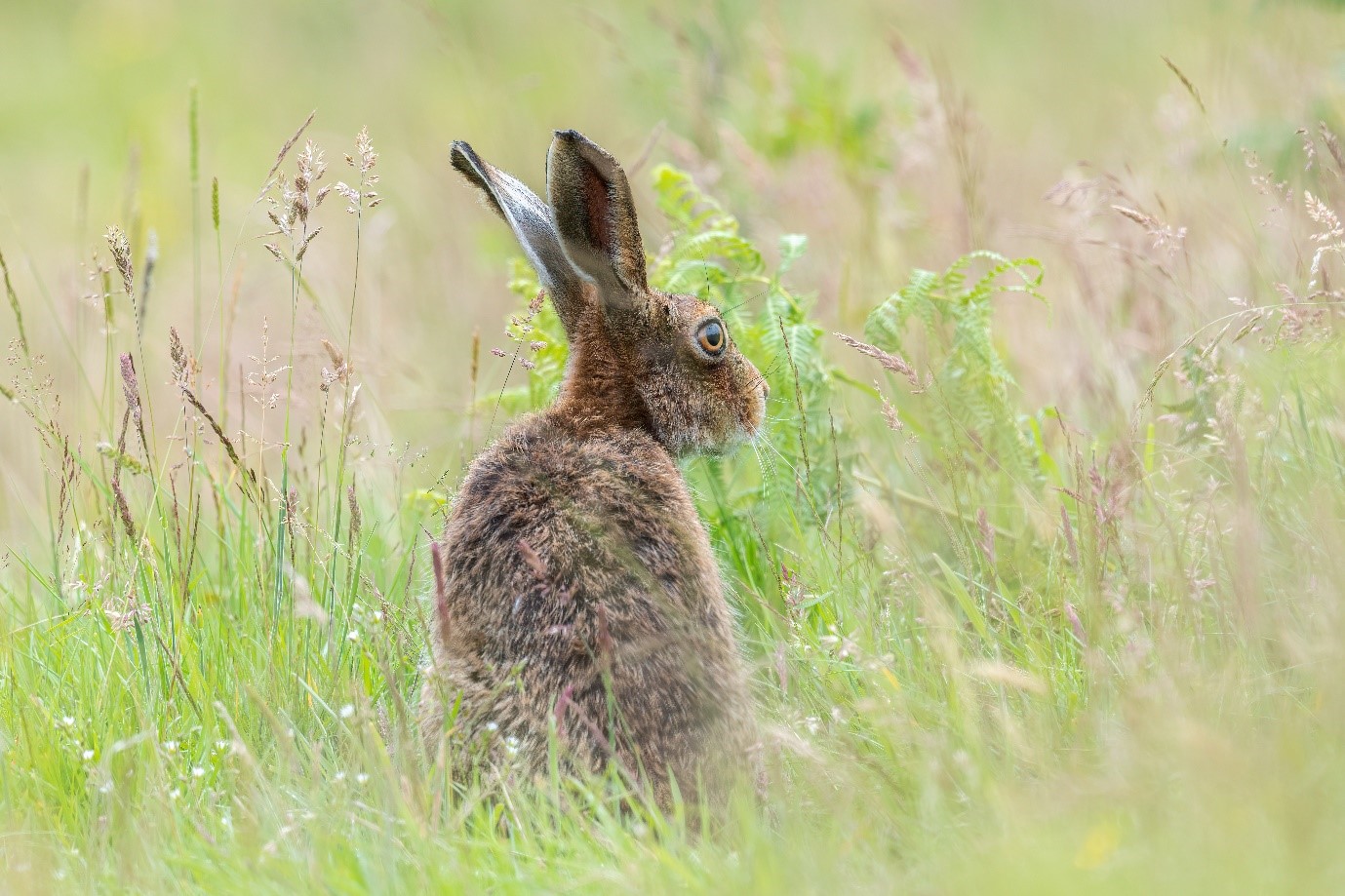
Brown hare (Lepus europaeus)
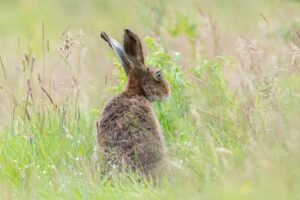
Image credit: Caroline Legg at Flickr
Habitats: Grassland, arable land.
Check your farm location for records!
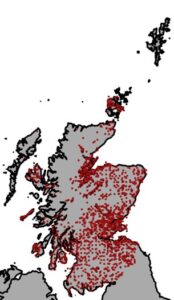
NBN Atlas occurrence download at https://nbnatlas.org accessed on 15 April 2024
Though only introduced during the Roman period, brown hares have now become a naturalised part of our countryside, and provide a valuable prey for some of our iconic birds of prey.
Actions to take to promote brown hares:
- Establish grass strips on the edge of arable fields
Having grass strips along the edge of arable fields will allow hares to travel through the countryside, with the cover protecting them from predators. Funding options for creating grass margins are available to farmers in some areas of Scotland through AECS.
- Establish bird seed mixes and winter stubble in arable fields
It is not only birds that benefit from these actions, winter stubble and establishing bird seed mixes will also provide food and cover for hares. Funding options for establishing bird seed mixes and for winter stubble are available through AECS.
- Leave grass to grow tall during summer and cut in a wildlife friendly manner
Leaving grass to grow tall during summer months will provide cover and food beneficial to hares. Baby hares, known as leverets, are particularly vulnerable to farm machinery. When threatened their response is to freeze – while this may be an excellent defence against a fox it is less successful against mowers or harvesters, or even grazing cattle. Adaptive multi-paddock grazing can provide safe zones for leverets, and cutting/harvesting in a wildlife friendly manner (from the inside of the field outward) will help prevent killing both baby and adult hares. Funding options are available to compensate for wildlife mown grassland across Scotland through AECS.
Harry Fisher, SAC Consulting
All map images taken from https://nbnatlas.org, accessed on 15 April 2024.
NBN Atlas occurrence download at https://nbnatlas.org accessed on 15 April 2024.
Maps produced using non-commercial occurrence records only (CC-BY-NC records excluded). Data providers for map data include:
Anthomyiidae Recording Scheme ([2024]) records via iRecord (Creative Commons Zero v1.0 (CC0) CC0 Creative Commons Public Domain). For more information: https://registry.nbnatlas.org/public/show/dr1852
Argyll Biological Records Centre ([2024]). Argyll Biological Records Dataset. Occurrence dataset on the NBN Atlas (Creative Commons with Attribution 4.0 (CC-BY) CC-BY). For more information: https://registry.nbnatlas.org/public/show/dr819
Balharry et al. (1996) Distribution of pine martens in Scotland as determined by field survey and questionnaire. Scottish Natural Heritage Research, Survey & Monitoring Report, No. 48 (Open Government Licence (OGL)). For more information: https://registry.nbnatlas.org/public/show/dr2125
Bat Conservation Trust ([2024]) National Bat Monitoring Programme. The BCT/MTUK Bats & Roadside Mammals Survey. Occurrence dataset on the NBN Atlas (Creative Commons with Attribution 4.0 (CC-BY) CC-BY). For more information: email pbriggs@bats.org.uk, or https://registry.nbnatlas.org/public/show/dr353
Biological Records Centre ([2024]). Mammal records from Britain from the Atlas of Mammals (1993), with some subsequent records. Occurrence dataset on the NBN Atlas (Creative Commons with Attribution 4.0 (CC-BY) CC-BY). For more information: email brc@ceh.ac.uk, or https://registry.nbnatlas.org/public/show/dr743
Caledonian Conservation ([2024]). Caledonian Conservation Ltd Incidental Records 2014 onwards. Occurrence dataset on the NBN Atlas (Creative Commons with Attribution 4.0 (CC-BY) CC-BY). For more information: email chris.cathrine@caledonianconservation.co.uk, or https://registry.nbnatlas.org/public/show/dr1367
Caledonian Conservation ([2024]). SNH Invertebrate Site Condition Monitoring 2015-16: Culbin Sands, Culbin Forest and Findhorn Bay SSSI. Occurrence dataset on the NBN Atlas (Open Government Licence (OGL) CC-BY). For more information: email chris.cathrine@caledonianconservation.co.uk, or https://registry.nbnatlas.org/public/show/dr1271
Caledonian Conservation ([2024]). SNH Invertebrate Site Condition Monitoring 2015-16: Morrich More SSSI. Occurrence dataset on the NBN Atlas (Open Government Licence (OGL) CC-BY). For more information: email chris.cathrine@caledonianconservation.co.uk, or https://registry.nbnatlas.org/public/show/dr1419
Campbell, R.D., Langridge, K., Kilshaw, K., Carus, H., Hislop, C., Rawling, E., and Tallach, N. (2023). Scottish Wildcat Action final report: Monitoring and Surveys. NatureScot, Inverness (Open Government Licence (OGL)). For more information: https://registry.nbnatlas.org/public/show/dr2963
Carss, D.N./Centre for Ecology and Hydrology (2004) Survey and identification of sites of importance to otter in the catchment of the River Dee. Scottish Natural Heritage Commissioned Report F03L08. (Open Government Licence (OGL)). For more information: https://registry.nbnatlas.org/public/show/dr2304
Commissioned surveys and staff surveys and reports for Scottish Wildlife Trust reserves - Unassessed data, SWT (2020) (Creative Commons with Attribution 4.0 (CC-BY) CC-BY). For more information: email kedata@scottishwildlifetrust.org.uk, or https://registry.nbnatlas.org/public/show/dr793
Conroy, JWH. 2000. Review of otter status along the River Dee and its tributaries. CEH Banchory. Report to SNH (Open Government Licence (OGL)). For more information: https://registry.nbnatlas.org/public/show/dr2302
East Ayrshire Countryside Ranger Service ([2024]). East Ayrshire Species Database. Occurrence dataset on the NBN Atlas (Open Government Licence (OGL) OGL). For more information: email James.macdonald@east-ayrshire.gov.uk, or https://registry.nbnatlas.org/public/show/dr1339
Environment Agency ([Insert year of upload]). Protected and Invasive Species Records Collected Through Environment Agency Survey 1995 - 2021. Occurrence dataset on the NBN Atlas (Open Government Licence (OGL) OGL). For more information: email marina.flamank@environment-agency.gov.uk, or https://registry.nbnatlas.org/public/show/dr815
Hebridean Whale and Dolphin Trust ([2024]). Visual sightings data set 2003-2021. Occurrence dataset on the NBN Atlas (Creative Commons, with Attribution, Non-commercial v4.0 (CC-BY-NC) CC-BY-NC). For more information: email biodiversityofficer@hwdt.org, or https://registry.nbnatlas.org/public/show/dr537
Highland Biological Recording Group ([2024]). HBRG Falk and Jones Cairngorms records Dataset. Occurrence dataset on the NBN Atlas (Creative Commons with Attribution 4.0 (CC-BY)). For more information: https://registry.nbnatlas.org/public/show/dr2969
Highland Biological Recording Group ([2024]). HBRG Insects Dataset Vol 1. Occurrence dataset accessed through the NBN Atlas (Creative Commons with Attribution 4.0 (CC-BY) CC-BY). For more information: email records@hbrg.org.uk, or https://registry.nbnatlas.org/public/show/dr965
Highland Biological Recording Group ([2024]). HBRG JP Blunt Fungus Dataset. Occurrence dataset on the NBN Atlas (Creative Commons with Attribution 4.0 (CC-BY)). For more information: https://registry.nbnatlas.org/public/show/dr2469
Highland Biological Recording Group ([2024]). HBRG Other Invertebrates Dataset. Occurrence dataset on the NBN Atlas (Creative Commons with Attribution 4.0 (CC-BY) CC-BY). For more information: https://registry.nbnatlas.org/public/show/dr810
Highland Biological Recording Group ([2024]). HBRG P.F. Entwistle Colln and Notebooks Dataset (Creative Commons with Attribution 4.0 (CC-BY) CC-BY). For more information: https://registry.nbnatlas.org/public/show/dr875
Highland Biological Recording Group ([2024]). Vertebrates (not Badger) Dataset. Occurrence dataset on the NBN Atlas (Creative Commons with Attribution 4.0 (CC-BY) CC-BY). For more information: email records@hbrg.org.uk, or https://registry.nbnatlas.org/public/show/dr885
Hsing, P.-Y., Hill, R. A., Smith, G. C., Bradley, S., Green, S. E., Kent, V. T., Mason, S. S., Rees, J., Whittingham, M. J., Cokill, J., MammalWeb citizen scientists & Stephens, P. A. (2022). Large-scale mammal monitoring: The potential of a citizen science camera-trapping project in the United Kingdom. Ecological Solutions and Evidence, 3, e12180. https://doi.org/10.1002/2688-8319.12180 (Creative Commons, with Attribution, Non-commercial v4.0 (CC-BY-NC)). For more information: https://registry.nbnatlas.org/public/show/dr2930
Joint Nature Conservation Committee ([2024]). England Otter Survey Database. Occurrence dataset on the NBN Atlas (Open Government Licence (OGL) OGL). For more information: https://registry.nbnatlas.org/public/show/dr494
Joint Nature Conservation Committee ([2024]). Marine Nature Conservation Review (MNCR) and associated benthic marine data held and managed by JNCC. Occurrence dataset on the NBN Atlas (Open Government Licence (OGL) OGL). For more information: https://registry.nbnatlas.org/public/show/dr883
Joint Nature Conservation Committee ([2024]). Scotland Otter Survey Database. Occurrence dataset on the NBN Atlas (Open Government Licence (OGL) OGL). For more information: https://registry.nbnatlas.org/public/show/dr495
Malcolm Storey ([2024]). http://www.bioimages.org.uk/ Malcolm Storey personal records and images. Occurrence dataset on the NBN Atlas (Creative Commons, with Attribution, Non-commercial v4.0 (CC-BY-NC)). For more information: https://registry.nbnatlas.org/public/show/dr1770
Mammal Society [2024] Mammal Mapper App Sighting Records (Creative Commons with Attribution 4.0 (CC-BY) CC BY Creative Commons Attribution). For more information: email atlas@themammalsociety.org, or https://registry.nbnatlas.org/public/show/dr2451
National Bat Monitoring Programme [date accessed] Sunset/Sunrise Survey, Bat Conservation Trust. (Open Government Licence (OGL) OGL Open Government Licence). For more information: https://registry.nbnatlas.org/public/show/dr2249
National Mammal Atlas Project, online recording (2026) (Creative Commons, with Attribution, Non-commercial v4.0 (CC-BY-NC) CC BY-NC Creative Commons Attribution Non-Commercial). For more information: https://registry.nbnatlas.org/public/show/dr671
National Museums Liverpool ([2024]). British mammal skins in the collections of World Museum Liverpool. Occurrence dataset on the NBN Atlas (Creative Commons Zero v1.0 (CC0)). For more information: https://registry.nbnatlas.org/public/show/dr2287
National Trust for Scotland ([2024]). National Trust for Scotland Species Records. Occurrence dataset on the NBN Atlas (Creative Commons with Attribution 4.0 (CC-BY) CC-BY). For more information: https://registry.nbnatlas.org/public/show/dr681
Natural History Museum (2023). Data Portal query on 1 resources https://doi.org/10.5519/qd.i4tk4lrk (Creative Commons Zero v1.0 (CC0) CC0-1.0). For more information: email data@nhm.ac.uk, or https://registry.nbnatlas.org/public/show/dr2677
Natural Resources Wales. ([2024]) Welsh Invertebrate Database (WID). Occurrence dataset accessed through the NBNAtlas (Open Government Licence (OGL) © CNC/NRW Data may be re-used under the terms of the Open Government Licence providing it is done so, acknowledging both the source and NRW's copyright. It is the recipient's responsibility to ensure the data is fit for the intended purpose. Attribution statement: Contains Natural Resources Wales information © Natural Resources Wales and Database Right. All rights Reserved.). For more information: https://registry.nbnatlas.org/public/show/dr1212
NatureScot ([2024]). Expansion zone survey of pine marten (Martes martes) distribution in Scotland, 2012-2013. Occurrence dataset on the NBN Atlas (Open Government Licence (OGL) OGL). For more information: https://registry.nbnatlas.org/public/show/dr313
NatureScot ([2024]). Lochaber wild boar/feral pig camera trap survey, 2015. Occurrence dataset on the NBN Atlas (Open Government Licence (OGL) OGL). For more information: https://registry.nbnatlas.org/public/show/dr934
NatureScot ([2024]). Records of otters from Site Condition Monitoring in Scotland 2011-2012. Occurrence dataset on the NBN Atlas (Open Government Licence (OGL) OGL). For more information: https://registry.nbnatlas.org/public/show/dr327
NatureScot ([2024]). Records of otters from surveys in relation to FCS casework in Angus, 2007. Occurrence dataset on the NBN Atlas (Open Government Licence (OGL) OGL). For more information: https://registry.nbnatlas.org/public/show/dr325
NatureScot ([2024]). Records of pine martens from SNH casework reports and licence applications, 2005 - 2016. Occurrence dataset on the NBN Atlas (Open Government Licence (OGL) OGL). For more information: https://registry.nbnatlas.org/public/show/dr843
NatureScot ([2024]). Water vole survey of Beinn Eighe National Nature Reserve - October 2011. Occurrence dataset on the NBN Atlas (Open Government Licence (OGL) OGL). For more information: https://registry.nbnatlas.org/public/show/dr344
NatureScot (2017). Compilation of records of 12 Article 17 terrestrial mammal species in Scotland (Open Government Licence (OGL) OGL). For more information: https://registry.nbnatlas.org/public/show/dr332
NatureScot (2020). Ben Eighe NNR invertebrate records compiled from SNH files (Open Government Licence (OGL)). For more information: https://registry.nbnatlas.org/public/show/dr2290
North Ayrshire Countryside Ranger Service ([2024]). Species within North Ayrshire from 1984 - Present. Occurrence dataset on the NBN Atlas (Open Government Licence (OGL) OGL). For more information: email rangerservice@north-ayrshire.gov.uk, or https://registry.nbnatlas.org/public/show/dr1160
Outer Hebrides Biological Recording ([2024]) Otter (Lutra lutra), Outer Hebrides. Occurrence dataset on the NBN Atlas (Creative Commons with Attribution 4.0 (CC-BY) CC-BY). For more information: https://registry.nbnatlas.org/public/show/dr787
Outer Hebrides Biological Recording ([2024]). Invasive Non-Native Species, Outer Hebrides. Occurrence dataset on the NBN Atlas (Creative Commons with Attribution 4.0 (CC-BY) CC-BY-NC). For more information: https://registry.nbnatlas.org/public/show/dr795
Outer Hebrides Biological Recording ([2024]). Vertebrates (except birds, INNS and restricted records), Outer Hebrides. Occurrence dataset on the NBN Atlas (Creative Commons with Attribution 4.0 (CC-BY) CC-BY). For more information: https://registry.nbnatlas.org/public/show/dr797
Pamplin, F. 2019. Survey of Eurasian otter (Lutra lutra) distribution in the Glenmore - Aviemore area. Scottish Natural Heritage Report. (Open Government Licence (OGL)). For more information: https://registry.nbnatlas.org/public/show/dr2312
Records provided by Anthomyiid Recording Scheme, accessed through NBN Atlas website. (2024). For more information: https://registry.nbnatlas.org/public/show/dp163
Records provided by Argyll Biological Records Centre, accessed through NBN Atlas website. (2024). For more information: email data@lnhg.org.uk, or https://registry.nbnatlas.org/public/show/dp59
Records provided by Bat Conservation Trust, accessed through NBN Atlas website. (2024). For more information: email enquiries@bats.org.uk, or https://registry.nbnatlas.org/public/show/dp57
Records provided by Biological Records Centre, accessed through NBN Atlas website. (2024). For more information: email brc@ceh.ac.uk, or https://registry.nbnatlas.org/public/show/dp77
Records provided by British Trust for Ornithology, accessed through NBN Atlas website. (2024). For more information: email info@bto.org, or https://registry.nbnatlas.org/public/show/dp29
Records provided by BTO, accessed through NBN Atlas website (Open Government Licence (OGL)). For more information: https://registry.nbnatlas.org/public/show/dr2331
Records provided by Caledonian Conservation, accessed through NBN Atlas website. (2024). For more information: email info@caledonianconservation.co.uk, or https://registry.nbnatlas.org/public/show/dp4
Records provided by CEDaR Online Recording, accessed through NBN Atlas website. (Creative Commons with Attribution 4.0 (CC-BY) CC BY Creative Commons Attribution). For more information: https://registry.nbnatlas.org/public/show/dr1954
Records provided by Central Scotland Green Network Trust, accessed through NBN Atlas website. (2024). For more information: email contact@csgnt.org.uk, or https://registry.nbnatlas.org/public/show/dp39
Records provided by East Ayrshire Countryside Ranger Service, accessed through NBN Atlas website. (2024). For more information: https://registry.nbnatlas.org/public/show/dp175
Records provided by Environment Agency, accessed through NBN Atlas website. (2024). For more information: email enquiries@environment-agency.gov.uk, or https://registry.nbnatlas.org/public/show/dp138
Records provided by Hebridean Whale and Dolphin Trust, accessed through NBN Atlas website. (2024). For more information: email info@hwdt.org, or https://registry.nbnatlas.org/public/show/dp81
Records provided by Highland Biological Recording Group, accessed through NBN Atlas website. (2024). For more information: email chair@hbrg.org.uk, or https://registry.nbnatlas.org/public/show/dp7
Records provided by Joint Nature Conservation Committee, accessed through NBN Atlas website. (2024). For more information: https://registry.nbnatlas.org/public/show/dp87
Records provided by Malcolm Storey, accessed through NBN Atlas website. (2024). For more information: email malcolm.storey@bioimages.org.uk, or https://registry.nbnatlas.org/public/show/dp217
Records provided by Mammal Society, accessed through NBN Atlas website. (2024). For more information: email atlas@themammalsociety.org, or https://registry.nbnatlas.org/public/show/dp8
Records provided by MammalWeb, accessed through NBN Atlas website. (2024). For more information: https://registry.nbnatlas.org/public/show/dp277
Records provided by Miscellaneous images, accessed through NBN Atlas website. (Creative Commons, with Attribution, Non-commercial v4.0 (CC-BY-NC)). For more information: https://registry.nbnatlas.org/public/show/dr1647
Records provided by National Trust for Scotland, accessed through NBN Atlas website. (2024). For more information: https://registry.nbnatlas.org/public/show/dp36
Records provided by Natural History Museum, London, accessed through NBN Atlas website. (2024). For more information: https://registry.nbnatlas.org/public/show/dp266
Records provided by Natural Resources Wales, accessed through NBN Atlas website. (2024). For more information: email nbnadmin@cyfoethnaturiolcymru.gov.uk, or https://registry.nbnatlas.org/public/show/dp122
Records provided by NatureScot, accessed through NBN Atlas website. (2024). For more information: https://registry.nbnatlas.org/public/show/dp9
Records provided by North Ayrshire Countryside Ranger Service, accessed through NBN Atlas website. (2024). For more information: https://registry.nbnatlas.org/public/show/dp153
Records provided by Outer Hebrides Biological Recording, accessed through NBN Atlas website. (2024). For more information: email admin@ohbr.org.uk, or https://registry.nbnatlas.org/public/show/dp3
Records provided by Royal Society for the Protection of Birds, accessed through NBN Atlas website. (2024). For more information: email Dataunit@rspb.org.uk, or https://registry.nbnatlas.org/public/show/dp0
Records provided by Scottish Beavers, accessed through NBN Atlas website. (2024). For more information: email gdowse@scottishwildlifetrust.org.uk, or https://registry.nbnatlas.org/public/show/dp148
Records provided by Scottish Wildlife Trust, accessed through NBN Atlas website. (2024). For more information: email kedata@scottishwildlifetrust.org.uk, or https://registry.nbnatlas.org/public/show/dp2
Records provided by Seasearch, accessed through NBN Atlas website. (2024). For more information: https://registry.nbnatlas.org/public/show/dp119
Records provided by South Lanarkshire peatland records 2013, accessed through NBN Atlas website. (Creative Commons Zero v1.0 (CC0) CC0). For more information: email emilie.wadsworth@csgnt.org.uk, or https://registry.nbnatlas.org/public/show/dr536
Records provided by The Conservation Volunteers Scotland, accessed through NBN Atlas website. (2024). For more information: email citizenscience-scotland@tcv.org.uk, or https://registry.nbnatlas.org/public/show/dp145
Records provided by The Wildlife Information Centre, accessed through NBN Atlas website. (2024). For more information: email info@wildlifeinformation.co.uk, or https://registry.nbnatlas.org/public/show/dp43
Records provided by Wild Surveys Otter Records, accessed through NBN Atlas website. (Creative Commons with Attribution 4.0 (CC-BY)). For more information: https://registry.nbnatlas.org/public/show/dr1617
Records provided by Wild Surveys, accessed through NBN Atlas website. (2024). For more information: email admin@wildsurveys.co.uk, or https://registry.nbnatlas.org/public/show/dp207
Records provided by World Museum, National Museums Liverpool, accessed through NBN Atlas website. (2024). For more information: https://registry.nbnatlas.org/public/show/dp242
Scottish Beavers ([2024]). Scottish Beaver Trial incidental species records. Occurrence dataset on the NBN Atlas (Creative Commons with Attribution 4.0 (CC-BY) CC-BY). For more information: email gdowse@scottishwildlifetrust.org.uk, or https://registry.nbnatlas.org/public/show/dr1190
Scottish Wildlife Trust ([2024]). Casual records for Scottish Wildlife Trust reserves - Verified data. Occurrence dataset on the NBN Atlas (Creative Commons with Attribution 4.0 (CC-BY) CC-BY). For more information: email kedata@scottishwildlifetrust.org.uk, or https://registry.nbnatlas.org/public/show/dr780
Scottish Wildlife Trust ([2024]). Commissioned surveys and staff surveys and reports for Scottish Wildlife Trust reserves - Verified data. Occurrence dataset on the NBN Atlas (Creative Commons with Attribution 4.0 (CC-BY) CC-BY). For more information: email kedata@scottishwildlifetrust.org.uk, or https://registry.nbnatlas.org/public/show/dr765
Scottish Wildlife Trust ([2024]). Survey and monitoring records for Scottish Wildlife Trust reserves from reserve convenors and Trust volunteers - Verified data. Occurrence dataset on the NBN Atlas (Creative Commons with Attribution 4.0 (CC-BY) CC-BY). For more information: email kedata@scottishwildlifetrust.org.uk, or https://registry.nbnatlas.org/public/show/dr766
Scottish Wildlife Trust ([2024]). The Scottish Squirrel Database. Occurrence dataset accessed through the NBNAtlas (Creative Commons with Attribution 4.0 (CC-BY) CC-BY). For more information: email SSRSData@scottishwildlifetrust.org.uk, or https://registry.nbnatlas.org/public/show/dr949
Seasearch ([2024]). Seasearch Marine Surveys in Scotland. Occurrence dataset on the NBN Atlas (Creative Commons with Attribution 4.0 (CC-BY) CC-BY). For more information: email info@seasearch.org.uk, or https://registry.nbnatlas.org/public/show/dr749
SNH (2008). National Water Vole Database & Mapping Project (Scotland data) (Open Government Licence (OGL)). For more information: https://registry.nbnatlas.org/public/show/dr2301
The Conservation Volunteers ([2024]). HogWatch Scotland Project - West European hedgehog records between 2019 and 2021. Occurrence dataset on the NBN Atlas (Creative Commons Zero v1.0 (CC0)). For more information: https://registry.nbnatlas.org/public/show/dr2525
The Royal Society for the Protection of Birds ([2024]). RSPB Lochwinnoch incidental species records. Occurrence dataset on the NBN Atlas (Creative Commons with Attribution 4.0 (CC-BY) Garnock Connections is a Landscape Partnership Scheme led by RSPB Scotland in partnership with North Ayrshire Council, Scottish Environment Protection Agency (SEPA), NatureScot and the Scottish Wildlife Trust. Historic Environment Scotland (HES) act as an advisory body to the partnership. Garnock Connections has been supported by a grant from the National Lottery Heritage Fund and a grant from the Nature Restoration Fund.). For more information: https://registry.nbnatlas.org/public/show/dr2637
The Wildlife Information Centre ([2024]). A.T. Sumner's Records. Occurrence dataset on the NBN Atlas (Creative Commons with Attribution 4.0 (CC-BY)). For more information: https://registry.nbnatlas.org/public/show/dr2785
The Wildlife Information Centre ([2024]). City of Edinburgh Natural Heritage Service - Natural Heritage Service Data. Occurrence dataset on the NBN Atlas (Open Government Licence (OGL) OGL). For more information: email admin@wildlifeinformation.co.uk, or https://registry.nbnatlas.org/public/show/dr826
The Wildlife Information Centre ([2024]). City of Edinburgh Natural Heritage Service - Ranger Ad-hoc records and sightings. Occurrence dataset on the NBN Atlas (Open Government Licence (OGL) OGL). For more information: email admin@wildlifeinformation.co.uk, or https://registry.nbnatlas.org/public/show/dr858
The Wildlife Information Centre ([2024]). City of Edinburgh Natural Heritage Service - Harperrig Otter Survey. Occurrence dataset on the NBN Atlas (Open Government Licence (OGL) OGL). For more information: email admin@wildlifeinformation.co.uk, or https://registry.nbnatlas.org/public/show/dr908
The Wildlife Information Centre ([2024]). City of Edinburgh Natural Heritage Service - General Public Records. Occurrence dataset on the NBN Atlas (Open Government Licence (OGL) OGL). For more information: email admin@wildlifeinformation.co.uk, or https://registry.nbnatlas.org/public/show/dr872
Related Resources
Sign up to the FAS newsletter
Receive updates on news, events and publications from Scotland’s Farm Advisory Service