
Alternative Protein Crops – Overcoming Market Barriers
10 March 2026In the current era of geopolitical instability, we need to think about how to build resilience and security into our agriculture and food supply chains. Arable growers in Scotland may be considering a variety of options, as the markets for malting barley are being affected by rippling effects of the whisky industry getting caught up in trade spats overseas. Securing the supply chain for the protein crops needed to produce chicken, eggs, and farmed fish has the potential to increase the resilience of UK food security, both for these sectors, as well as the arable farmers who have the potential to grow these protein crops.
Key Considerations for New Crops
In uncertain times, growers are looking for solutions which are less risky. To be willing to consider integrating a new crop type, farmers need a guarantee that there will be a market there to buy their output. The emergence of robust demand for these crops requires adopting balanced rations which are cost-competitive with diets based around soya protein. The key considerations in balancing a diet based around a new crop type are protein-to-energy ratios, fibre characteristics, amino acid profiles, nutrient density, and palatability. Some figures for conventional and alternative protein feeds are given in the table below.
Table: Nutritional value and carbon footprint of protein feeds. Based on nutritive values of feeding stuffs for ruminants, using barley and rapeseed meal as standard reference foods.
| Feed | Metabolisable Energy (megajoules / kg dry matter) | Crude Protein (% dry matter) | kg CO2e / kg of feed | Price (£/tonne) |
|---|---|---|---|---|
| Soybean meal | 13.8 | 50-52 | 0.3-0.9 | 336 |
| Rapeseed meal | 12 | 40 | 0.2-0.6 | 266 |
| Peas | 13.5 | 26 | 0.2-0.6 | 375 |
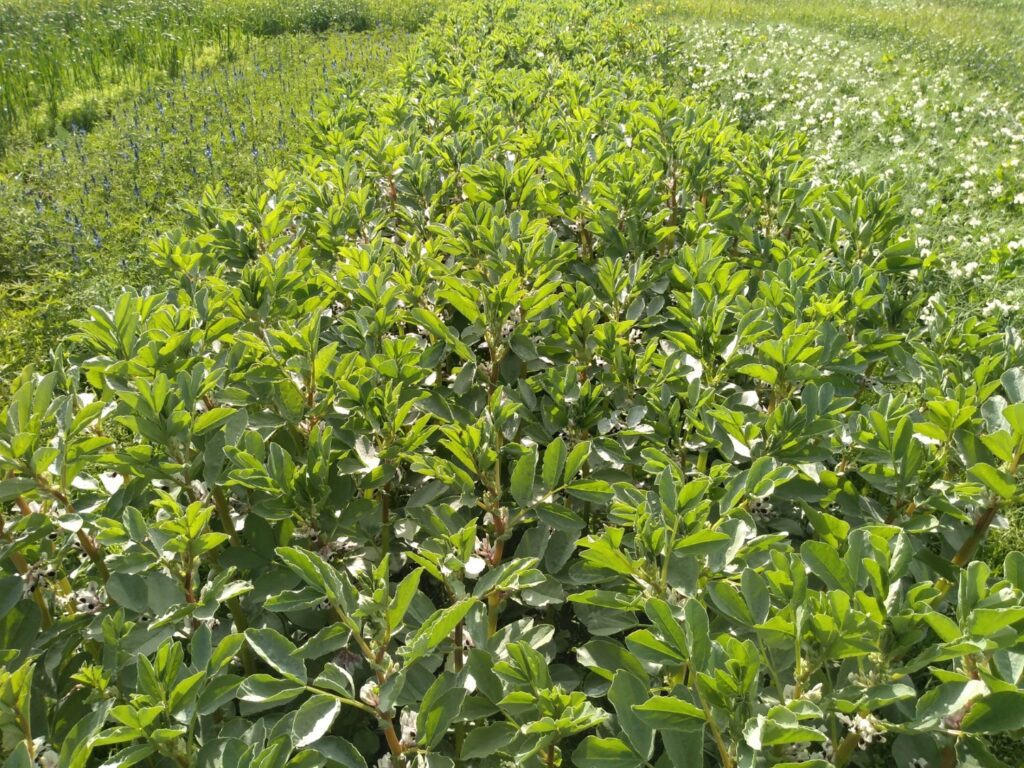
| Field beans | 13.3 | 30 | 0.3-0.9 | 243 |
| Maize distillers grains | 14 | 32 | 0.3-0.7 | 255 |
| Wheat distillers grains | 13.5 | 34 | 0.3-0.7 | 296 |
| Lupins | 11-14.5 | 19 | 0.3-0.9 | 300 |
Specific animal type and production stage determines target levels for metabolisable energy, crude protein, fibre, minerals, and key amino acids. Feed ingredients are then combined so that the total ration meets these nutrient requirements on a dry-matter basis. Because alternative protein crops generally contain less protein and a less balanced amino acid profile than soybean meal, the diet must often include higher inclusion rates or additional ingredients to maintain the correct protein-to-energy balance.
Fine-Tuning your Ration
The next stage is to fine-tune the ration around amino acid balance and digestibility. Soybean meal is widely used because it has a favourable balance of essential amino acids such as lysine and methionine, whereas many alternative plant proteins are comparatively deficient in one or more of these “limiting” amino acids. To compensate, nutritionists may combine several alternative protein sources or add synthetic amino acids, so the final ration meets animals’ requirements without excessive crude protein (although most of these synthesised versions are imported from China, introducing another international dependency).
Finally, practical feeding considerations are checked: some legume crops contain anti-nutritional compounds such as tannins or other inhibitors, so they are often milled, heat-treated, or included only up to recommended levels to maintain digestibility and palatability.
Matching the Economics with your Business
Scientists and nutritionists maintain that there are ways integrate these alternative protein crops into rations. However, the economics need to stack up to enable scaling up. At the volumes needed to achieve nutritional requirements, none of the alternatives in the above table are competitive with soya, especially once other costs factored in (i.e. establishment, specialised machinery). To encourage experimentation and domestic production of protein crops, DAERA in Northern Ireland operates a Pilot Protein Crop Scheme. Introduced in 2021 and now extended until 2026, the scheme supports the cultivation of peas, beans and lupins, providing a payment of £330 per hectare up to a maximum supported area of 1,300 hectares. Uptake has grown steadily since launch: in 2020, around 150 hectares were grown on 32 farms, rising to 481 hectares across 96 farms by 2025, with spring beans proving the most widely adopted crop.
It should also be noted that these crops may enable several types of savings for growers: for example, legumes fix nitrogen, decreasing fertiliser costs for them as well as subsequent crops in rotation. They also do not require fossil fuels involved in drying grain. In addition, because many of them are sown and harvested at different times of year, they can allow farmers to hire machinery and labour outside of the conventional peak seasons. The combination of these factors could make these crops extremely attractive to farms looking to insulate themselves from input price shocks and boost resilience in the current era of geopolitical instability.
Brady Stevens, SAC Consulting, Brady.Stevens@sac.co.uk
and
Julian Bell, SAC Consulting Julian.Bell@agrecalc.com




Sign up to the FAS newsletter
Receive updates on news, events and publications from Scotland’s Farm Advisory Service