
Business and Policy October 2026 – Arable
Global cereal supply and demand outlook
Global cereal supplies are expected to remain relatively comfortable in 2026/27, although the balance is tightening compared with last season. FAO forecasts global cereal production at 2,980 million tonnes, down 61.1 Mt or 2.0% year-on-year, the largest annual decline since 2018, but still the second largest crop on record.
The reduction is concentrated in coarse grains, particularly maize. Global maize production is forecast at 1,309 Mt, with deteriorating prospects in the EU following summer heat and drought, especially in France and Poland. These losses are partly offset by strong crops in Argentina and Brazil. Wheat production has been revised upwards to 810.7 Mt, although this remains 3.8% below 2025. Better prospects in Canada, Morocco, Russia and Ukraine offset reductions in the EU and UK.
Demand remains firm. Global cereal utilisation is forecast at 2,965 Mt, slightly above 2025/26. Coarse grain consumption continues to expand, driven particularly by feed demand, including barley in China and maize in the US. Wheat utilisation is expected to decline as less wheat moves into feed following exceptionally heavy use in 2025/26.
Global cereal stocks are forecast at 947.2 Mt, only marginally above opening levels. The stocks-to-use ratio slips from 31.9% to 31.6%, suggesting supplies remain historically comfortable but with less surplus available. Maize and barley stocks are particularly tighter because of strong exports and feed demand.
World cereal trade is forecast at 509.3 Mt. European import demand is expected to increase following poorer harvests, benefiting competitive exporters including the US and Argentina. Meanwhile, uncertainty over Black Sea logistics could encourage buyers to diversify origins. Overall, the picture is therefore one of ample global cereal availability, but a moderately tighter supply-demand balance than in 2025/26.
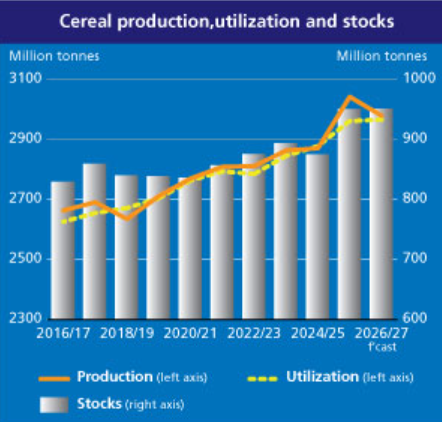
Source: FAO
Commodity updates
Wheat
Wheat markets remain dominated by the contrast between adequate global supplies and increasing difficulty moving grain out of the Black Sea region. The underlying availability of wheat is not especially tight, but disruption to Russian and Ukrainian ports, attacks on infrastructure and logistical restrictions have changed trade flows and added a significant risk premium. This remains relevant, although Russia is increasingly adapting. Russian companies are converting Baltic and Arctic facilities previously handling fertiliser and coal to grain exports. Even so, Russian grain exports were 31% lower year-on-year in July-August, with September shipments also expected to be sharply reduced. Black Sea disruption will remain supportive, but alternative routes could gradually reduce its impact.
Markets have nevertheless weakened in the past week. November 2026 London feed wheat closed at £205.75/t on 28th September, down from £211/t a week earlier and well below the early-September high of £219.25/t. May 2027 closed at around £213.25/t.
UK Feed Wheat Nov 26 Futures
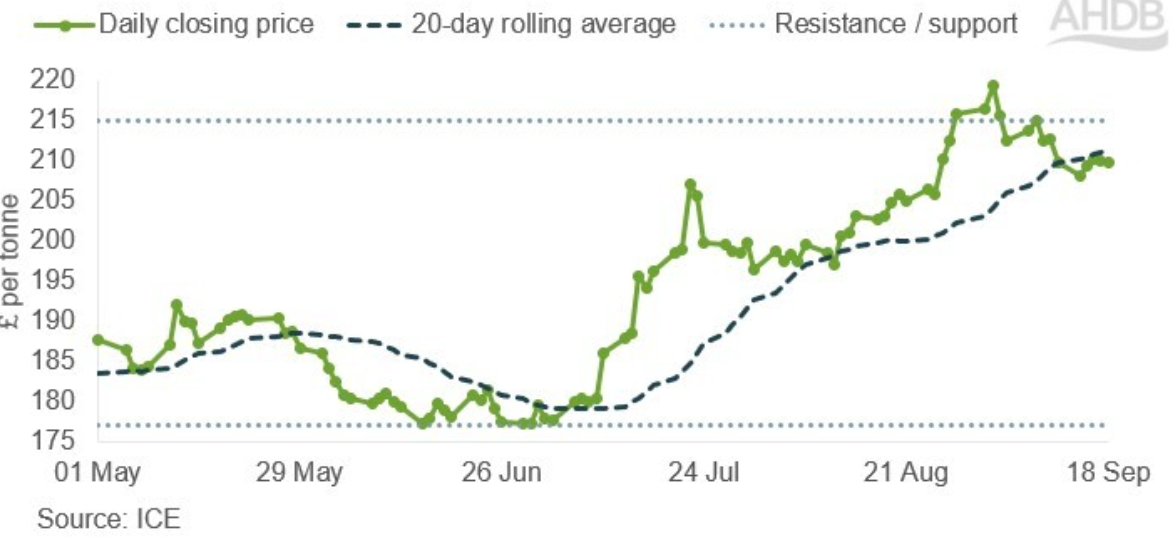
Global supply remains relatively comfortable. World wheat stocks are estimated at around 276 Mt, with improving Canadian production and larger southern hemisphere crops helping offset weaker European production.
Domestically, however, the UK supply position is tighter. AHDB's final harvest survey puts the 2026 wheat yield at 6.9 t/ha, 11% below the five-year average. Moreover, the UK entered the season with relatively low stocks: 2025/26 commercial closing wheat stocks were 1.5 Mt, the lowest since 2020/21.
Demand is less supportive. UK flour millers, starch manufacturers and bioethanol plants used 14% less wheat in July than a year earlier, partly reflecting the closure of Vivergo. UK wheat therefore has a tighter supply base but relatively subdued industrial demand.
Barley
The UK barley market presents two contrasting pictures. Feed barley remains relatively well supported, whereas malting barley continues to face weak consumer demand despite quality concerns.
AHDB's final harvest figures show winter barley performing comparatively well at 6.9 t/ha, broadly in line with its five-year average. Spring barley was much poorer at just 4.8 t/ha, 17% below average, although later crops in Scotland and northern England improved the national figure.
Feed barley continues to benefit from its discount to wheat, encouraging inclusion in livestock rations. On-farm demand may also remain elevated where forage supplies are tight. Farmer selling remains cautious, particularly in livestock areas where grain may be retained against winter feeding requirements. Ukrainian barley exports have also been sharply reduced, despite sizeable Russian and Ukrainian crops.
Malting barley is more difficult. English spring barley has produced mixed quality, raising the possibility that Scottish and imported barley will be required to cover malting specifications. However, maltsters remain cautious buyers and generally appear adequately covered nearby, preventing malting premiums from widening materially.
Demand from the drinks sector is particularly important for Scotland. By way of example, brewers, maltsters and distillers used 112,800t of barley in July, 19% less than July 2025, reflecting weaker malt and distilling demand. Longer-term export opportunities for Scotch whisky, particularly India, remain encouraging, but they are unlikely to translate into an immediate improvement in malting barley demand.
Oilseed Rape
Oilseed rape remains fundamentally firmer than cereals, although prices have struggled to establish a sustained upward trend. MATIF November rapeseed closed around €548.75/t on 25 September, having traded above €556/t earlier in the week.
European supplies remain relatively tight following drought related yield reductions in several producing regions, while geopolitical developments and volatile crude oil prices continue to influence vegetable oils. Conversely, improving Canadian canola supplies, favourable Australian prospects and ample Brazilian soybean availability are limiting the upside. UK crushers are also reported to have good coverage through the remainder of 2026, reducing immediate buying urgency.
The UK crop itself has been the notable success of harvest 2026. AHDB's final survey puts average OSR yield at 4.0 t/ha, 19% above the five-year average, with harvest complete. This improved domestic availability provides some counterweight to the tighter European situation.
Pulses
UK pulse markets remain subdued, with limited export competitiveness and cautious domestic buying. Beans are increasingly trading on their own fundamentals rather than simply following London wheat.
Export prospects are difficult. UK feed beans remain too expensive relative to competing exporters, while quality problems, including visual blemishes, bruchid damage and shattering, are restricting human consumption opportunities. Firm human consumption export offers were effectively absent in September. Domestic demand is largely concentrated in poultry feed, but buyers are comfortable purchasing hand-to-mouth and show little appetite for significant forward cover.
Peas face even greater supply pressure. Feed peas are around £200–225/t ex-farm, depending on location, but substantial Canadian stocks and a large 2026 Canadian crop are generating aggressively priced competition in international markets. Eastern European supplies are adding further competition too.
Indicative grain prices on 28th September 2026 (Source: SAC//United oilseeds/AHDB)
| £ per tonne | Sept‘26 | Nov ‘26 | May ‘27 | Nov ‘27 | |||
|---|---|---|---|---|---|---|---|
| Wheat | Ex farm Sept. Nov’26/May’27/Nov‘27 Futures | 200 | 205 | 211 | 202 | ||
| Malting Barley | Ex Scot Sept | 178 | - | ||||
| Beans | Ex farm Sept | 225 | - | ||||
| Feed Oats | Ex farm Sept | 155 | |||||
| Oilseed Rape | Del Montrose | 439 | 454 | ||||





Sign up to the FAS newsletter
Receive updates on news, events and publications from Scotland’s Farm Advisory Service