
Honest Conversations, Better Farm Businesses
I’m Kerry, I’ve been a Principal Consultant at SAC Consulting for ten years, and I own and operate a couple of rural tourism businesses with my family outside of my day job. I am no stranger to difficult conversations, whether at work, with a client, and often with family about how we run our business.
Over the last ten years I’ve become a practicing coach, mediator, negotiator and am now training as a counsellor, and one thing that’s super clear to me, is that most people struggle to communicate well, and most people feel unheard.
Difficult conversations are part of everyday life on farms, crofts and rural businesses. Whether the topic is succession planning, introducing new technology, raising safety concerns, discussing workload, or suggesting a new direction for the business, these conversations can often feel uncomfortable, emotional, and difficult to start. However, avoiding them can have significant consequences for both people and businesses.
Communication is often overlooked as a business skill, yet its impact reaches far beyond workplace relationships. Poor communication can contribute to safety issues, inefficiencies, unresolved frustrations, conflict, and even people leaving the industry altogether. On farms and crofts, where family, business and home life are frequently intertwined, the stakes can feel particularly high.
The problem is not that people do not care. In fact, the opposite is usually true. Conversations become difficult because people care deeply about the land, the business, their family, and the future. When decisions involve years of hard work, personal identity, financial security, or family legacy, emotions naturally follow. Unfortunately, many people have never been taught how to manage these discussions effectively. As a result, concerns are often left unspoken until frustration builds, positions become entrenched, and conflict eventually erupts. More commonly, nothing changes at all because everyone continues to "just get on with it."
In a recent webinar I explored how better communication can strengthen farm businesses, improve relationships, and create healthier working environments. I introduced a practical framework designed to help individuals approach challenging discussions with confidence and clarity. I began the webinar sharing the anonymised story of ‘Sam’ a client of mine.
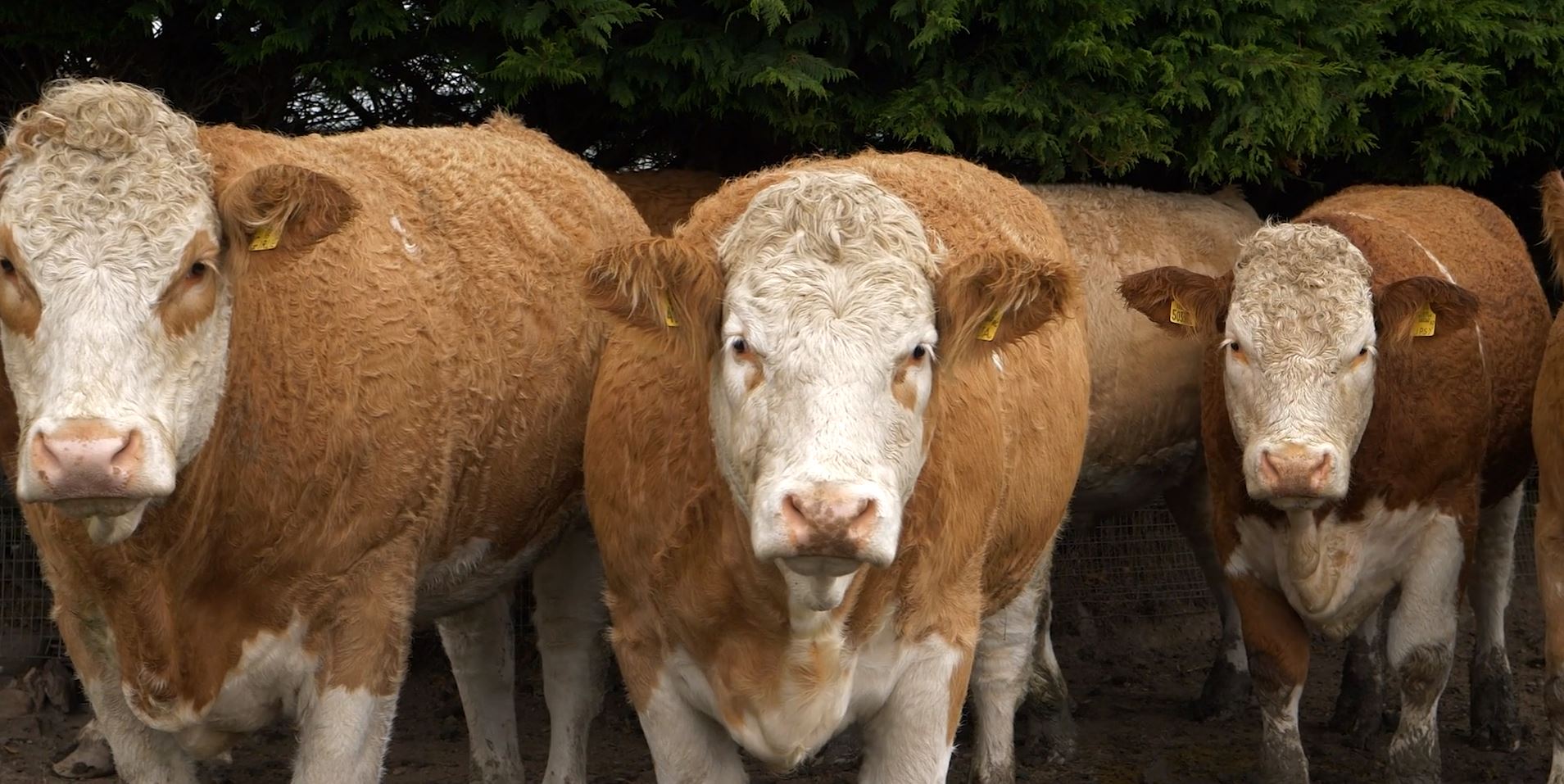
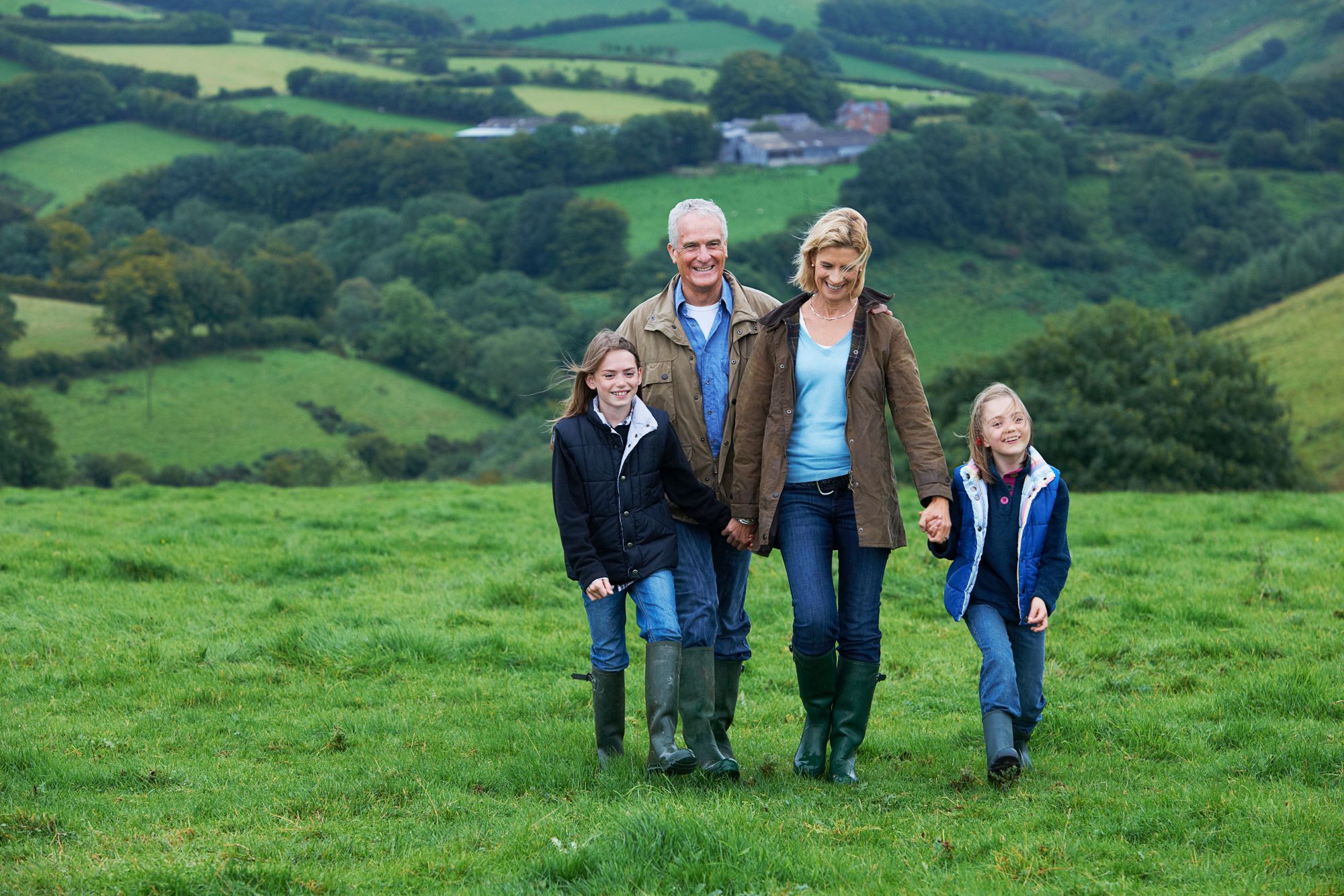
'Sam' is a young farmer who returned home after studying agriculture. Full of new ideas about diversification, technology and future opportunities, Sam wanted to discuss a significant change, potentially removing cattle from the family farm. For Sam, the conversation represented future planning and business development. For Sam's parents, particularly a father who had spent decades building a successful herd, the same conversation felt like a rejection of a life's work. Every attempt to raise the subject failed. The timing was wrong, the setting was unsuitable, emotions were high, and nobody felt fully heard.
While the details may differ, many farming families will recognise similar situations. Conversations about succession, investment, change, workload and future direction often become difficult not because people disagree completely, but because they struggle to communicate effectively.
To help navigate these situations, I introduced the FIELD Framework, a practical structure designed to slow conversations down, reduce emotional escalation, and increase the likelihood of productive outcomes.
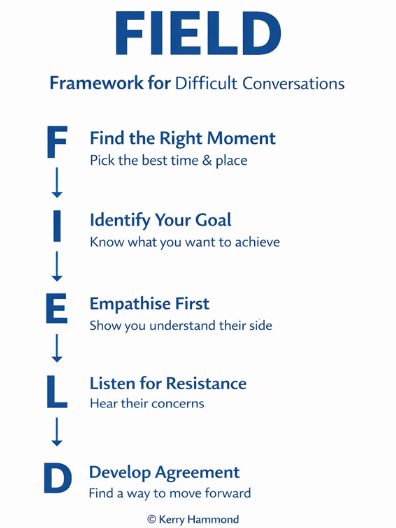
Each stage serves a specific purpose in helping people move from conflict towards collaboration.
Find the Right Time and Place
Many difficult conversations happen at the worst possible moment: during busy periods, when people are tired, distracted, stressed, or under pressure. The framework encourages us to deliberately choose a suitable time and setting. Privacy, calm surroundings, sufficient time, and advance preparation, all improve the chances of a successful conversation. Simply asking for permission in advance can make a significant difference. Rather than raising an issue unexpectedly, scheduling time allows everyone involved to prepare mentally and practically.
The physical environment also matters. Conversations conducted across a kitchen table or between a manager and employee separated by a desk can unintentionally reinforce confrontation and power dynamics. More collaborative arrangements, such as sitting side-by-side or walking together outdoors, often create a greater sense of partnership and ease.
Identify Your Goal
Before entering a difficult conversation, it is important to be clear about the desired outcome.
Ask yourself, ahead of the conversation "What do I really want to achieve?"
The distinction between venting and problem-solving is critical. While venting may provide emotional relief, it rarely creates change. Productive conversations focus on identifying a clear issue, understanding the preferred outcome, and considering how everyone involved might contribute to a solution.
Keeping the discussion focused on a single issue also prevents conversations becoming overwhelming or unfocused. Clear objectives help participants stay on track and reduce the risk of unrelated frustrations entering the discussion.
Empathise First
One of the most powerful elements of the framework is empathy.
Empathy does not mean agreement, nor does it mean feeling sorry for someone. Instead, it means recognising and acknowledging the pressures, concerns and circumstances influencing another person's perspective.
Simple statements such as:
- "I know this season has been stressful."
- "I can see how much work you've put into this."
- "I understand there is a lot on your shoulders right now."
Can help to lower defensiveness and demonstrate respect. When people feel understood, they are often more willing to listen to concerns and consider alternative viewpoints. Genuine empathy shifts the conversation away from blame and towards understanding.
Listen for Resistance
Resistance is frequently interpreted as rejection; I would challenge you to think about resistance differently.
People may resist an idea because they do not understand it, do not like its implications, or have concerns about the person presenting it. Behind resistance often lie fears about risk, loss, tradition, reputation, trust, or uncertainty.
Instead of arguing against resistance, the framework encourages curiosity. Open-ended questions such as:
- "Can you tell me more about that?"
- "What causes you the most worry?"
- "What would need to happen for you to feel comfortable with this?"
Can help to uncover underlying issues and create opportunities for meaningful discussion. Listening to understand, rather than listening simply to respond, often reveals information that can move the conversation forward.
Develop Agreement
The final stage focuses on creating momentum.
A successful conversation does not always solve every problem immediately, but it should produce clarity about what happens next. Agreements should be specific and identify who will do what, and by when.
Even small agreements build trust. A commitment to gather more information, revisit a discussion at an agreed date, or trial a new approach can create progress while strengthening relationships. The goal is not for one person to win and another to lose. The goal is to move forward together.
Returning to Sam's story, the FIELD framework transformed a previously avoided conversation into a productive one. Rather than demanding an immediate decision about the future of the cattle enterprise, Sam created space for discussion, showed empathy for the Father's perspective, listened carefully to concerns, and secured agreement on next steps. The family did not immediately decide to remove the cattle. Instead, they agreed to continue the conversation, review a business plan, and explore future possibilities together. Progress was achieved because trust, understanding and structure replaced avoidance and confrontation.
I’ll leave you with this simple but powerful message, “healthy farming and crofting businesses grow from healthy conversations”. By approaching difficult discussions with structure, empathy and curiosity, we can create stronger relationships, better decisions and more resilient businesses for the future.
Kerry Hammond, SAC Consulting
Related Resources






Sign up to the FAS newsletter
Receive updates on news, events and publications from Scotland’s Farm Advisory Service