
Organic Arable Silage – What You Need To Know
27 March 2026At Kirwaugh Farm near Wigtown in the Machars peninsula, Andrew Robinson has been running his dairy farm organically for over 17 years. As part of his crop rotation and weed control, grass reseeds are established with an undersown arable mix. This helps with weed management, in particular dock which are common in the local area. This case study will explore the benefits and challenges of this method.
Natural Solutions To Soil Health
Before turning organic, Kirwaugh was reliant on nitrogen fertilisers for growing grass silage. One of the reasons to convert to organic was to farm without chemicals and move back towards nature. Andrew has embraced the challenge of finding natural solutions to problems when they have arisen and has worked hard to improve the soil fertility and pH balance so is not reliant on inorganic fertilisers instead utilising farmyard manures and slurry produced on farm.
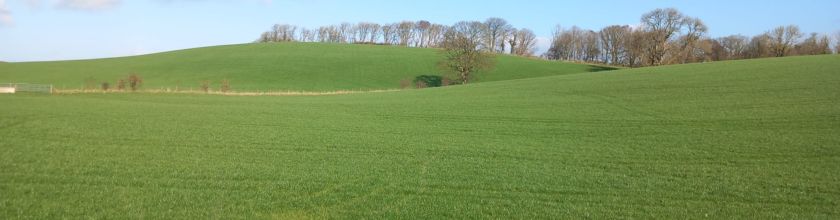
The silage fields at Kirwaugh are in a 7-year rotation. In total there is approximately 250 acres of silage ground across the farm. The fields that are being re-seeded have a first cut silage taken off in early May, then soon after the fields are ploughed.
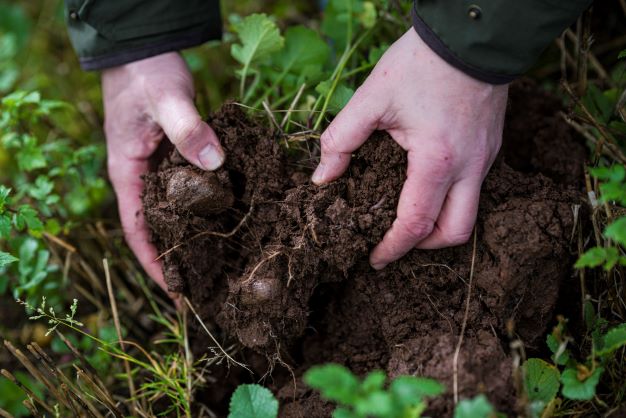
Earlier in the year soil sampling will have been conducted to ascertain the pH level of the fields. If they are found to be deficient a program of liming will be undertaken at the time of ploughing. Farmyard manure is also spread across the fields prior to ploughing, and this is the only fertiliser the ground will receive.
Following ploughing the arable silage mix consisting of an organic spring barley and spring forage pea mixture will be drilled. This is drilled at a rate of 50kg/acre. It is ultimately intended as a nurse crop to allow the grass sward that is planted next to establish itself. Peas have a dual purpose. As a legume they can fix nitrogen which is then taken up by the barley and grass crop.
The Seed Mix
The organic grass seed, which is usually drilled the same day as the arable mix, comprises intermediate and late perennial rye grasses, red clover and white clover. This is drilled at 14kg/acre. The red clover is an essential part of the mix as Andrew has found that not only does it naturally improve the nitrogen uptake and fertility of the soils, but in drought years the tap root of the clover allows for the sward to have better yields in comparison to grass-only swards.
Herbs and other legumes are not included in the seed mix as previous experience has proven that their limited lifespan in the sward is not financially justifiable and that the cattle do not always find these mixes palatable.
Harvesting & Storage
The whole crop is typically harvested after 10 weeks, receives an application of slurry and is then cut again as part of the third-cut silage in early August. Andrew finds that he compromises on the yield for his whole crop silage with an earlier harvest but, the bulk in third-cut silage compensates.
Fourth-cut silage will be taken from fields that have been re-seeded within 3 years, and from year 4 depending on their location to the farm steading, may be strip-grazed in September by the dairy herd. Care will be taken however that the red clover isn’t overly dominant to prevent any health issues arising from the grazing.
Andrew stores the multi-cut silage in pits and feeds the arable silage in a TMR diet. He believes it brings a bit of variety into the diet adds a fibre source.
Weed Control
Weed control in limited to ploughing and grazings, and in general they are not an issue in the silage fields. However, Andrew does admit that seeing dock and other weeds in moderation is something that organic farmers have to accept as part of the farming cycle.
Reduced Fertiliser Costs
At the time of writing, fertiliser costs are expected to increase, so in being organic, Andrew has to a degree shielded his business from external factors. There will always be variables such as the weather, however the rotation which Andrew is adopting has provided stability and sustainability in this farming business and could be applied for many other business even if not certified organic.

Related articles
Organics

Sign up to the FAS newsletter
Receive updates on news, events and publications from Scotland’s Farm Advisory Service