
Planning for Spring Cultivations and the Whole Farm Plan
As autumn cultivations are completed, a quieter period over winter provides the perfect opportunity to think forward to spring. Take the chance to plan for nutrient management to optimise crop production and work towards obtaining the necessary audits and plans required for the Whole Farm Plan by 15th May 2028.
Soil Analysis
Autumn/winter soil sampling enables growers to understand the potential nutrient requirements of their soils ahead of the spring growing season. With fertiliser costs continuing to rise due to geopolitical unrest, understanding soil nutrient requirements is imperative to maximise the efficiency of fertiliser applications to remain profitable.
Soil sampling also supports sustainable farming by providing key information regarding soil health and nutrient availability. It enables farmers to make informed decisions that support crop production, reduce nutrient loss and greenhouse gas emissions from fertiliser application, and improve resilience to unpredictable weather conditions.
Undertaking soil analysis in the autumn allows lime applications to be made before any fertiliser or slurry is applied in spring, avoiding conflict and taking advantage of drier ground conditions coming out of summer. Scottish soils range from very acidic (pH 4) to calcium and magnesium-rich soils (pH 8). Soils acidify quickly, influenced by farming practices, meaning it is important that soil analysis is carried out every 4-5 years to obtain pH levels. This allows appropriate measures to be carried out to maximise crop production and nutrient cycling.
It is advised that the target pH for arable crops/rotational grass is 6.2 with permanent grass soils pH 5.8 or higher. Target pH can vary depending on soil type, crop type and species, the impact of soil pH on nutrient availability, soil organisms and the decomposition rate of organic matter. Nutrient availability changes depending on the pH of the soil. The diagram below from the Potash Development Association shows the optimal pH levels for each nutrient to be available to crops.
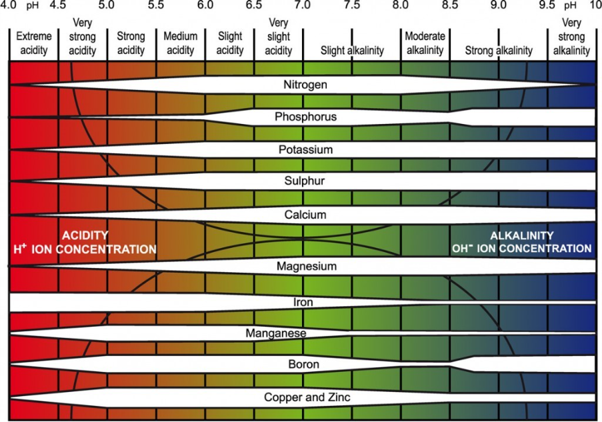
Influence of Soil pH on Nutrient Avavilability, Source: Potash Development Association (PDA.org.uk)
Whole Farm Plan
As well as optimising crop production, soil sampling is particularly important to those who hold entitlements on permanently managed Region 1 land that has artificial fertiliser and/or organic manure applied. From 15th May 2028, to receive BPS payments, claimants must have completed all relevant plans and audits that make up the Whole Farm Plan. Each land parcel claimed in region 1 must have valid soil analysis taken between 16th May 2023 – 15th May 2028. The analysis must include pH, Phosphorous (P), Potash (K) and Carbon as a minimum standard requirement, with magnesium and trace elements recommended also.
Now is the perfect time to get ahead and check if the dates of your latest soil analysis meet the 5-year requirement and ensure each land parcel in region 1 has valid soil analysis. Another benefit of checking your soil analysis now is that work can be started on producing a Nutrient Management Plan which will also be required as part of the Whole Farm Plan by 2028.
More information
For additional guidance on soil sampling, understanding soil analysis, technical notes on nutrient management and a more in-depth look at the Whole Farm Plan, visit the Farm Advisory Service website or the links below.
If you require any further advice or support regarding soil sampling, understanding soil analysis or the Whole Farm Plan contact your local SAC office.
Soils resources for farmers from Farm Advisory Service
Understanding soils | Helping farmers in Scotland
Preparing For The Future | Helping farmers in Scotland
Technical Notes | Helping farmers in Scotland
Katherine Marsh, SAC Consulting





Related articles
Soil Analysis

Soil Health and Management



Soils


Sign up to the FAS newsletter
Receive updates on news, events and publications from Scotland’s Farm Advisory Service