
Slatted Sheep Housing Made Simple
2 April 2026Housing sheep on slats significantly reduces bedding costs and labour demands while improving hygiene within the housing environment. When designed and managed correctly, the cleaner, drier environment can enhance animal health, reduce lameness, and support improved ewe performance.
This practical guide provides the information you need to design an effective slatted system to boost productivity and profitability within your flock. In this guide we will look at types of slats, shed design and other key considerations, including water, ventilation, manure management, grazing benefits and ewe nutrition.
Getting The Basics Right
Success with this system relies on getting the basics right:
- Floor space, pen size and stocking rate.
- Feed space.
- Nutrition.
- Overall shed design and layout.
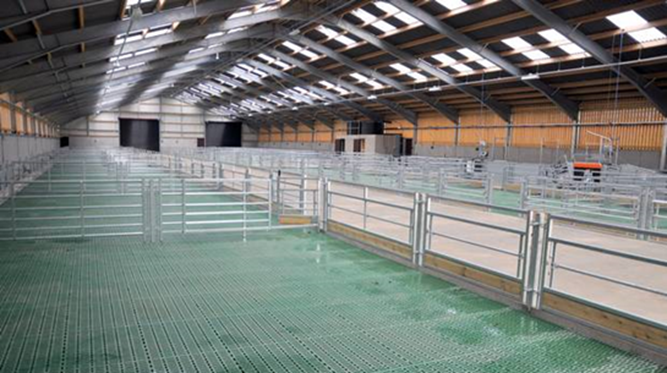
Source: CAFRE Hill Farm, Northern Ireland
Types of Slats
Sheep slats can be manufactured from plastic, metal mesh, wood or concrete. The spacing between the slats should be between 14-16mm wide, allowing organic material to pass through while reducing the risk of foot or leg injuries in younger sheep.
It is important to consider all options when investing in sheep slats as the right choice can significantly improve efficiency.
Table 1: Slat Types
| Material | Advantages | Disadvantages |
|---|---|---|
| Plastic Panels | Non-slip surface | Most expensive option |
| Long term durability | ||
| Comfortable | ||
| Promotes good foot health & hygiene | ||
| Easily cleaned and disinfected | ||
| Will not corrode or rot | ||
| Metal Mesh Panels | Cheaper option | Panels may warp or sag over time |
| Non-slip surface | Dry forage and wool can block the gaps leading to dirty pens | |
| Promotes good foot health & hygiene | Can be draughty | |
| Long term durability | Mesh may corrode over time | |
| Wooden Slats | Cheaper option | Wood may warp over time |
| Difficult to wash and disinfect properly | ||
| Worn or wet wood can become slippy | ||
| Sheep could get feet/legs stuck in worn or damaged areas | ||
| Concrete Slats | Strong and durable | Colder and harder underfoot, reducing comfort |
| Can be easily cleaned and disinfected |

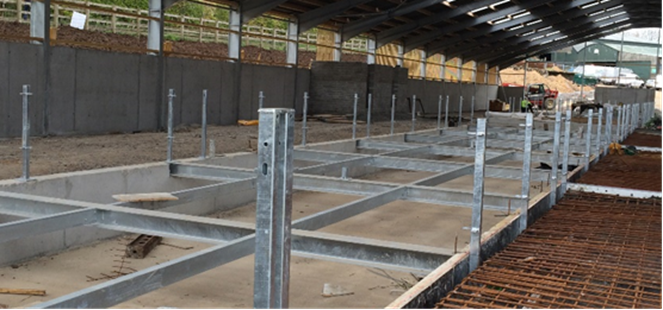
Regardless of which type of slats you install, they must have an adequate load bearing support structure beneath them.
Shed Design
Floor and Feed Space
Sheep slats offer an effective way to increase stocking rates, with many farmers reporting gains of around 10% compared to traditional straw bedded systems, while also benefiting from reduced labour requirements.
To achieve this and maximise performance, calculating the pen size, stocking rates and feed space is arguably the most important part of the process contributing to overall success.
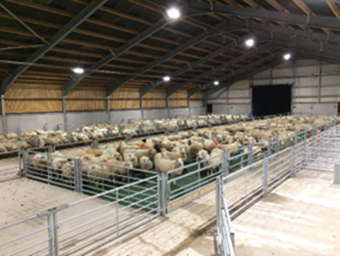
An understocked pen can result in manure not being adequately pushed through the slats, while an overstocked pen increases the humidity and pathogen load. This can reduce performance, elevate stress levels, and intensify competition for floor and feed space, leading to injuries as well as a buildup of manure and disease.
Minimum floor and feed space requirements are shown in the tables below and must be adhered to when sheep are housed.
Table 2: Floor Space Requirements
| Category of Sheep | Space allowance (m²) |
|---|---|
| Lowland Ewe | 1.2 – 1.4 per ewe |
| 60 – 90kg liveweight | |
| Hill Ewe | 1.0 – 1.2 per ewe |
| 45 – 65kg liveweight | |
| Lambs | 0.75 – 0.90 per lamb |
| 3 – 12 months of age | |
| Rams | 1.5 -2.0 per ram |
Published from the DEFRA Code of Recommendations for the Welfare of Livestock
For winter shorn ewes, reduce the space allowance by 10%.
Other points to note:
- Newly born and young lambs should not be kept on slatted floors unless suitable bedding is also provided. This means lambing on slats is prohibited.
- Where possible, pregnant ewes should be kept in groups of 50 or below to allow for better individual recognition and attention in the run up to lambing time.
Pen capacity and feed space should be considered together. Where a pen accommodates 50 ewes, adequate feed space must be provided to allow all 50 to feed at once. It is vital that all ewes have access to feed, especially in late pregnancy to avoid pregnancy toxaemia (twin lamb disease) which is most common in the last 6 weeks of pregnancy. Best practice would be to group pregnant ewes by litter size and body condition score.
Feed space requirements differ according to the feeding system used (e.g. Total Mixed Ration (TMR) or concentrates), as outlined below.
Table 3: Feed space requirements
| Category of Sheep | Fed concentrates (mm per ewe) | Fed restricted forage (mm per ewe) | Fed TMR (mm per ewe) |
|---|---|---|---|
| Small Ewes | 450 | 200 | 150 |
| (50 – 70kg liveweight) | |||
| Large Ewes | 500 | 250 | 150 |
| (70 – 90kg liveweight) |
In late pregnancy, space allowances should be increased to accommodate the ewe’s increased body size, rising to approximately 500mm per head for smaller ewes and 600mm for larger ewes. Providing this additional space helps minimise stress and competition and reduces the risk of injury or metabolic disorders during this critical stage of gestation.
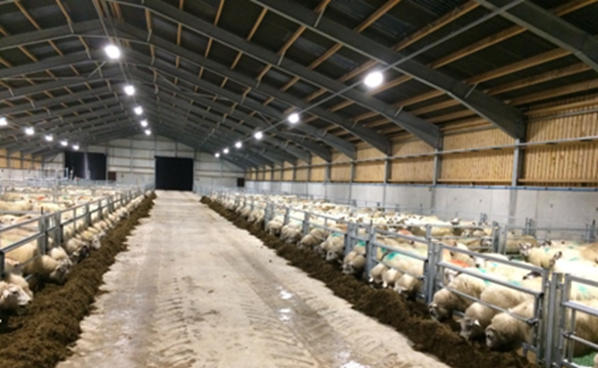
Source: CAFRE Hill Farm, Northern Ireland
Worked Example
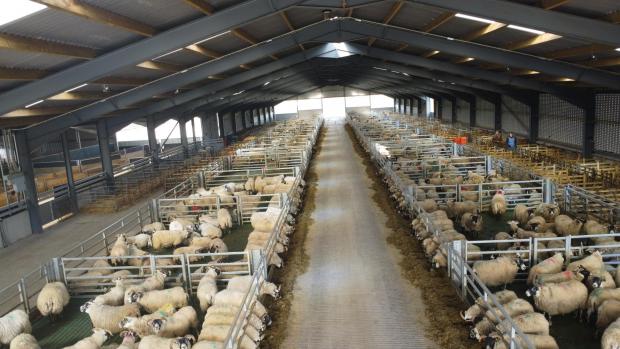
In this example, the four individual pens will accommodate 42 ewes each. However, if the ewes are fed concentrates, there is only feed space for 30 ewes, compared to 100 ewes if fed a TMR.
Table 4: Example
| Method | This example | |
|---|---|---|
| Step 1 | Calculate the total floor space available: | 60m x 4m = 240m² |
| (shed length multplied by shed width) | ||
| Step 2 | Determine how many pens are required for management within this area: | 240m² / 4 pens = 60m² per pen |
| (Total area divided by number of pens required) | ||
| Step 3 | Calculate how many ewes each pen would accommodate based on their liveweight: | Ewes at 90kg - 60m² / 1.4m² = 42 ewes per pen |
| (Pen size divided space allowance from table 1) | ||
| Step 4 | Ensure the feed space is sufficient: | 60m / 4 pens = 15m (15,000mm) per pen |
| (calculate feed face length for each pen) | ||
| Feed space required for ewes fed concentrates : | 15,000mm / 500mm = 30 ewes | |
| (feed face length divided by feed space required per ewe from column 1 on table 2) | ||
| Feed space required for ewes fed a TMR: | 15,000mm / 150mm = 100 ewes | |
| (feed face length divided by feed space required per ewe from column 3 on table 2) | ||
Discovering a shortage of feed space at a later stage would require additional feeding provisions, such as installing hanging troughs. In practice, this would most likely involve someone having to enter the pen to feed the remaining animals, negating the labour-saving benefit of feeding directly from the passage.
Water
Sheep must have access to a constant supply of fresh drinking water. The intake rate depends on stage of production and dry matter content of the ration. Points to consider are:
- Access: does each pen require a drinker or can two pens share one?
- Type of bowl: automatic troughs refill to maintain a consistent water level allowing multiple sheep to drink at once. Traditional water bowls provide fresh water to each animal as they are activated when the sheep drinks. These are more suited to smaller pens as only one animal can drink at a time.
- Water pressure: ensure this is sufficient to supply adequate water supplies.
- Trough placement: ensure troughs are installed away from feed to minimise contamination.
- Frost protection: pipes must be insulated or buried 600mm deep to prevent freezing. Heated drinking bowls or water circulation systems can be installed.
- Hygiene: ensure troughs can be easily cleaned to remove build-up of debris and potential faeces.
Ventilation
Poor ventilation creates a cascade of problems affecting animal health, performance and farm efficiency:
- Stale, humid air allows bacteria and viruses to build up, increasing the risk of respiratory diseases.
- Excess moisture leads to damp conditions that encourage infections to spread and make animals more susceptible to chilling.
- The build-up of gases, such as ammonia from urine and manure, can irritate the eyes and lungs of both sheep and humans.
The image below demonstrates thermal buoyancy, more commonly known as the ‘stack effect’.
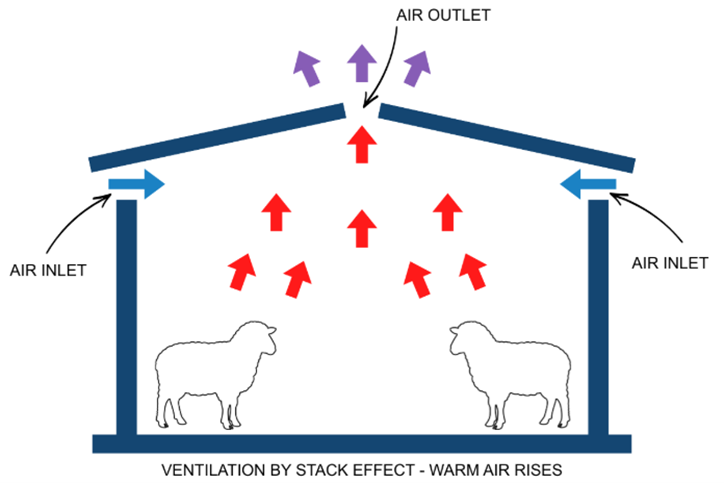
Natural ventilation is the best option if the shed site allows, it relies on wind and thermal buoyancy (the rising of warm air) to circulate air flow. To optimise airflow the roof must have openings/vents at the roof peak to allow hot, stale air to escape from the environment (outflow). There must be sufficient vents or openings on both sides of the shed to enable fresh air to enter the shed (inlet). The total ‘inlet’ area should be at least twice the ‘outlet’ area.
A smoke bomb can be used on a calm day to visually assess the effectiveness of shed ventilation, by highlighting the airflow direction and the speed of air exchange. Ideally the smoke should leave the building in less than 1 minute.
In the absence of good natural ventilation, mechanical systems such as fans or ducts can be used. These systems typically work in the same way by drawing in fresh air to circulate and remove the stale air. Tunnel ventilation systems use high speed fans to push air through the entire building. These systems are more costly and their demand on energy consumption should be considered.
Tips on Ventilation
- Position the shed so that the prevailing wind blows along its side, not directly into the entrance or walls to maximise air flow into the shed.
- Steep pitched roofs improve thermal buoyancy.
- If using overhangs, ensure they are long enough to protect the feed space from rain and snow.
- Minimise draughts as slatted floors may be colder than straw bedded floors, it is important that sheep remain comfortable.
Manure Management
Manure management in slatted sheep sheds focuses on the efficient collection of organic material beneath the slats to keep the pens clean, maintain good foot health, and reduce labour compared to traditional straw bedding systems. There are several options for manure collection, all with different cost and storage implications.
Organic material falls through the slats into some form of under-floor tank, which can often hold manure for the whole winter or longer, depending on the design. Larger systems typically use under floor collection tanks and store the manure as slurry while smaller systems may opt for a reduced cost and use a permeable floor, allowing the dirty water to drain away leaving a solid manure, similar to many straw bedded systems.
The nutrient value of the manure will differ depending on the form of manure which is stored and the dry matter content. Sheep manure is a valuable source of Phosphate (P) and Potassium (K). It is highly recommended to analyse the organic material produced and create a nutrient management plan that accounts for the nutrients available, allowing it to be applied to fields at optimal times to minimise fertiliser costs.
Regardless of the source, all livestock slurry and manure must be collected, stored and applied to land in accordance with the Water GBR’s contained within the Environmental Authorisations Scotland Regulations 2018 - https://www.farmingandwaterscotland.org/know-the-rules/
Slurry:
- Sheep slurry is defined as a liquid or semi-liquid mixture composed of sheep excreta (dung and urine) and may be mixed with water, which can be pumped or discharged by gravity.
- Typical dry matter content between 4 – 20%.
- Slurry is regulated by the General Bunding Rules (GBRs) and requires a minimum storage capacity of 22 – 26 weeks.
- It must be collected in approved watertight storage and applied during the correct conditions, adhering the GBR’s to prevent environmental damage.
Manure:
- Sheep manure is classed as a solid manure if it can be stacked in a freestanding heap without slumping.
- Typically sheep manure has a dry matter content of 20% or above.
- Run off is defined as slurry under the regulations and must be collected and stored in a storage facility which meets the requirements of the regulations, prior to application to land.
- Whilst slurry collection involves pumping the slurry out the tanks, drier manure generally needs mucked out with machinery. Consider how this will be achieved, many farmers lift the slats for mucking out. Whilst the volume of manure is less, cleaning out more frequently prevents the build-up of manure and reduces how compact it becomes.
Slurry/manure top tips:
- Consult SEPA in advance of any construction work and be aware of the General Binding Rules affecting the collection and spreading of manure.
- Sheep manure has a high dry matter content and can therefore form a crust in the tank. Slurry treatments or bacterial additives can help break it down and make emptying easier.
- It’s important to keep the slats clear of wool and debris so manure passes through freely.
- Floors must drain effectively, for every 600 mm of floor length, the floor should drop by 10 mm. For example: - in a 6 meter (6000 mm) deep sheep pen, a 1 in 60 slope means the back of the pen should be 100 mm higher than the front (6000 / 60 = 100 mm)
Grazing Benefits
Slatted housing for sheep provides a significant ‘rest and recovery’ period for pastures which often results in substantially higher grass yields in the spring and prevents poaching. Research suggests continuous winter grazing can reduce April grass yields by up to 40%.
The opportunity to improve spring grass depends on the fundamentals of grassland management being right:
- The soil should be maintained at an optimal nutrient status, with pH, phosphate, and potassium levels all within their target ranges.
- Soil compaction should be monitored and corrected if poor to ensure good root development, drainage, and air circulation.
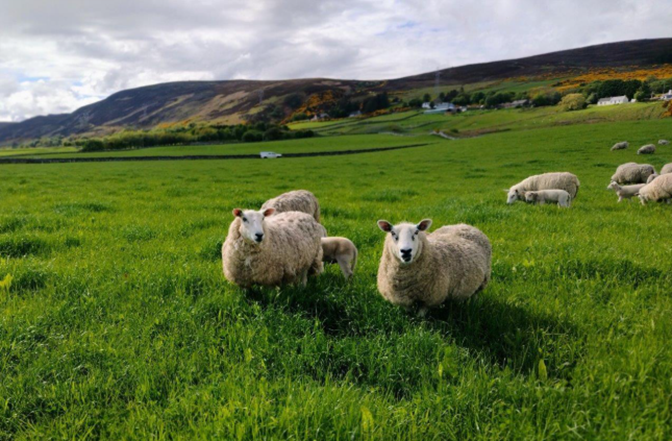
Source: Vic Ballantyne, Clynelish Farm
Housing sheep for longer periods provides numerous benefits:
- Access to cleaner pastures when ewes and lambs are turned out in the spring, reducing potential health issues from dirty and contaminated pastures.
- Ungrazed winter swards often promote stronger spring regrowth as they avoid the stress associated with continuous winter grazing, although they may also contain a higher proportion of dead material.
- The reduced foot traffic in winter conditions prevents soil damage from poaching and soil compaction.
- The ability to collect sheep manure which is high in P and K for spring application when the grass can best utilise of the nutrients.
Forage Production and Ewe Nutrition
When housing sheep for extended periods, farmers may need to adjust their silage making practices to produce both a larger quantity and higher quality of forage.
Producing high quality forage is crucial when feeding housed sheep, especially when feeding pregnant or lactating ewes. The optimal silage is leafy, high in protein, and highly digestible. The use of high-quality silage can reduce both the quantity and duration of concentrate feeding required during the housing period. Chopped silage is best as bulky feeds such as hay can block the slats.
Planning ahead is essential as the production of high-quality silage will mean earlier cutting dates. Please refer to the FAS Technical Note (TN748): Strategic Silage Production for Sheep Systems for more information.
Housing ewes pre-lambing in a healthy environment, with sufficient feed space provides consistency and allows for precise rationing and close monitoring. This ensures their energy and protein requirements are met during this critical stage which is vital for maintaining ewe body condition, foetal development, colostrum and milk production, and ultimately has a lasting impact on lamb survival and performance.
Similarly, housing finishing lambs on slats and controlling their nutrition supports higher feed intakes and promotes better feed conversion as energy is focussed on growth. As a result, they grow faster and reach slaughter weight sooner.
Final Tips and Points to Note
- Appoint a design consultant with experience in this area.
- Research farms with the system you are considering and undertake farm visits to see what works.
- Take time to design all the little things that matter such as pen access, gates, walkways and feed barriers.
- Review the resources on farm and be aware there are options available for every budget.
- Ensure sheep are in good foot health and free of foot rot before housing as foot rot and other infections can spread rapidly in confined conditions.
- Regularly clean and disinfect slats to promote good hygiene and reduce the risk of disease.
- Explore other opportunities to utilise the shed, can you incorporate a handling system or finish store lambs in the space?

Sign up to the FAS newsletter
Receive updates on news, events and publications from Scotland’s Farm Advisory Service