
Spring Malting Barley Outlook 2026
Key Points
- Weak and uncertain export demand for whisky is feeding back down the supply chain
- Spring malting barley contract tonnage expected to be lower in 2026
- Feed markets likely to remain important for spring barley again in 2026
- Higher autumn sowings have cut the UK barley area to a 15 year low that may support feed barley prices locally
Wider global market trends will remain the main driver of both feed and malting barley prices
Underlying Global Grain Market
World grain markets are subdued due to a very large US maize crop and higher grain crops in most major exporters. Since the first USDA estimates were made in May 2025, global grain output has risen 120mt to 2,433kt, the largest annual increase since 2016. Grain demand has also risen by 70mt and ending stocks by 17mt. This has resulted in lower global cereal prices with US maize futures currently at £123/t, a fall of £32/t since a year ago. UK wheat futures have fallen £19/t in the same period to £164/t. Ex-farm UK feed barley prices are £144/t, down £14/t on a year ago. EU malting barley prices at port are £157/t, down £43/t from £200/t a year ago.
Brewing and Distilling
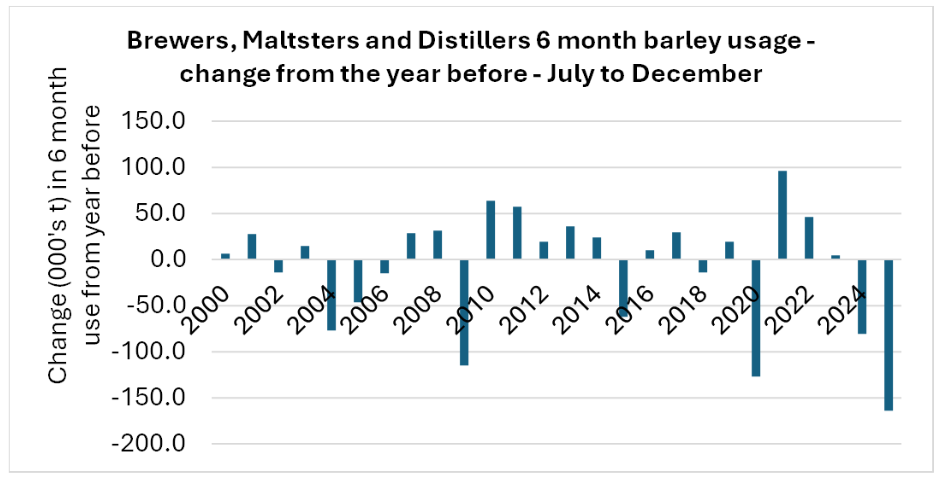
UK barley usage by Brewers, Maltsters and Distillers fell by 17% or 164kt in the first half of the 2025-26 crop year. This is the largest 6 month decline in usage since available records began in 1990.
The whisky market is experiencing a downturn in export demand. This follows over a decade of expanding distillery capacity, spirit production and demand for malting barley and wheat for distilling.
With the US being the largest whisky export market by value, the imposition of a 10% tariffs on Scotch whisky exports to the US has been particularly damaging. There are also structural changes in consumer demand (lower alcohol consumption) in both US and other global markets. As well as rising geo-political and economic uncertainty that is tending to suppress consumer spending in key markets.
With rising stocks of whisky in store in Scotland and uncertain market demand, the distillers are seeking to reduce the rate of current production to avoid further build up in stocks. Several maltings and distilleries are reducing output or going offline for several months as a result. One malting is expected to close as are a small number of distilleries. As a result, distillers and maltsters are understood to be seeking lower spring malting barley contract tonnage for harvest 2026.
Will the drop in demand for malting barley be a short or longer-term issue? The last two downturns in whisky production were 2008; the financial crisis and 2021; Covid. It took 3 years for whisky production to recover in 2008. There are signs that medium to longer term the whisky market could benefit from some recent positive news on import tariffs. India, the largest whisky buyer by volume; has signed a deal with the UK to substantially reduce tariffs on Scotch whisky imports, halving them initially. China has also announced a cut in tariffs from 10% to 5% on Scotch whisky, which may help sales but to a lesser extent.
Spring Planting
Demand for spring malting barley for the coming harvest appears at risk evidenced by growers reports of reductions in contract tonnage. Farmers have already acted on this negative outlook by increasing autumn sowings of wheat, barley and oilseed rape. As a result the AHDB Early Bird survey suggest a 10% (25k ha) cut in Scottish spring barley sowings to 227k ha and a 15% (107k ha) fall in UK sowings to 612k ha. That could mean 150kt less spring barley in Scotland, and 600kt less in the UK with output and quality as ever subject to weather and market uncertainty.
This leaves farmers with the difficult choice of what to plant this spring. Current forward margins are fairly weak for most cereal crops and there are not many obvious alternatives to spring malting barley. While choosing to leave fields fallow is not usually a good option for most farmers given their need to cover fixed costs, putting some poorer fields land into fallow or a grass break may make sense. Where the decision is made to stick with spring barley, this will have to done on the basis that some may end up in the feed market. Sticking with malting varieties for now with a decision to be made later in the spring season on how much nitrogen to apply maintains flexibility. If the whisky downturn looks like it may persist for a longer time, an ongoing review of cropping plans will be needed.
Julian Bell, SAC Consulting







Sign up to the FAS newsletter
Receive updates on news, events and publications from Scotland’s Farm Advisory Service