
Business and Policy May 2026 – Beef
4 May 2026Beef Prices Fall Below 2025 Levels
Finished beef prices continue to disappoint, continuing a downwards trajectory now tracking behind 2025 prices. While prices rose sharply in spring 2025, reaching £7.20/kg at the start of May, this year’s prices are far less exciting with finishers margins being further squeezed. For the week ending 18 April Scottish finished price for R4L grade steers sat at 637p/kg/deadweight (-4.2p/kg back from the previous week and down 6p/kg from the start of April). GB deadweight prime cattle prices also slipped further back, with GB deadweight prices down 4p/kg from the week previous to 630p/kg/dwt in the week ending 18 April. The GB average young bull price also fell back, however at a lesser rate – down by 2p/kg to 614p/kg.
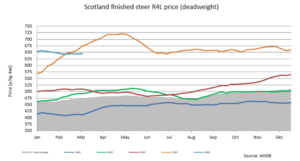
While finished prices are not at the levels recorded in spring 2025, they remain ahead of £5.50p/kg received in January 2025. To put this into perspective, a 400kg carcass had risen by £680/head in just over 15 months which has been followed by a drop of £360/head. Price fluctuations on this scale are simply not sustainable especially when finisher margins were already under pressure from increased input costs, with further price volatility due to the US war with Iran. There is currently very little if no margin for finishers who bought high priced store cattle in the autumn of last year.
Consumer Demand
Unfortunately reports suggest that prices are unlikely to improve in the short term, with prices predicted to go lower in the coming weeks – a reflection of consumer buying habits. On paper, prices should be rising due to reduced cattle numbers however consumer demand is incredibly low. Consumers are reacting to increased costs – with fuel and council tax just some of the costs having gone up since April – which is affecting beef buying habits as consumers look for value. This is contributing to pressure on prices at the farmgate.
With a summer festival of football ahead at the World Cup, kick-off times are expected to support the dining-out market, and it is hoped that beef sales will increase.
Minced Beef
Strong demand for cheaper cuts and manufacturing beef continues, as consumers look for lower cost beef. Unsurprisingly as consumers look for value when buying beef, mince is performing well and is a clear first choice for shoppers. Beef mince remains the most popular mince, with data from AHDB highlighting that over the past 52 weeks 70% of GB households have purchased minced beef. Mince is a weekly staple for most households as a quick and easy to cook option associated with family meals such lasagne and cottage pie. These family favourites areenjoyed by adults and children thus reducing the risk of waste or the need to cook separate meals, which makes for an attractive option when food budgeting.
Last year’s price surge saw restaurants remove prime cuts and steak from their menus, choosing instead to increase offerings of traditional beef mince meals which led to carcass imbalance issues, while increasing the demand for manufacturing beef and supporting the cull cow trade.
At the time of writing, the cow trade remains fairly strong, with prices sitting around 560p/kg albeit prices have fallen back from earlier in the month.
May Breeding Sales
We are weeks away from the May breeding sales getting underway and it is anticipated that breeding cattle will be met with strong demand. The annual spring bull sales at United Auctions Stirling and Harrison and Hetherington Carlisle will see in the region of 950 pedigree bulls go through the sales ring. Demand for bulls in recent years and values have risen significantly with many breeds now averaging close to £10,000, and some breeds above £10,000.
Over the past 18 months, suckler cows have at long last become profitable however the money now tied up in cattle is colossal which makes buying in replacements a huge investment. To buy a heifer and a calf it is likely to cost around £4,000 and, for those looking for top quality continental types with shapely calves, it’s more like £5,000.
Scottish Suckler Beef Support Scheme (SSBSS) 2025 payments
By now, most suckler producers should have received their calf payment for 2025. As predicted, fewer claims due in part to the continued decline of sucklers but mostly due to the number of ineligible calves mean that producers received higher rates per calf compared with last year. Mainland herds received £127.20 (+£15.88) per animal with islands receiving £175.90 (+£20.87) per animal. With fuel, fertiliser, haulage, net and silage wrap all increasing recently due to the current situation in the Middle East, these payments will be welcome.
Sarah Balfour, sarah.balfour@sac.co.uk
Scotland prime cattle prices (p/kg dwt) (Source: drawn from AHDB and IAAS data)
| Week Ending | R4L Steers (p/kg dwt) | -U4L Steers | Young Bulls -U3L | Cull cows | ||||||
|---|---|---|---|---|---|---|---|---|---|---|
| Change on week | Diff over North Eng. | Change on week | Diff over North Eng. | Diff over North Eng. | R4L | -O3L | ||||
| 28-Mar-26 | 641.4 | -0.6 | -5.4 | 637.9 | -0.8 | -16.1 | 630.3 | -4.2 | 572.2 | 547.9 |
| 4-Apr-26 | 643.5 | 2.1 | -3.6 | 640.1 | 2.2 | 1.2 | 636.2 | 0.2 | 576.6 | 550.3 |
| 11-Apr-26 | 641.5 | -2.0 | -6.8 | 634.3 | -5.8 | -8.4 | 633.3 | 4.4 | 577.9 | 551.2 |
| 18-Apr-26 | 637.3 | -4.2 | -6.2 | 627.9 | -6.4 | -15.5 | 630.9 | 3.7 | 566.7 | 547.0 |


Sign up to the FAS newsletter
Receive updates on news, events and publications from Scotland’s Farm Advisory Service