
Check Your Wheat’s Revised Yellow Rust Resistance Rating
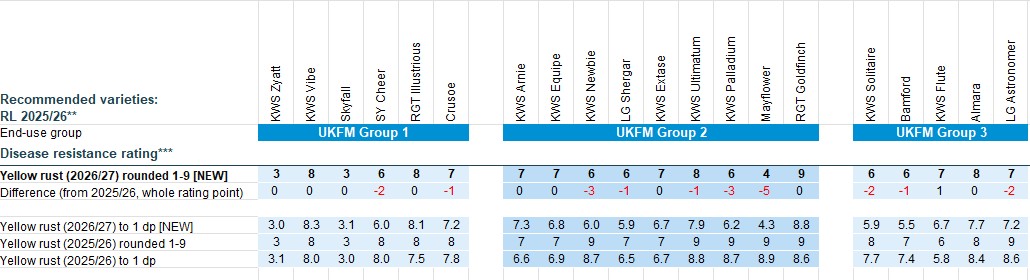
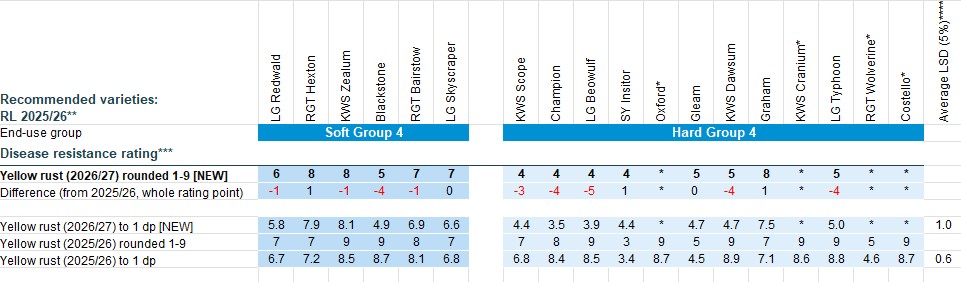
5 November 2025Several winter wheat varieties have seen significant drops in yellow rust resistance ratings in the latest AHDB Recommended List (RL) 2026/27 release, some by as many as five points. The revised ratings were published earlier than usual to help growers adapt management strategies for harvest 2026, following the rapid emergence of a new yellow rust strain virulent on the key resistance gene Yr15.
AHDB Reccommened Lists
Winter wheat yellow rust disease resistance ratings: 2025/26 and 2026/27
Rapid Emergence of a New Strain
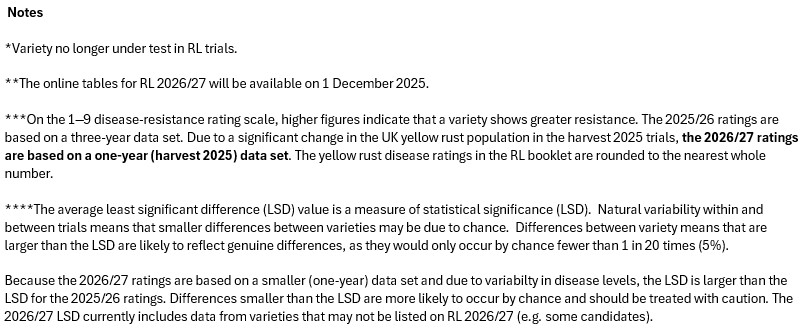
Normally, rust disease ratings are based on three years of trial data. However, due to the sudden and widespread impact of this new strain, the 2026/27 yellow rust ratings are based solely on 2025 harvest data to best reflect current conditions. This is only the second time AHDB has based ratings on a single year, following a similar situation in 2016 after a major shift in virulence.
Genotyping analysis by NIAB and the John Innes Centre indicates that the Yr15-breaking strain likely evolved through mutation in late 2024. First detected in North East England, it spread rapidly during spring 2025, affecting many RL trials and commercial crops. Yr15-virulent isolates have since been identified in several other European countries.
Understanding the Ratings
Adult plant disease resistance ratings are scored from 1 (least resistant) to 9 (most resistant). Since RL 2021/22, the data has been weighted to give greater influence to recent trials, improving responsiveness to emerging rust populations. The decision to use a single season’s data for yellow rust ratings ensures they accurately reflect the current dominance of Yr15-virulent isolates.
Young Plant Resistance
Since RL 2023/24, each variety’s young plant resistance (r) or susceptibility (s) status has been presented alongside adult plant ratings. On RL 2025/26, 13 out of 38 winter wheat varieties were classified as resistant at the young plant stage — a trait now understood to be closely linked to Yr15. With the breakdown of this gene, almost all varieties are expected to be classified as susceptible at the young plant stage in the RL 2026/27 release.
Mark Bowsher-Gibbs


Sign up to the FAS newsletter
Receive updates on news, events and publications from Scotland’s Farm Advisory Service