
Could Sustainable Farming Affect Ergot Risk in Barley?
10 March 2026In 2024, arable farmers across the UK saw a huge increase in ergot in cereal crops and felt the financial impact through grain rejections and the loss of premium prices for their hard-earned harvests. The reasons were hardly a mystery. Difficult drilling conditions in autumn 2023, followed by a warm, wet spring and a cool, rainy summer, created ideal conditions for the fungus to germinate and spread. Thanks to a return to drier weather, ergot levels fell again in 2025, but the disease still poses a real risk to farmers’ bottom lines. Legal limits for ergot in grain are extremely low – just 0.5 g per kilogram is permitted – and this strict threshold meant ergot was the leading cause of malting barley rejections in three out of the last five years, according to MAGB. When grain is rejected, farmers lose access to premium markets and may also face additional costs for testing, sorting and cleaning grain. While weather is a key driver, attention is now turning to whether some farming practices might be affecting the risk of ergot and other fungal diseases.
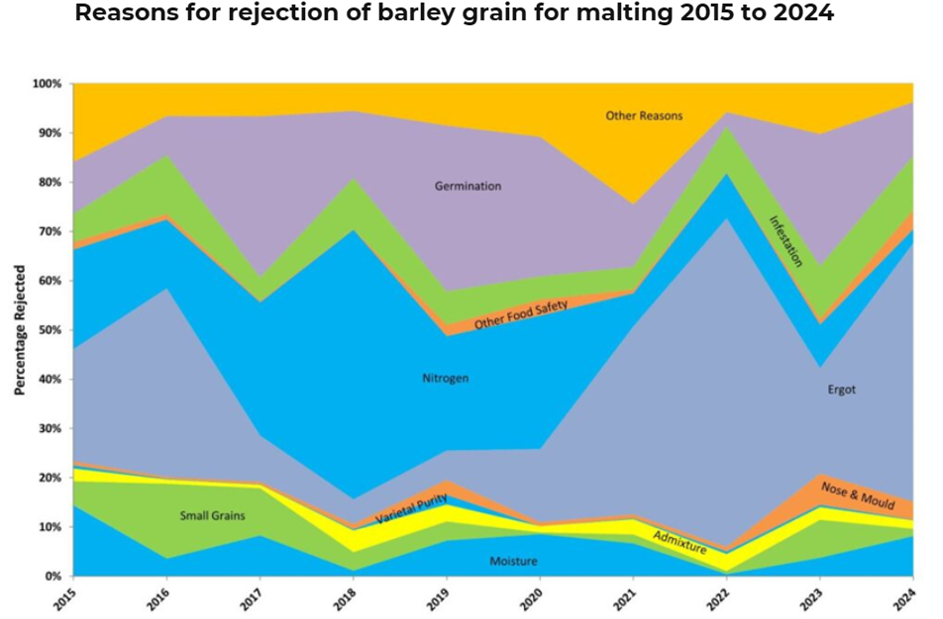
The Impact of Sustainable Farming Methods
Sustainable farming incentives have encouraged the uptake of practices such as minimum tillage and direct drilling, alongside grassy margins, beetle banks and reduced use of herbicides and fungicides. These approaches can improve soil structure and support biodiversity, helping overall farm ecosystem health. However, it’s not clear if there are unintended impacts on crop disease.
Ergot has a complex life cycle, with several stages where management choices could be influencing its development. For example, ploughing can bury ergot bodies – known as sclerotia – deeper than 5 cm, where they are unlikely to germinate successfully. In contrast, direct drilling leaves them on the soil surface, where they may germinate if conditions are favourable. Ergot is a generalist fungus capable of infecting more than 400 grass species. This means species-rich margins and grassy habitats could potentially act as reservoirs for inoculum, while increased insect activity in diverse systems may also play a role in spreading the fungus.
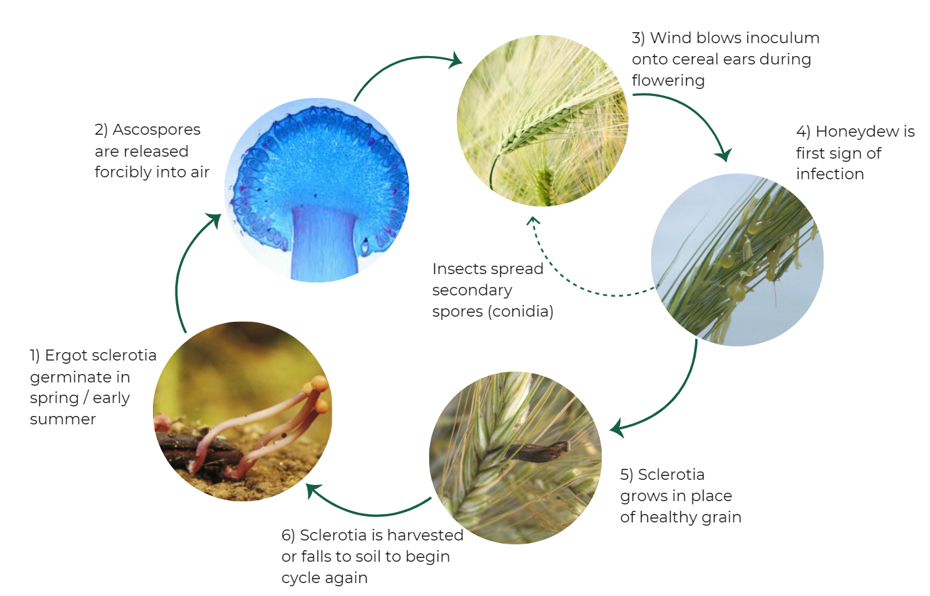
Figure 2: The lifecycle of ergot (adapted from AHDB, 2025)
At first glance this explanation might seem straightforward, but nature is rarely that simple. Recent work in Scotland has found that oats grown in organic systems contained lower levels of mycotoxins (indicators of fungal infection) than those grown in conventional systems. This could simply reflect differences in crop rotations, as organic systems often include break crops that reduce fungal carryover from one season to the next. However, there may also be something more interesting at play. Greater diversity within organic farming systems may be helping crops become more resilient to fungal attack. Exploring whether this is the case will form part of my research over the next four years.
As the climate becomes increasingly unpredictable and arable farmers face growing challenges, understanding how farming practices influence disease risk will become even more important. If we can better predict when conditions favour ergot, farmers may be able to adapt management practices accordingly, avoiding certain practices in high-risk years and returning to them when the risk is lower. Ultimately, the aim is to help farmers strike the right balance between protecting crop quality, maintaining soil health and supporting the wider farm environment.
Have you seen an increase in ergot or Fusarium in your spring barley? I’d love to hear from you. Please reach out to me at samantha.kitchen@sruc.ac.uk.
Samantha Kitchen, SRUC
Further Reading
Abram, 2025 'Breaking the ergot cycle', 26–28. Crop Production magazine - Agronomy: theory to field. Available at: chrome-extension://efaidnbmnnnibpcajpcglclefindmkaj/https://www.cpm-magazine.co.uk/wp-content/uploads/sites/9/2025/09/026-28-Theory-September-25.pdf
AHDB (2025) The life cycle of ergot and its impact on cereals and grasses. Available at: https://ahdb.org.uk/knowledge-library/the-life-cycle-of-ergot-and-its-impact-on-cereals-and-grasses.
Bounds, P., Bryson, R., Cook, S. and Smith, J. (2025) Updating UK management guidelines for ergot (a review). Available at: https://projectblue.blob.core.windows.net/media/Default/Research%20Papers/Cereals%20and%20Oilseed/2025/RR102%20final%20report.pdf
Macdonald, S., Holmes, S. and Woodward, A. (2024) Project Report No. 652: Monitoring of mycotoxins and other contaminants in UK cereals used in malting, milling and animal feed. York: AHDB. Available at: https://projectblue.blob.core.windows.net/media/Default/Research%20Papers/Cereals%20and%20Oilseed/2024/PR652%20final%20project%20report.pdf

Related articles
Crop Health
Sign up to the FAS newsletter
Receive updates on news, events and publications from Scotland’s Farm Advisory Service