
Managing the Impacts of Beavers – A Practical Guide for Farmers and Land Managers
9 March 2026- Beavers are well established in several river catchments in Scotland and are likely to continue to spread through natural dispersal and translocation.
- Conflicts with land management are most likely where watercourses adjoin high quality agricultural land on floodplains and include damage to riverbanks and flood defences through burrowing, flooding due to dam-building and damage to crops and trees through foraging.
- The Scottish Beaver Strategy sets out a mitigation hierarchy that must be followed when addressing land-use conflicts.
- New dams (less than 2 weeks old), short burrows without chambers and water channels created by Beavers can be removed without a license.
- Dealing with older dams and larger burrows requires a license.
- Where Beaver conflicts can’t be effectively mitigated, licensed translocation is possible and lethal control remains as the option of last resort.
- Advice and some financial support is available to help with licensing and mitigation nationally through NatureScot and locally through the Cairngorms National Park Authority.
Although the re-establishment of Beavers in Scotland enjoys high public support and their role as ecosystem engineers can deliver biodiversity benefits in semi-natural habitats, they can also have significant local negative impacts on land management, particularly on good quality agricultural land on floodplains. The economic effects of these impacts therefore fall disproportionately on farmers in the affected areas, and it is important that there are mechanisms in pace to help farmers avoid and mitigate this damage. This practical guide highlights the options that are available to farmers and other land managers seeking to protect their land and livelihoods from damage.
The Eurasian Beaver (Castor fiber) has been reintroduced to Scotland over the past 25 years, after an absence of around 500 years since they originally became extinct. An official reintroduction took place from 2009 in Argyll, but by then a population was already becoming established in the Tay catchment from unofficial releases or escapes, with the first sightings in this area occurring in 2001. Unsuccessful attempts to remove the Tayside population were abandoned by 2016 and in 2019 the Beaver was formally designated as a European Protected Species, which has led to the development of Scotland’s Beaver Strategy 2022-2045, to help address conflicts with land management.
Beavers are now well established in central Argyll and across the Tay, Forth, Beauly and Spey river catchments. It is likely that Beavers will continue to spread into new parts of Scotland either through natural dispersal or translocation.
Concerns for Land Managers
Problems that can arise for land managers when Beavers are present can mostly be attributed to three aspects of their behaviour:
Burrowing
The majority of Scottish Beavers choose to live in burrows rather than lodges, although they can use both within the same territory. Burrow entrances tend to be underwater and lead upwards into living chambers above the water level. This means that flood-banks within 20 metres of watercourses can provide ideal locations for Beaver Burrows, but extensive burrowing can cause these to collapse, leading to increased erosion and flooding risk to what is often prime agricultural land on the floodplain.
Dam-building
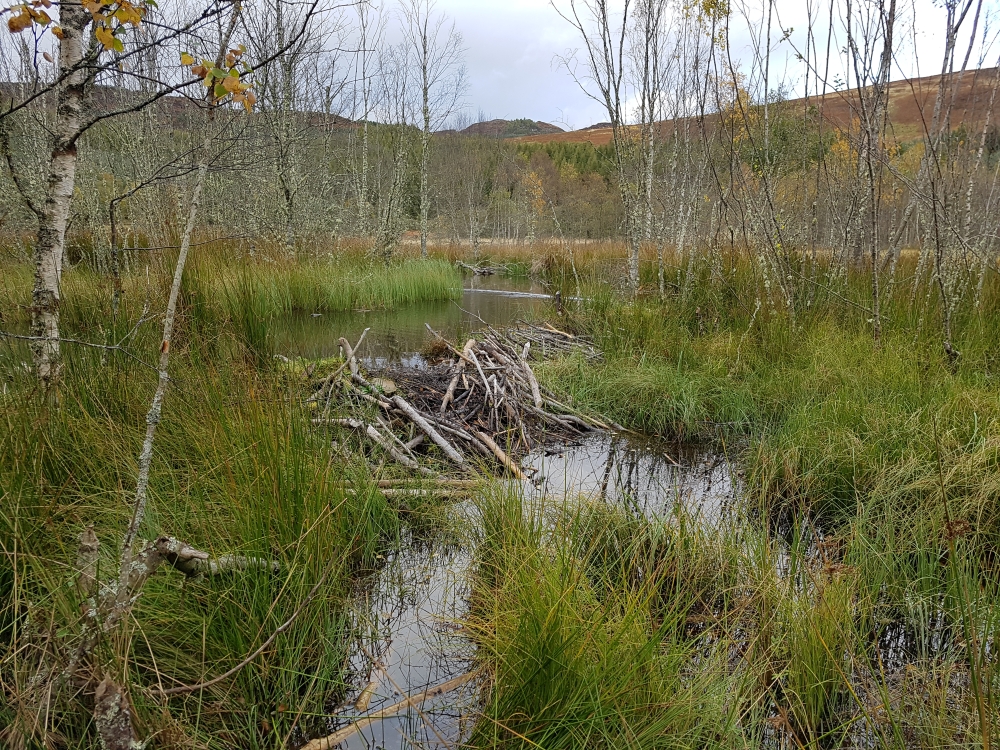
Beavers build dams to raise water levels to increase the area of foraging habitat that is easily accessible to them without leaving the water, and to conceal underwater entrances to burrows and lodges. Where good quality agricultural land is affected, this can obviously have significant negative impacts. Where flooded areas are adjacent to large areas of flatter agricultural land, the raised water levels can also cause field drainage to back up and cause flooding in low-lying areas some distance from the dam-building.
Foraging and tree-felling
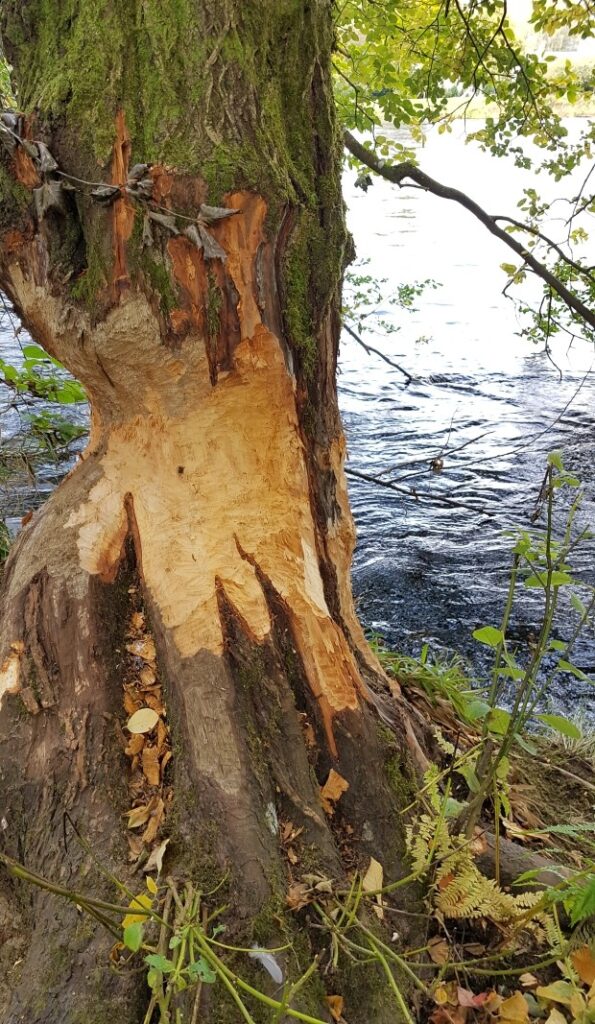
Beavers can cause localised damage by feeding on cereals and other crops, although this damage is usually restricted to areas within a few metres of watercourses. Felling of trees by Beavers can also be a significant localised problem where long-established specimen trees are present, for example in parkland or where scattered trees grow along watercourses. Another potential issue is that Beavers will readily feed on the invasive non-native Japanese Knotweed growing on riverbanks. In doing so, fragments of Knotweed can be washed downstream and give rise to new infestations due to vegetative growth.
Overall, the impacts of Beavers on land management are likely to be greatest in areas where productive agricultural land is close to watercourses and land gradients are low, for example on floodplains. Unfortunately, this often coincides with some of the best agricultural land, including areas of prime agricultural land that are of strategic importance for food security. For this reason, there is a Scottish Beaver Strategy, which sets out a management framework for intervention when conflicts arise.
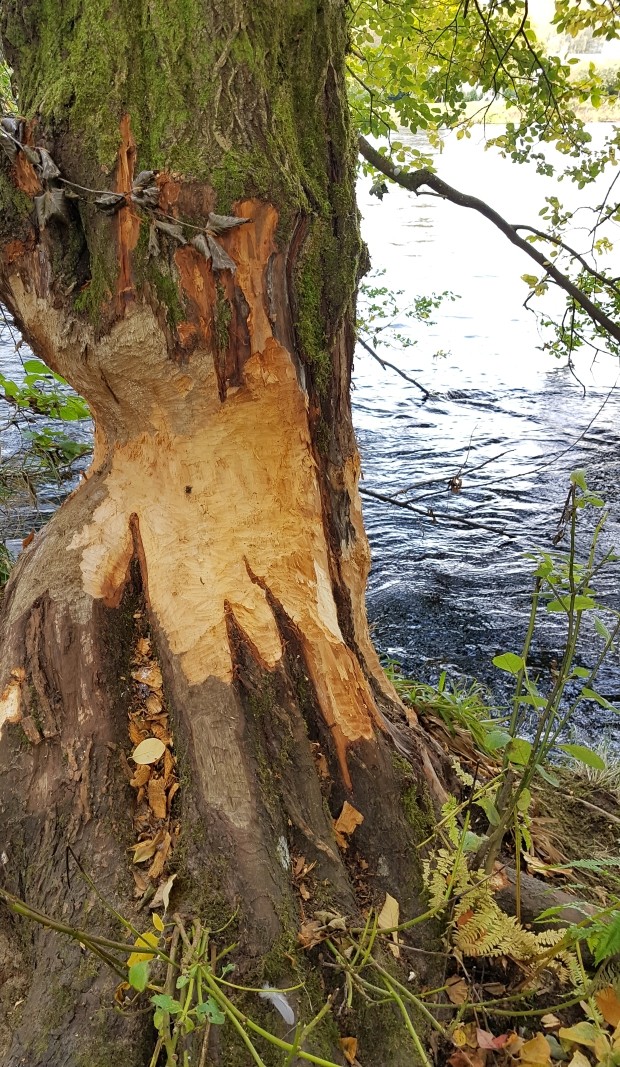
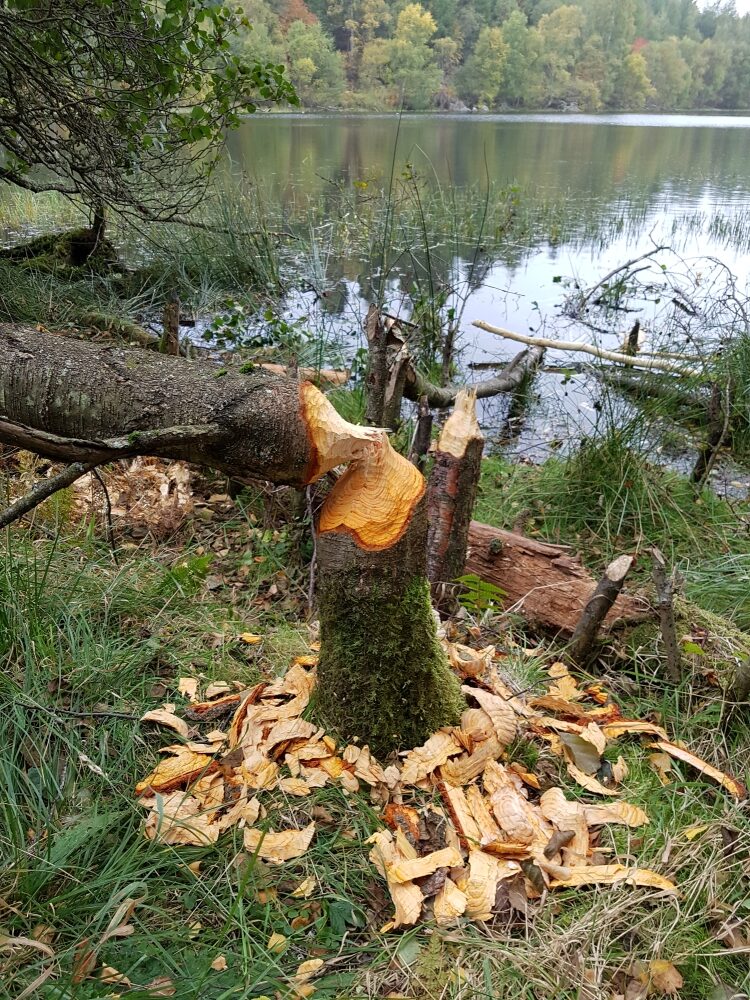
Signs of beaver feeding and damage
Beaver Management Framework
There is a clear sequential mitigation hierarchy that must be followed by land managers affected by Beaver activity. This reflects the species’ status as a European Protected Species, while recognising the conflicts with land management that can arise. The hierarchy is:
Accommodate > Mitigate > Translocate > Lethal Control
Moving to the next step in this hierarchy is dependent on the earlier steps being impractical or unlikely to succeed. In addition, translocation, lethal control and some mitigation measures require a license from NatureScot to proceed.
Accommodation
In some areas, particularly in upper catchments, marginal land and areas where there are not extensive low-lying areas close to watercourse, conflicts between Beavers and land management may not be significant. In these situations, the best course of action is to accept their presence and address any issues with mitigation if necessary. As Beavers are highly territorial, an established family group which is causing few problems is best left alone. Even if it was permitted (which it is unlikely to be in these circumstances) interventions to remove Beavers would simply create a vacuum and an ongoing issue of dealing with new animals moving in.
Mitigation
Where Beavers cause negative impacts, it may be possible to continue to accommodate them, if appropriate mitigation measures are implemented. These vary depending on the nature of the impact and some may require a license.
Mitigation to Manage Forage Activity
- Creating buffer zones to separate Beaver activity from agricultural activity, using greening options such as field margins, agri-environment scheme water margins or riparian woodland creation schemes.
- Protecting individual trees with mesh
- Fencing Beavers out of vulnerable areas
Requirements for Beaver Fencing and Tree Protection
Beaver fencing and tree protection must use heavy duty galvanised mesh (1.8mm minimum diameter) with an aperture no more than 50mm x 50mm and extending at least 900mm above the ground. Tree protection should be securely fastened to the ground and allow room for the tree to grow within the mesh. Beaver fencing should be dug at least 150mm into the ground or include a 90cm skirt of mesh extending out across the ground from the bottom. Mesh can also be used on the ground to protect vulnerable areas from burrowing.
In areas where Beavers are being newly translocated, landowners should ideally protect important trees pre-emptively, as trees can be felled very quickly after Beavers arrive in new areas.
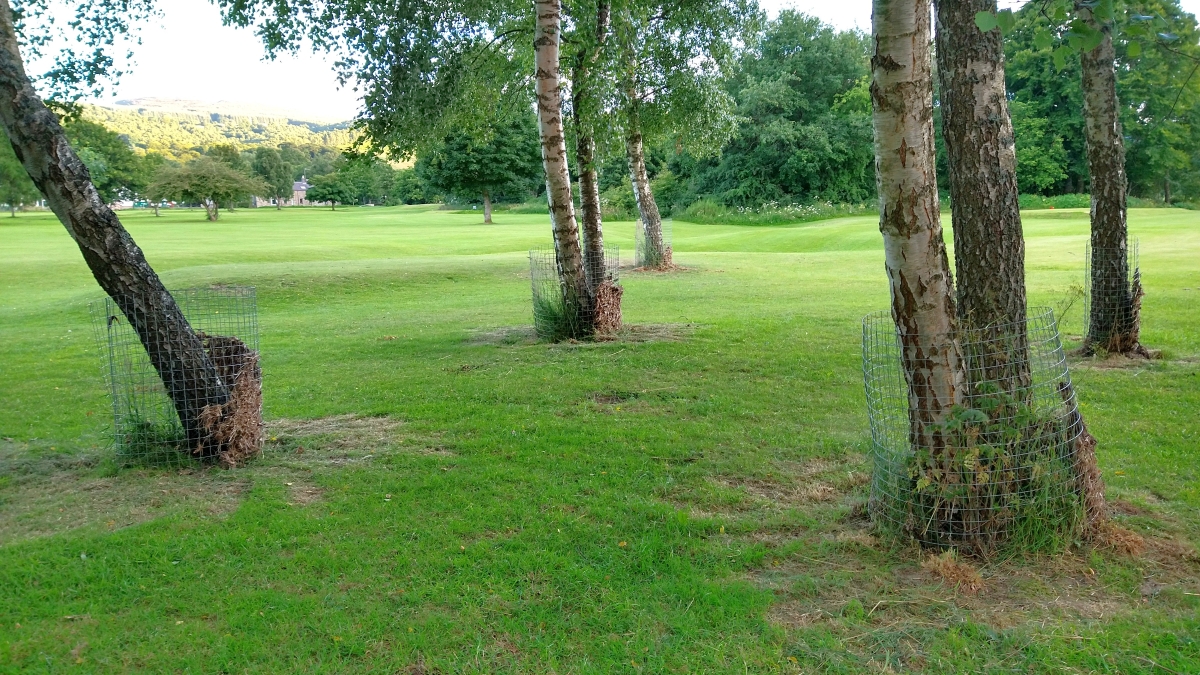
Beaver protection on trees
Mitigation to Manage Dam Building
Please note, this requires a license if the dam is more than 2 weeks old.
- Removing dams
- Notching
- Installing water flow devices
- Fencing Beavers out of vulnerable areas
Managing Beaver Dams
Beaver dams less than two weeks old can be removed without a license. However, this requires land managers to quickly identify when new dams are being established. Automated water level monitors have been used in locations that are likely to be vulnerable to dam building. These devices can send an email or text message when an unexpected rise in water levels is detected and provide land managers with an early warning of dam building activity.
Any work on longer-established dams will require a license application. Apart from dam removal, there are other options to reduce the water level behind a dam without removing it altogether, if this reduces the conflict.
Cutting a notch in the centre of a dam is a relatively simple way of doing this but is often only a short-term measure as Beavers will often repair this obvious ‘damage’.
Water flow devices involve running a concealed pipe through dams, with the inflow set at the desired water level some distance back from the dam and protected with a mesh cage to prevent blockage. These can provide a medium to long-term solution on sites where lowering the water level, rather than removing the dam can be tolerated.
Mitigation to Manage Burrowing or Digging
- Destroying short burrows with no end chamber
- Destroying burrows with chambers (REQUIRES A LICENSE)
- Bank protection, e.g. mesh, planting of fast-growing trees such as willow. (NB Hard engineering works will require SEPA authorisation under the Environmental Authorisations (Scotland) Regulations 2018)
- Infilling channels created by Beavers
- Realignment of flood banks to move them further away watercourses (only likely to be practical as part of a wider flood management scheme).
Translocation
Translocation of Beavers from areas where there are high levels of conflict with land-use has been developed as an alternative to lethal control and in conjunction with a policy of assisting the range expansion of Beavers in Scotland. Translocation is highly regulated and can only be carried out under license.
There are two separate licensing activities involved. Firstly, the recipient site must have a license, and this may take some time as the potential impacts of Beavers on the translocation site needs to be assessed and this requires engagement with local communities and other stakeholders.
A second, separate license will be required to capture the Beavers from the source site and while this license may be applied for by the land manager, the trapping of the Beavers must be carried out by a licensed and experienced contractor to ensure high standards of animal welfare.
As a solution to land-use conflicts, translocation is therefore dependent on there being suitable, licensed recipient sites available. Once Beavers are removed from a site, mitigation measures may be required to reduce the likelihood of the site being re-occupied, otherwise it will be a temporary solution only.
Lethal Control
Lethal control is considered a measure of last resort as the Scottish Beaver strategy favours translocation where possible. However, lethal control remains an option where mitigation measures have not been or are known not to be effective and there is no suitable location licensed for translocation. Licenses are more likely to be granted where prime agricultural land is affected and can be issued for a maximum period of two years, following which a new license must be sought. Shooting is the main method of control and must use accredited controllers to ensure that it is carried out humanely. Normally, lethal control aims to remove the whole family group but is not usually allowed during the period when there are dependent kits (1st April – 16th August) unless there is an imminent threat to public health and safety or serious damage to property.
As with translocation, lethal control creates a vacuum effect, which means that sites are likely to be re-occupied unless mitigation measures can be used to deter Beavers.
Support Available to Land Managers
Land managers can access advice on management of Beavers and the licensing process at a national level from NatureScot (beavers@nature.scot). In addition, the Cairngorms National Park authority also employs a Beaver Project manager with a remit that includes engagement with land managers to help address conflicts, including assistance with license applications.
The Beaver Trust, which is an independent charity, also provides advice and support with mitigation measures and license applications.
There is a national mitigation scheme that provides funding for some measures to address Beaver conflicts, which may include:
- Tree protection
- Flow devices
- Water level monitors
- Deterrent fencing
- Translocation
The Cairngorms National Park Beaver Project currently provides support above and beyond the national mitigation scheme including preparation of license applications, and financial support for the costs of dam removal, flood bank repair and even lethal control as a last resort.
Other funding streams including the Agri-Environment Climate Scheme, Forestry Grant Scheme and Nature Restoration Fund may provide support for habitat restoration projects that help reduce the conflicts between Beavers and land management.
Paul Chapman, SAC Consulting





Sign up to the FAS newsletter
Receive updates on news, events and publications from Scotland’s Farm Advisory Service