
Business and Policy August 2026 – Arable
For much of the past year grain markets have struggled to find any real direction. Large global harvests, comfortable stocks and generally favourable growing conditions across the world’s major exporting regions have kept buyers relaxed, leaving prices under pressure and many growers questioning what it would take to generate a meaningful recovery. Over the past few weeks, however, the market outlook has changed quite dramatically.
Market Overview
Whilst the current firming of prices is certainly welcome, the important question is whether this is simply another weather rally or the start of a more sustained improvement in grain markets. The answer lies in a combination of factors rather than one single event. Escalating geopolitical tensions, deteriorating crop prospects across Europe, tightening global maize supplies and firmer energy markets have all arrived at the same time, forcing traders to reassess the level of risk within the global grain balance sheet. For much of the past twelve months the market has largely ignored bullish news, but sentiment now appears to be changing.
Conflict in the Black Sea
The most significant driver has undoubtedly been the escalating conflict in the Black Sea region. Throughout much of the war, grain exports continued to move despite repeated disruption, allowing world markets to remain relatively well supplied. That confidence is now being tested. Ukraine has intensified attacks on Russian infrastructure around the Sea of Azov, an area believed to handle between 25-30% of Russian wheat exports, while Russia has responded with further strikes on Ukraine’s grain terminals around Odesa. Ukrainian farming organisations estimate that around 30% of the country’s export capacity has now been affected, with several deep-water ports either suspending or severely restricting loading operations.
Importantly, this is not currently a production issue. Both Russia and Ukraine are expected to harvest respectable crops this season. Instead, the concern is whether those crops can reach international markets. Domestic grain prices in Ukraine have weakened as grain backs up within the country, while international prices have moved in the opposite direction as buyers begin to factor supply risks into the market. Should these logistical problems persist, demand for European grain is likely to increase, providing further support to UK prices.
Hot Weather
Weather has become the second major driver of the recent rally. Much of Western Europe has endured one of its driest springs and early summers for many years. Rainfall across France, Belgium, western Germany and southern parts of the UK has been well below average since March, with some areas receiving little more than 25% of normal rainfall during the past three months. Several periods of extreme heat, with temperatures exceeding 40°C in southern Europe, have arrived during critical stages of crop development, reducing yield potential across a wide range of crops.
As the French wheat harvest nears completion, analysts at Argus estimate the wheat crop – excluding durum – at 30.8 million tonnes. That represents a fall of 8% compared with 2025 and leaves production 6% below the five-year average. Meanwhile, as harvesting gathers pace in Germany, the farm co-operatives’ association DRV has reduced its wheat production forecast by 0.7 million tonnes to 21.9 million tonnes, around 5% lower than last season. DRV has also revised down its outlook for other cereals, forecasting a 5% year-on-year decline in barley production and a 10% reduction in oat output.
The biggest weather concern, however, may yet prove to be maize rather than wheat. Large areas of the European crop experienced heat and moisture stress during pollination, with only 41% of the French maize crop currently rated good or excellent. The USDA has consequently reduced its estimate of the EU maize harvest by 3.7 million tonnes to 53.8 million tonnes, while the International Grains Council has also lowered its global production forecast. Lower maize production inevitably supports wheat and barley markets as feed manufacturers increasingly substitute maize with other cereals.
Further support has come from the latest USDA World Agricultural Supply and Demand Estimates (WASDE), which point towards steadily tightening global maize stocks. World ending stocks are now forecast at around 275 million tonnes, the lowest level for thirteen years, while stocks held by the major exporting countries are expected to fall to just 4.8% of annual consumption, below the ten-year average of 5.2%. These are not critically tight supplies, but markets rarely wait for shortages to develop before reacting. Instead, traders are beginning to build more weather and supply risk back into prices.
Energy Costs
Energy markets have also played their part. Renewed tensions across the Middle East have strengthened crude oil prices, providing support to vegetable oils and, in turn, the wider oilseed complex. MATIF November rapeseed futures have climbed above €558/t, their highest level since late 2024, while soybean oil, palm oil and canola have all moved higher. Continued Chinese buying and forecasts suggesting another El Niño weather pattern later this year have added further uncertainty and helped reinforce the stronger tone across agricultural commodity markets.
Price Rally
From a UK perspective, supply concerns are now beginning to feed through into domestic prices. November 2026 UK feed wheat futures have increased from £177.25/t at the beginning of July to £199.00/t at the time of writing on the 28th July, an 11% increase and an increase on the previous high of £190/t in early May associated with the Iran conflict.
UK Feed Wheat Futures Aug’25 – July’26
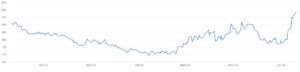
Source : ICE Futures Europe
Current estimates suggest the UK wheat crop may total around 13.5 million tonnes, roughly 1.5 million tonnes below earlier expectations, while the barley crop also appears likely to be smaller than last year. As supplies tighten, basis levels have strengthened, the traditional discount of feed barley to feed wheat has narrowed considerably and quality premiums are beginning to return. Reports of malting barley premiums approaching £15/t are now emerging, something largely absent over recent seasons.
Harvest reports remain mixed. Winter barley yields have generally been respectable, although quality has proved variable, with concerns over screenings and grain retention likely to increase the proportion entering feed markets. Spot prices continue to come under pressure from harvest movement and limited export demand, but deferred values remain much firmer, reflecting expectations of tighter supplies later in the season.
For Scottish growers, the picture is rather different from much of mainland Europe. Although the prolonged dry spring reduced yield potential in some eastern areas and on lighter soils, crops have largely escaped the extreme temperatures experienced across France and Germany. Attention will now turn firmly towards the wheat and spring barley harvest, where, for the latter, grain nitrogen content and screenings are likely to prove every bit as important as yield in determining crop value. Should European malting barley production continue to disappoint, Scottish growers producing premium quality grain may find themselves well placed to benefit from stronger demand and improving premiums later in the marketing season.
Mark Bowsher-Gibbs, mark.bowsher-gibbs@sac.co.uk
Indicative grain prices on 22nd July, 2026 (Source: SAC//United oilseeds/AHDB)
| £ per tonne | July‘26 | Nov ‘26 | May ‘27 | Nov ‘27 | |||
|---|---|---|---|---|---|---|---|
| Wheat | Ex farm July. Nov’26/May’27/Nov‘27 Futures | 180 | 202 | 210 | 199 | ||
| Feed Barley | Ex Scot July | 156 | - | ||||
| Beans | Ex farm July | 215 | - | ||||
| Feed Oats | Ex farm July | 123 | |||||
| Oilseed Rape | Del Montrose | 428 | |||||










Sign up to the FAS newsletter
Receive updates on news, events and publications from Scotland’s Farm Advisory Service