
Beavers and Water Resilience: A Natural Ally for Arable Systems?
Heatwaves, drought and water scarcity are no longer occasional challenges for arable farmers: they are becoming defining features of the growing season. The UK has already experienced multiple heatwaves in 2026, with drought conditions affecting large areas and wildfires reported across Scotland and Europe. For growers, the implications are clear: reduced yields, tighter margins, and increasing pressure to build resilience into farming systems. Against this backdrop, attention is turning to solutions that can help stabilise water availability across the farmed landscape. One such solution that is increasingly visible across Scotland is the Eurasian beaver.
Engineering Water Back into the Landscape
Beavers are often described as ‘ecosystem engineers’ because of their ability to rapidly modify local hydrology through dam building and wetland creation. Evidence from Scotland and wider Europe shows that beaver dams increase in-stream water storage, raise groundwater levels, and extend water residence time. In practical terms, this means more water is retained within the landscape for longer periods. During dry spells, this stored water can help sustain base flows in rivers and burns and soil moisture, reducing the severity of drought conditions for water users and adjacent landholdings.
For arable farms reliant on consistent soil moisture, particularly those on lighter soils, these changes could be significant. Improved groundwater recharge and soil moisture retention may help buffer crops against increasingly erratic rainfall patterns. At the same time, beaver dams act as ‘leaky barriers’, slowing the movement of water during heavy rainfall events. While they do not eliminate flooding (sometimes increasing it locally – more on that below), they can delay and reduce peak flows downstream. In catchments prone to flash flooding, this moderation effect may provide wider benefits at a landscape scale.
Biodiversity and Pollinator Gains
Beyond water management, beaver activity brings a suite of co-benefits that align with the direction of travel in agricultural policy and support schemes. By creating wetlands and opening up riparian habitats, beavers increase habitat diversity and ecological complexity. Selective tree felling and browsing allow more light to reach the ground, encouraging the development of diverse understorey vegetation and supporting a wider range of plant and insect species. This, in turn, benefits birds, bats and other wildlife.
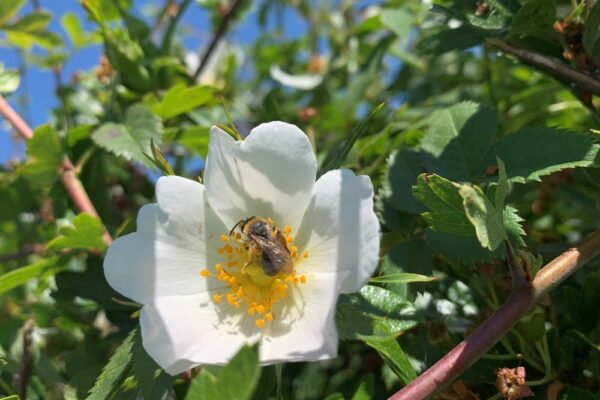
Recent research also highlights gains for pollinators. Beaver-created wetlands have been shown to increase hoverfly and butterfly abundance and diversify floral resources compared to some human-made ponds. For arable systems, where pollination services are increasingly recognised as valuable natural capital, these enhancements could contribute to both productivity and environmental outcomes (Cook et al, 2025. Beaver wetlands create a buzz and a flutter for pollinators).
Understanding the Trade-Offs
For arable farmers, the key question is not whether beavers are good or bad, but where and how they can be part of a resilient farming system. Farms with less productive riparian areas, existing buffer strips, or marginal land may be well placed to accommodate beaver activity. In these locations, the trade-off between a small loss of land and wider water and biodiversity benefits may be favourable.
Integrating beavers into farmed landscapes is not without challenges. The same processes that deliver benefits can also create localised impacts that need careful management. Flooding behind beaver dams can lead to the loss of productive land, particularly in low-lying areas adjacent to watercourses. While this flooding can enhance groundwater recharge and soil moisture, it may be unacceptable where it affects high-value cropping land or infrastructure.
In some cases, tree felling along water margins may conflict with existing land management objectives due to risk of drainage disruption, blocked culverts, or impacts on field access. This means that the net effect depends heavily on site-specific conditions, including topography, soil type and land use.
Catchment-scale thinking is also essential. The benefits of increased water storage, improved base flows and moderated flood peaks are often realised beyond the immediate site of beaver activity. Collaboration between neighbouring farms and land managers may therefore be required to unlock the full value of beaver-led restoration.
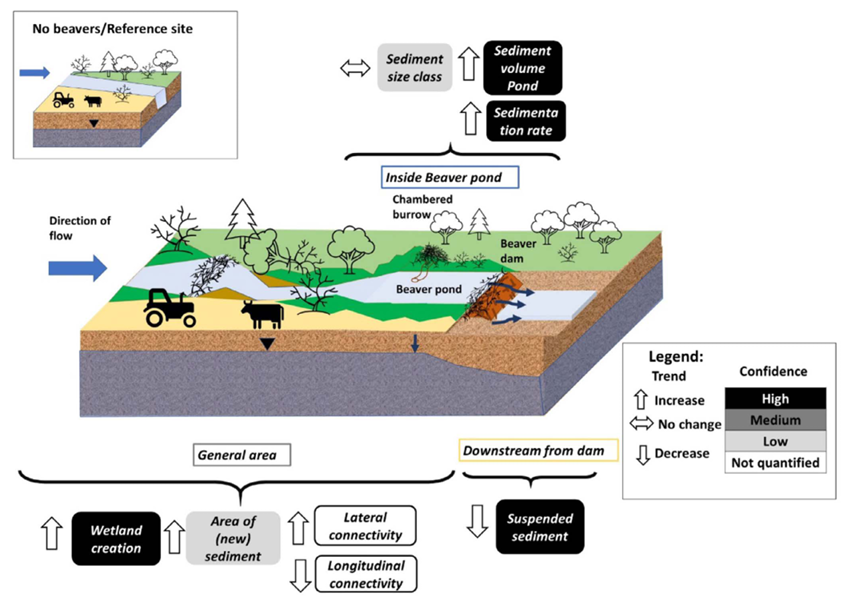
Figure: Overview of changes in physical processes related to water quantity due to beaver activity, with confidence levels. From Geris J, Dimitrova-Petrova K, and Wilkinson M (2022) Establishing the potential influence of beaver activity on the functioning of rivers and streams and water resource management in Scotland: Report for Centre of Expertise for Waters CREW.
Support, Guidance and Practical Management
Beavers are now well established in Scotland, and their range is expanding through both natural spread and managed translocation. As a result, more farmers are encountering them, and more support is becoming available. Resources from the Farm Advisory Service and NatureScot provide practical guidance on beaver management, including mitigation measures such as flow devices, fencing, and licensed interventions where necessary. Seeking professional advice is recommended when addressing conflicts, particularly to ensure compliance with environmental regulations and animal welfare considerations.
As climate pressures intensify, building water resilience will be central to the future of arable farming in Scotland and across the UK. For some farms, particularly those with suitable habitats, beaver reintroduction or accommodation could form part of a broader strategy to manage water more effectively, enhance biodiversity, and future-proof the business.
Brady Stevens, SAC Consulting
Related FAS Resources:
Beaver Accommodation & Mitigation
Beavers: Translocation & Licencing
Thrill of the Hill Podcast – A Damming Conclusion? Parts 1 and 2
Other resources:
NatureScot: Beavers in Scotland
NatureScot: Scotland’s Beaver Strategy
Geris J, Dimitrova-Petrova K, and Wilkinson M (2022) Establishing the potential influence of beaver activity on the functioning of rivers and streams and water resource management in Scotland: Report for Centre of Expertise for Waters CREW


Sign up to the FAS newsletter
Receive updates on news, events and publications from Scotland’s Farm Advisory Service