
Business and Policy May 2026 – Milk
Milk production data
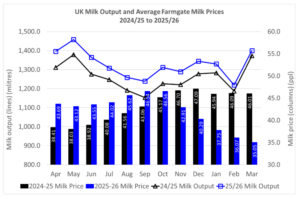
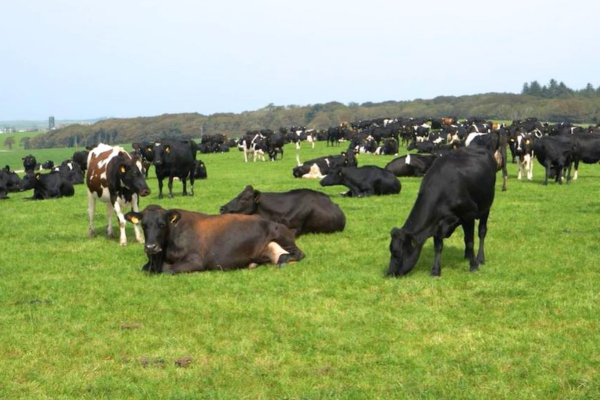
Milk production continues to rise, with GB milk deliveries increasing by 0.6% when compared to the week ending 25th April. However, they are running slightly below the same week last year by approximately 0.02m litres. The weather has improved at long last, with drier, warmer days allowing for cows to be turned out to grass and for many to look towards first cut silage. The latest data from AHDB estimates the GB milk volume for March 2026 at 1,132mlitres, 16m litres more than the previous March. Daily production is currently 37.92mlitres for the week ending 18th April, 0.6% more than the previous week and 1.0% above the same week last year.
Farm-gate prices
The Defra farm-gate milk price for March was 35.05ppl, down 0.86ppl from the February price (2.4%) and 22% less than 12 months ago. At the time of writing, Müller has served a number of businesses in Scotland and North Wales with 12 months notice, with their last collections scheduled for 31st March 2027. The Agricultural Director at Müller explained that changes to the supply base were made to maintain a sustainable balance between supply and demand for dairy commodities. Grahams, Müller and First Milk have all announced a price hold for May 2026.
| Milk Prices for Oct/Nov 2025 Scotland | Standard Ltr ppl | ||
|---|---|---|---|
| First Milk2 | May | 30.75 | |
| Müller - Müller Direct - Scotland 1, 3 | May | 34.5 | |
| Grahams1 | May | 34.5 | |
| Arla Farmers2 | Apr | 34.07 | |
| Lactalis / Fresh Milk Co.2 | Apr | 31.57 | |
| 1 | Liquid standard litre – annual av. milk price based on supplying 1m litres at 4.0% butterfat, 3.3% protein, bactoscan = 30, SCC = 200 unless stated otherwise. | ||
| 2 | Manufacturing standard litre - annual av. milk price based on supplying 1m litres at 4.2% butterfat, 3.4% protein, bactoscan = 30, SCC = 200 unless stated otherwise. | ||
| 3 | Includes 1.00ppl Müller Direct Premium. Haulage deducted depending on band for 2023 vs 2021 litres, ranging from -0.25 to -0.85ppl. | ||
Dairy commodities & market indicators
The tentative recovery seen in the dairy markets last month has stalled under the pressure of continuing large milk volumes. The conflict in Iran has also undermined confidence and disrupted some export channels, eroding value in the fats markets.
Skimmed Milk Powder
Skimmed milk powder has been the strongest performer relative to fats, with prices rising by £20 to £2,360. Prices softened slightly in recent weeks but found renewed support following a strong GDT auction. Demand from Southeast Asia/Middle East has been constrained by logistical challenges and elevated freight costs.
Cheddar
Cheddar prices have eased after the gains made in March, with the expected upswing in prices failing to materialise. The average price for mild Cheddar stood at £2,980, down 3% from the previous period. Demand is reported to be weak, as many buyers have already covered their positions, while sellers remain reluctant to sell much below the £3,000/t level.
Cream
Bulk cream prices have lost much of the value gained during the March uplift, with the market appearing incredibly volatile. Ongoing conflict has fuelled buyer uncertainty and dampened demand. Over the period, prices fell sharply from around £1.75/kg to £1.05/kg, bringing the monthly average to £1,238/tonne. UK prices are reported to be firmer than those on the continent.
Butter
As with the cream market, butter has experienced significant volatility and has given back all the gains made in the first quarter of the year. The market is now averaging £3,540/t, the lowest level since September 2021. Buyers are adopting a more cautious stance, while storage levels across Europe are reported to be high. A reduction was seen in the AMPE indicator price for April, due to declines in butter and SMP. This also led to a 0.47ppl drop in the Milk Market Value indicator (34.91ppl for April), which suggests the average market value of milk, based on how it is typically processed in the UK.
| UK dairy commodity prices (£/tonne) | April 2026 | March 2026 | October 2025 |
|---|---|---|---|
| Butter | 3,540 | 3,980 | 4,680 |
| Skim Milk Powder (SMP) | 2,360 | 2,340 | 1,820 |
| Bulk Cream | 1,238 | 1,556 | 1,986 |
| Mild Cheddar | 2,980 | 3,080 | 3,110 |
| UK milk price equivalents (ppl) | April 2026 | March 2026 | October 2025 |
|---|---|---|---|
| AMPE | 35.25 | 37.35 | 35.87 |
| MCVE | 34.82 | 34.89 | 34.64 |
Bluetongue Virus (BTV) control strategy update
Since Bluetongue arrived in England in 2023, BVT-3 has spread to all parts of the UK except Scotland. As temperatures rise and midge activity heightens, the government has implemented stricter livestock movement controls on bluetongue susceptible animals from restricted zones in an attempt to retain BTV-free status in Scotland for as long as possible.
From 1st June 2026 – 9th September 2026:
- Animals moving to Scotland must have their disease status confirmed by means of a PCR test with negative results received prior to movement.
- Cattle fully vaccinated with Bultavo-3 are exempt from PCR testing.
- Animals from Scotland attending a show or sale in a Restricted Zone can return to Scotland without a test, as long as they spend no longer than four days in the Restricted Zone.
- Slaughterhouses must be designated, and movements direct to abattoir premises after leaving a Restricted Zone.
Pre-cutting grass analysis
It is advisable to test grass around one week before the planned cutting date to measure free nitrates, as well as sugar and dry matter(DM) levels. To reduce the risk of poor fermentation, nitrate levels should be below 1000mg/kg on a fresh weight basis. Dry matter and sugar content will vary with weather conditions and time of day, ideally grass should be around 18% DM for cutting and sugars >15% DM or >3% fresh. Under favourable conditions, grass DM can increase by approximately 1% per hour of wilting. However, care should be taken to avoid over-wilting, as this can lead to nutrient losses. The target DM at ensiling is around 30% for clamp silage, with higher levels suitable for baled silage, up to a maximum of 45% DM.
Keira Sannachan, Keira.Sannachan@sac.co.uk


Sign up to the FAS newsletter
Receive updates on news, events and publications from Scotland’s Farm Advisory Service