
Business and Policy September 2026 – Beef
Finished beef prices in Scotland have rebounded significantly since mid-June, with prices rising throughout August following a seasonal reduction in slaughter availability, reflecting the dominance of spring calving. While still down over 3% on Easter and trailing 2025 levels by 6%, prices are up 25% compared to 2024. AHDB reported that the GB all-prime cattle average reached 608p/kg in the week ending 8 August, with steers averaging 610p/kg and heifers 609p/kg, with prices edging upwards in the subsequent weeks. For the week ending 22 August, R4L steers achieved 626p/kg dwt (+6p w/e August 1). At the time of writing (27/08), prices remain stable sitting around 625/626p/kg dwt with Angus sired cattle achieving 635/640p/kg dwt.
The recovery is positive for finishers, although prices remain below the exceptional levels seen during the first half of 2025. It is anticipated that once the English and Welsh schools return in September, demand for beef will increase.
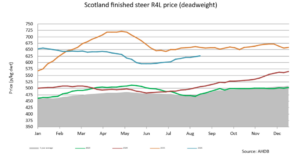
Increased slaughter numbers suggest that some finishers are bringing cattle forward earlier, partly in response to concerns about forage availability following a difficult summer south of the border. AHDB reported GB estimated prime cattle slaughtering had risen 500 head week-on-week, finishing the week ending 15 August at 32,700 head (+2,300 head compared to the same week in 2025). The continued drought in England could lead to some volatility in seasonal supplies at GB level.
Cattle supplies are expected to be relatively firmer in Scotland in 2026 due to increased numbers on farm compared to 2025. Recent data from QMS shows numbers of males and beef-sired females aged between 12 and 30 months were 1.6% higher year-on-year, while cattle aged 18–24 months increased by 2%. This suggests that Scotland may have more finished cattle available during the second half of the year. While this will no doubt be a welcome development for processors looking to maintain consistent supply, it remains a balancing act with demand and what additional cattle will do for finished prices.
Questions are being asked about whether the UK will become an outlet for Brazilian beef banned from the EU? From early September it is feared that the prospect of cheaper beef from Brazil will tempt our new Prime Minister into accepting Brazilian beef into the UK to reduce the cost of living.
Cow prices remain strong reflecting the demand for manufacturing beef and a smaller herd, however, prices have dropped back in recent weeks, following a rise in deadweight throughput at GB level. The increase in the number of cows coming forward is attributed to tight grazing stocks and a lack of forage in some areas particularly in England and those areas worst affected by drought.
Cull cow prices rose significantly in mid-September last year, coinciding with ‘Back to School,’ but will this happen again this year? With high numbers of cows having been slaughtered in recent weeks, it is more likely that a potential ‘supply gap’ could appear during mid-October and lift prices.
Store cattle continue to trade strongly and are now marginally above the highs recorded in 2025. Prices remain historically high, underpinned by lower throughput at Scottish auctions, a reflection of the decline in suckler cow numbers coupled with dairy beef cattle being traded using integrated supply chain contracts. Elevated store prices continue to give confidence to producers, and with a mostly favourable haymaking and harvest season having reportedly left Scotland well supplied with both hay and straw, as we move towards the autumn suckled calf sales it is anticipated that prices will remain high. Store cattle prices continue however to increase pressure on finisher margins. Suckled calf producers will hope that confidence ringside remains as if finished prices were to drop and remain low, this could then filter through to the store ring at the autumn sales.
Sarah Balfour, sarah.balfour@sac.co.uk
Scotland prime cattle prices (p/kg dwt) (Source: drawn from AHDB and IAAS data)
| Week Ending | R4L Steers (p/kg dwt) | -U4L Steers | Young Bulls -U3L | Cull cows | ||||||
|---|---|---|---|---|---|---|---|---|---|---|
| Change on week | Diff over North Eng. | Change on week | Diff over North Eng. | Diff over North Eng. | R4L | -O3L | ||||
| 1-Aug-26 | 620.3 | 4.2 | 3.9 | 614.3 | 5.4 | -2.1 | 611.6 | 3.9 | 559 | 526.3 |
| 8-Aug-26 | 619.9 | -0.4 | 5 | 616.3 | 2 | 1.4 | 614.6 | 9.2 | 555 | 520.3 |
| 15-Aug-26 | 623.2 | 3.3 | 5.8 | 620.4 | 4.1 | 3 | 615.5 | 12.2 | 540.5 | 514.4 |
| 22-Aug-26 | 626.4 | 3.2 | 1.4 | 622.8 | 2.4 | 6.8 | 618.7 | 14.5 | 531.1 | 498.9 |


Sign up to the FAS newsletter
Receive updates on news, events and publications from Scotland’s Farm Advisory Service