
Managing Wildfire Risk
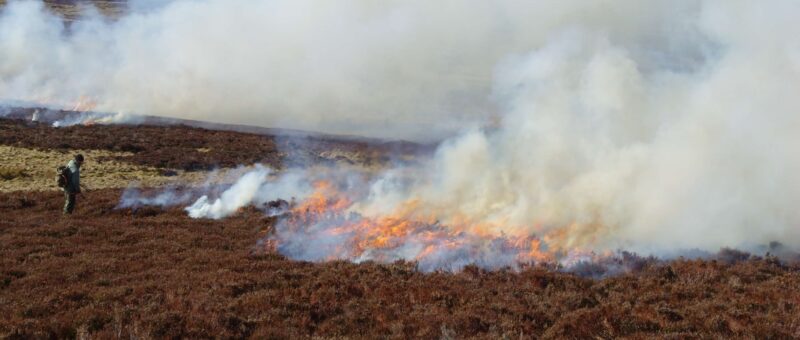
This publication looks at risk factors for wildfires, land management options for reducing the risk of wildfire and considers different approaches for different areas and the role of controlled burning and firebreaks.
Wildfires were very much in the news in 2026, with the devastating blaze in the Cairngorms burning more than 30km2 of the Abernethy and Glenmore National Nature Reserves. This comes after the largest wildfire ever recorded in Scotland, at Dava Moor in 2025, which burnt nearly 100km2. Prior to 2019, there were no recorded wildfires of greater than 20km2, but there have been six such fires since then.
This has led to much discussion about how land is managed and how the fuel load in the vegetation contributes to fire risk and intensity, much of this focusing on ‘rewilding’ with competing claims that this either increases or reduces the wildfire risk. As with so many land management issues, the reality is more complex and it is important to understand the many factors that are involved, to reduce the risk of such fires in future.
Risk Factors For Wildfire
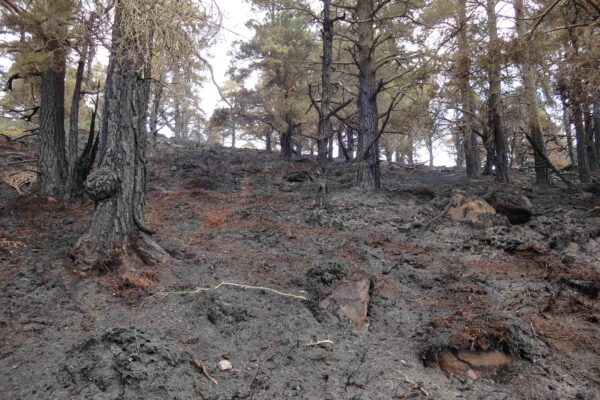
Natural wildfires caused by lightning strikes or spontaneous combustion in extreme heat are very rare in Scotland and the ignition of wildfire almost always has a human cause, which could be a campfire, barbecue, discarded cigarette or glass bottle, land management burns that have got out of control or sometimes deliberate fire-raising. This means that the risk of wildfire tends to be greatest in areas with more human access.
Once ignited, the extent and intensity of the fire depend on the fuel load available to drive it forwards. While many types of vegetation can provide fuel for fires, including gorse, trees and mosses, the primary fuel in most Scottish wildfires is usually heather (Calluna vulgaris), or purple moor-grass (Molinia caerulea). Active crown fires, where the burning canopy of trees is the primary fuel driving the fire forward, and which are much faster moving and dangerous than surface fires, are fortunately very rare in Scotland at present. However, trees are often ignited and consumed by surface fires of burning heather or grass.
Molinia fires tend to predominate in the wetter west of Scotland where this grass can dominate the landscape. In dry spring weather, the dead, straw-like leaves of the previous year’s growth burn readily. Molinia is relatively unpalatable to sheep and deer and high stocking rates in the past have selectively grazed out other plants and allowed Molinia to become dominant.
In the drier, eastern parts of Scotland, heather fires are more common and although they are also most common in the spring, before the new season’s fresh vegetation growth has started, recent large fires have occurred in summer. In the absence of grazing and burning, heather can grow tall and dense and result in an increased fuel load that can result in hotter, faster moving, and more destructive fires.
In both heather and Molinia fires, there is a risk that the peat layer in the underlying soils can catch fire and this can then become very difficult to control, often smouldering and re-igniting for many weeks after the main surface fire has stopped.
Weather and climate are the other key risk factors for wildfires. The 2026 Cairngorms wildfire appeared to be coming under control after about a week, but an increase in wind speed and change of direction caused it to flare up and burn as large an area again.
With devastating wildfires also affecting England, Wales, France, Spain, Belgium and Canada during the summer, it is becoming hard to ignore the impact that climate change is having, with longer spells of higher temperatures drying out vegetation more quickly and making it much more likely to catch light and spread rapidly.
Managed Moorland or Rewilding?
In the face of the warming climate, it is not possible to remove the risk of wildfire altogether, but it should be possible to manage the land in ways that reduce the risk, particularly of very large, damaging fires. In some ways, the conflicting claims about the merits of managed moorland versus rewilding are both correct and can both be used to reduce risk in different situations.
Open moorland below the natural treeline is a largely man-made habitat maintained by grazing and/or controlled burning and can be a valuable habitat for a range of wildlife, particularly when heather-dominated. Continuing appropriate grazing or burning can reduce the fuel load in this habitat and reduce the risk of uncontrollable fires. However, in the wetter west of Scotland, burning and overgrazing by sheep or deer can entrench Molinia’s dominance in the landscape by removing competing plants and result in a habitat that is both fire-prone and of limited conservation or grazing value.
At the same time, restoring woodland cover and rewetting peat bogs and other wetlands ultimately creates a landscape that is more resilient to wildfires. The shade of mature woodland tends to limit the growth of flammable ground vegetation such as heather and grasses, while wet ground is less prone to drying out. However, during the process of re-establishing these habitats, there is a period of many years where the reduced grazing and burning that is necessary to allow trees and woodland to regenerate can also result in an increased fuel load of heather and grasses. In other words, the potential for a long-term wildfire-resilient landscape comes with an increased short to medium term risk of more intense wildfires.
Different Approaches in Different Areas
The most appropriate strategy for any site will therefore depend on the long term aims for management of the landscape.
Heather-dominated Moorland
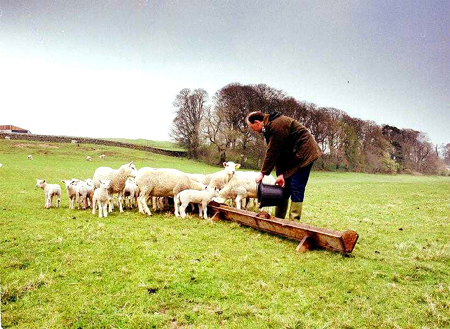
If an area is open heather-dominated moorland and likely to remain so for the medium to long term, a suitable level of grazing and/or controlled burning or cutting, is likely to be necessary to prevent heather becoming rank and creating a build-up of fuel load. It is usually important to ensure that grazing is spread relatively evenly across the area as it is not uncommon to see heather moorland with heavy grazing close to the inbye fields but low grazing resulting in a high fuel load on the more remote areas.
Molinia-dominated Moorland
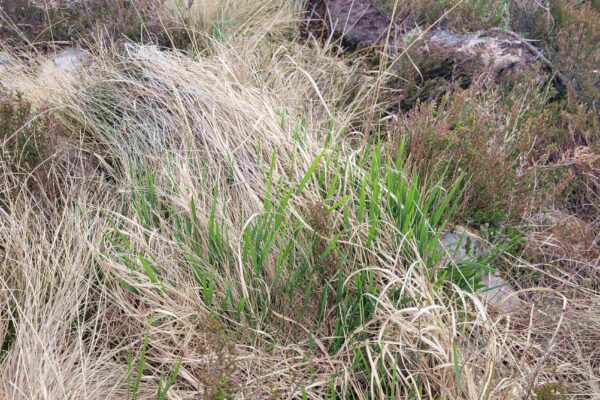
Managed burning is likely to entrench Molinia dominance and in these areas, reducing Molinia dominance may require a different approach, such as summer cattle grazing and reducing winter sheep grazing. Being less selective grazers, cattle are more likely to graze Molinia than sheep or deer, and the advent of GPS collars for cattle is starting to make hill grazing by cattle a more practical proposition than it has been for many years. Cutting is also an option for Molinia dominated areas, if they aren’t too wet for machinery.
Peatland
On areas with peat greater than 40cm deep, restoration projects that block artificial ditches and reprofile eroded gullies can help increase their resilience to wildfire. On flatter and gently sloping areas, this is partly a result of making the ground wetter, but it is also about reducing the vigour of heather, which grows less well in waterlogged ground. It’s important to note that the new muirburn licensing system can allow controlled muirburn on peatland to reduce wildfire risk. This is most likely to be applicable as a one-off operation on peatlands carrying a high fuel load of heather due to past drainage, and where restoration work will make this less likely to recur in future.
Regenerating Woodland
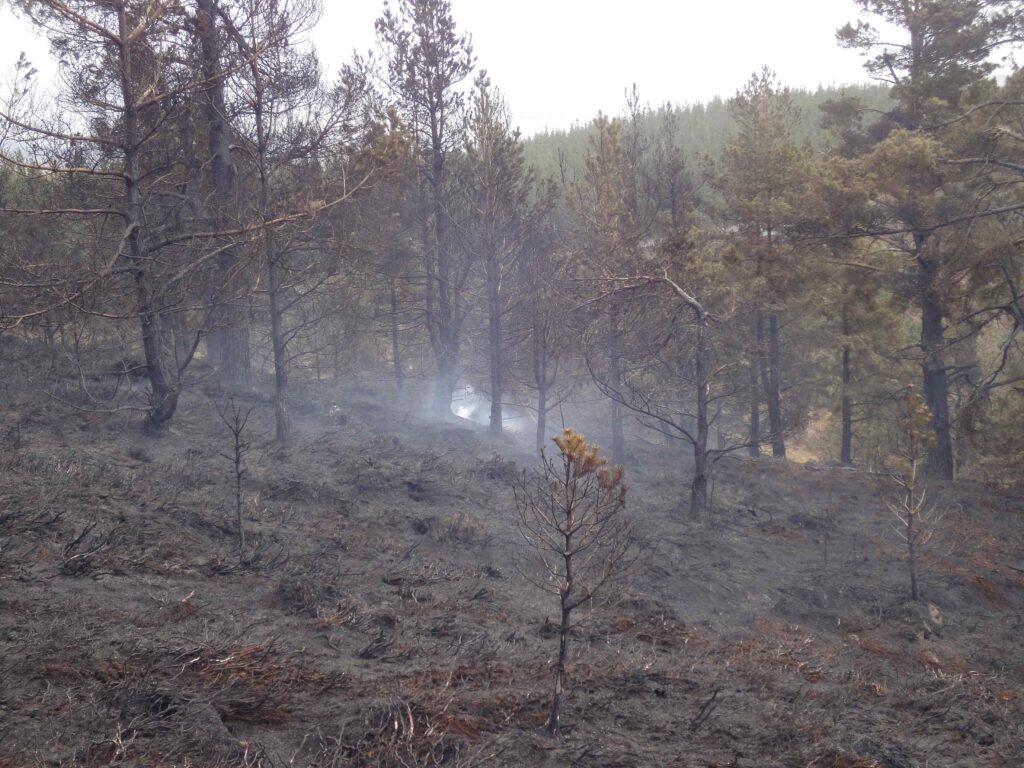
This is probably the most challenging situation to manage fire risk during the establishment phase. Grazing, controlled burning or cutting can be used to control the ground vegetation fuel load, but it can be difficult to do this without also affecting the regenerating trees that will eventually form the woodland, particularly where regeneration is vigorous. In these situations, the creation of firebreaks may be the only option, providing lines of defence where there is more chance of stopping the uncontrolled spread of a fire once it has broken out.
Controlled Burning and Firebreaks
Controlled burning is now regulated by the Wildlife Management and Muirburn (Scotland) Act 2024 and those carrying it out must be suitably trained and have a license to undertake muirburn on a site. The Act sets out the purposes for which a license may be issued, which includes preventing, or reducing the risk of, wildfire on both peatland and non-peatland sites. While the legislation is intended to prevent poorly managed muirburn, which can damage upland habitats and can itself be a cause of wildfires, it recognises the role of well-managed muirburn in maintaining upland habitats.
One issue that is often overlooked in discussions about the use of muirburn is that in many areas of Scotland, reduced muirburn and increased fuel loads are not just associated with rewilding, but instead result from economic and demographic pressures, with fewer people available to safely carry out muirburn in some areas. Where resources for vegetation management are limited, it may make sense for those resources to focus on creating and maintaining firebreaks.
A general rule of thumb for firebreaks is that they should be at least 10 metres wide and preferably at least 20 metres wide and can be created by cutting or controlled burning of strips. They will need to be maintained by cutting or burning every few years and even then, they may not necessarily stop a fire, but will hopefully slow the fire sufficiently to allow it to be contained.
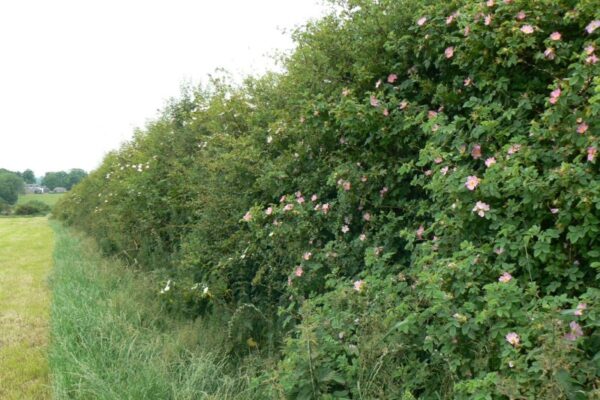
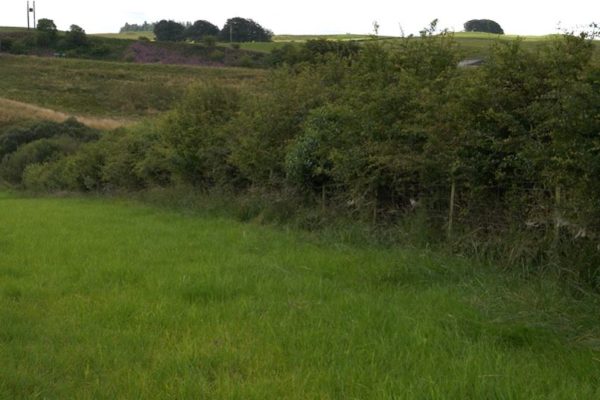
More permanent natural firebreaks can be formed by wetlands or strips of woodland, particularly broad-leaved trees such as birch, which are less flammable than conifers. When planning the layout of managed firebreaks, linking to natural firebreaks and placing them alongside other landscape features such as watercourses, tracks and roads may increase their effectiveness. Where there is regular human access, managing the vegetation alongside tracks and paths, even if it is a narrow strip of only a few metres, can help to reduce the risk of fires getting started in these high-risk areas.
Summary
- On heather moorland, grazing and controlled rotational burning or cutting can help reduce fuel loads.
- On moorlands dominated by Molinia (purple moor-grass), cattle grazing can help reduce the dominance of this fire-prone grass and encourage more resilient vegetation.
- On peatland deeper than 40cm, peatland restoration can reduce fire risk by re-wetting the ground and reducing heather vigour, although some muirburn may initially be required where rank heather is already established on drained deep peat.
- On woodland regeneration or planting sites, reducing fuel loads can be difficult during the establishment phase when trees are small, but firebreaks may help contain any fires that do break out.
- Firebreaks may be the best option for focusing limited resources on open moorland habitats.
- Where human access is high, focusing management on areas alongside paths and tracks may reduce the risk of fires getting started.
Although we can’t prevent wildfires altogether, undertaking appropriate management suited to the habitats on individual landholdings can help to reduce this risk and should form part of a wider strategy alongside public education and provision of effective firefighting resources for wildfires at a national level.
Further Resources
Paul Chapman, SAC Consulting









Sign up to the FAS newsletter
Receive updates on news, events and publications from Scotland’s Farm Advisory Service