
Working Together Across a Catchment: The Upper Forth Farmer and Land Manager Network
Across Scotland, farmers, crofters and land managers are increasingly working together in groups organised around shared river catchments. Usually convened by a rivers trust or catchment partnership, each group has a facilitator who organises farm walks, shares knowledge between members, and helps them access funding. This case study looks at one such group: the Upper Forth Farmer and Land Manager Network.
These networks have emerged in response to real change on the ground. Flooding and drought are becoming more frequent and severe, and neither can be managed effectively by one farm in isolation. Agricultural support is shifting away from rewarding production alone towards paying for outcomes such as water quality and biodiversity. And private investment in nature-based solutions is increasingly directed at organised groups of land managers rather than individual holdings.
Underpinning all of this is a simple reality: farming alone is hard. Weather, markets, labour and costs are all unpredictable, and few businesses have the capacity to tackle them single-handed. Working as a group lets members pool knowledge, pick up new practices faster, and carry more weight when applying for grants and investment. It also means that individual actions, such as planting trees or creating a wetland, join up to deliver measurable gains in water quality, flood resilience and habitat connectivity across the whole catchment.
Crucially, when shocks do occur, whether a flood, a poor season or a change in policy, a network of farmers who already know and trust each other is far better placed to respond than any business acting alone. None of this is about farming less. It is about keeping farms productive while looking after the land and water they depend on.
The Catchment
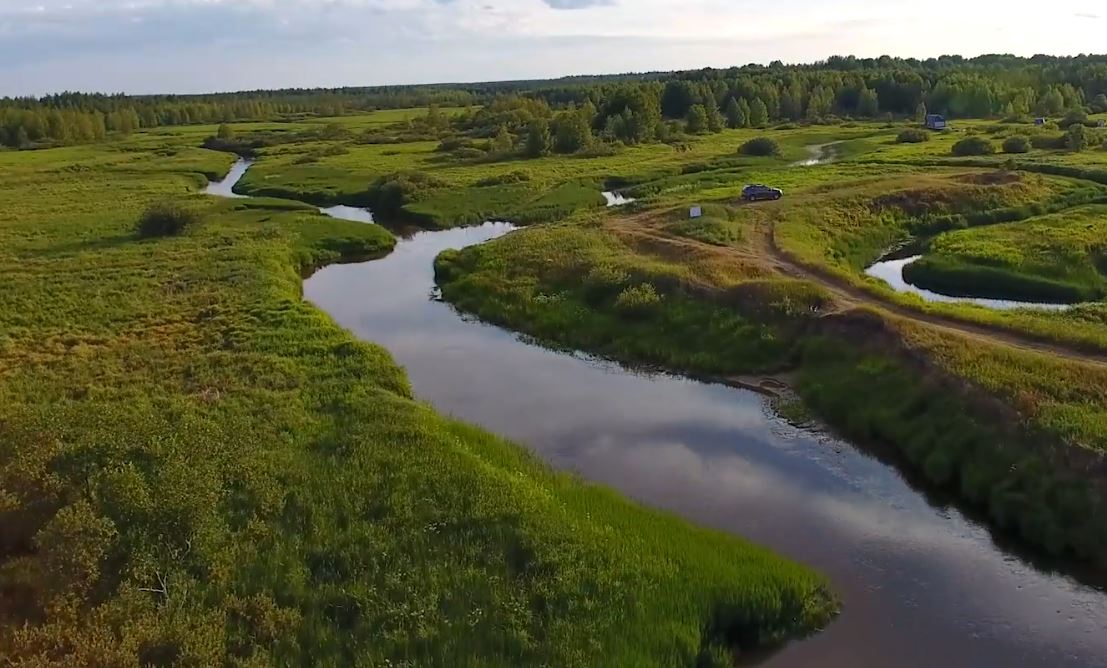
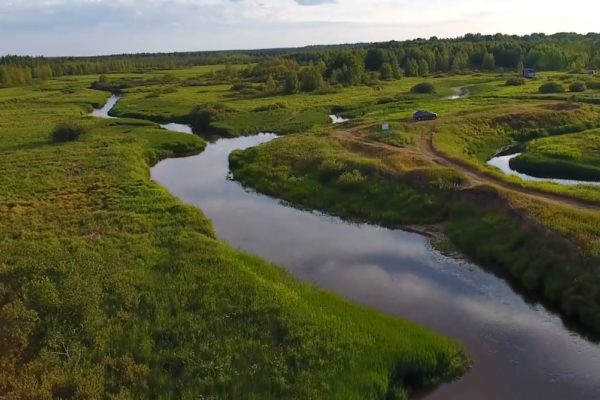
The Upper Forth runs from Loch Chon and Loch Ard, in the wooded hills west of Aberfoyle, down onto the flood plains of the Carse of Stirling, meandering through a diverse landscape of rural land uses and communities until it reaches Stirling.
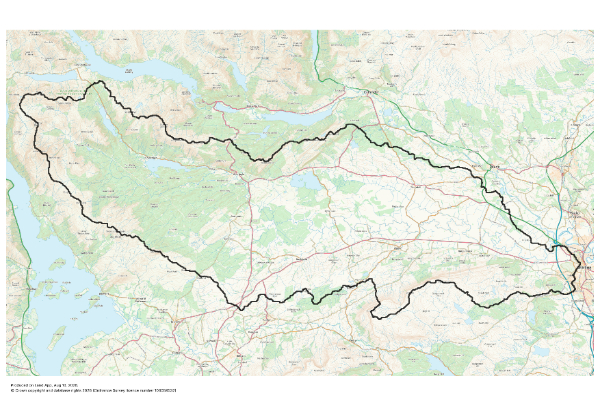
Figure 1: Upper Forth River Catchment
Every land use across the catchment is connected by the rivers and burns that make up the Upper Forth. Water flows down from the hills, through the farms and villages below, and onto the city. Actions taken at the top of the catchment are felt not only there but all the way down, which is what makes catchment-wide collaboration so important.
What the network is for
The Upper Forth Farmer and Land Manager Network was set up to help people working across the catchment manage land and water together.
It is a collaboration between multiple organisations working in partnership including Forth Rivers Trust, Carse of Stirling Partnership, Glasgow Caledonian University, and Propagate Scotland.
The network has three broad aims:
- Bring together a range of farmers and land managers, from the headwaters to the floodplain, and build an understanding of how people are managing their land and water and why.
- Share practical knowledge, experiences, and support farmers and land managers in adopting resilient soil and water management measures.
- Make the catchment a thriving landscape resilient to flooding, drought and biodiversity loss, while keeping farms productive and improving food security.
Learning from each other on the ground
Most of the network’s activity happens on farms, hosting demonstration across the catchment where land managers are already doing something different, whether that is managing a watercourse, changing grazing, or living alongside beavers. The format is simple: a coffee, a walk, and a conversation about best practice, what is working and what is not.
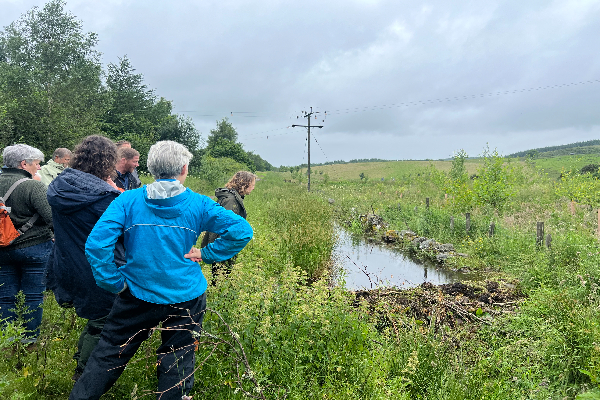

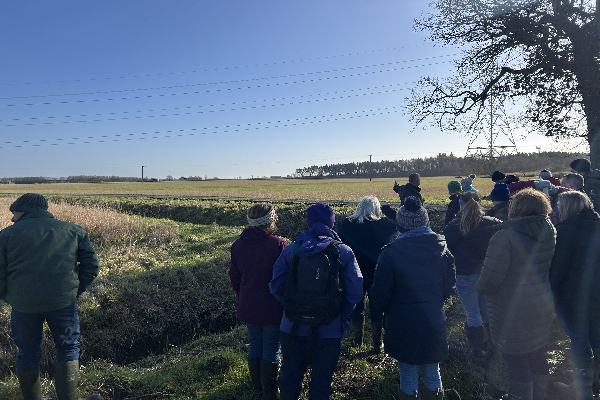
Photo Credit - R Smilie
The topics range from the practical to the strategic and are led by the network members. One visit looked at sustainable management of waterways, with the question of when you can dredge but also discuss what other options are available, which might suit the business more. Another visited a productive sheep farm that has seen output rise alongside a thriving beaver population, showing supporting nature and improving productivity can go hand in hand. A Working with Nature conference brought together case studies from across Scotland on how nature leveraged to tackle issues such as flooding. Beyond the organised events, the network also helps members to connect with one another and set up their own farm-to-farm visits.
From ideas to plans
Seeing something on the ground is one thing; working out whether it fits your own farm is another. That is where Forth Rivers Trust’s advisory visits come in. Trust staff visit network members to help design projects, from pond creation and wetland scrapes to riparian tree planting, new woodland, hedgerow planning and integrating cattle into grassland.
All of these measures are designed to work with the water cycle rather than against it: slowing water down, encouraging it to soak in, directing it to boggy corners that are already wet, and improving soil structure so the land holds more.
To target the work, the Trust uses innovative modelling tool including NatureInsight. Created by Arup and integrated via SCALGO Live, it merges hydrological modelling with environmental data analysis and pinpoints specific landscape opportunities to restore natural functions, reduce flood risks, sequester carbon, and boost biodiversity.
Using innovative technologies like these in decision making processes makes it is possible to work with the natural movement of water and place measures where they will offer the greatest benefit, rather than where they happen to be convenient.
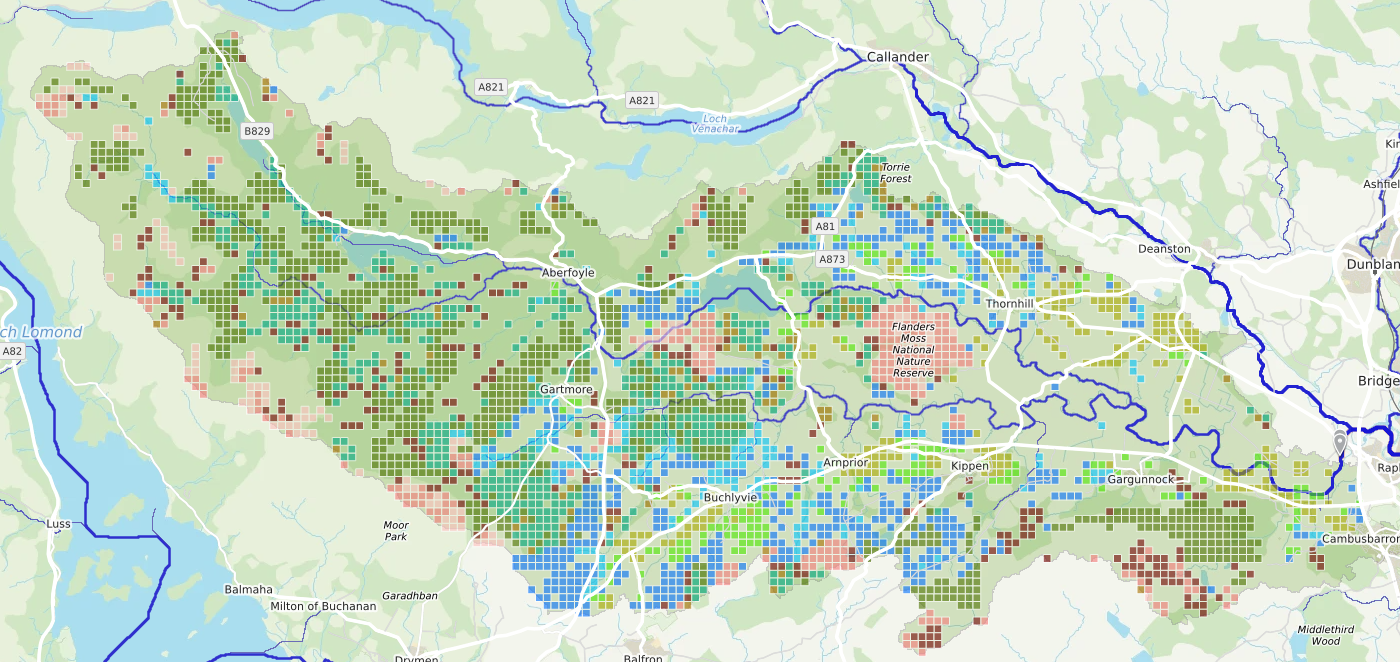
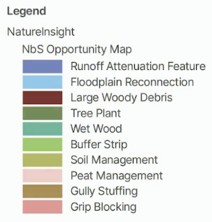
Figure 2: Example of a NatureInisght opportunity map for Upper Forth catchment identifying suitable locations for ten different types of NbS using suitability score of 75. - From Arup / SCALGO NatureInsight, https://scalgo.com/en-US/core-plus-products/coreplus-natureinsight
The right measure in the right place
The value of the catchment approach is clearest in the projects that are currently being developed with Forth Rivers Trust.
In the upper catchment, the focus is on slowing the flow: creating ponds and wetlands that hold water back in the hills and bringing livestock onto neutral grassland to shift it towards species-rich meadow over time. Lower down, on the Carse, the priorities are different: riparian planting to stabilise eroding banks, wet woodland to keep stock out of awkward, waterlogged corners, and wader scrapes to direct water to parts of the farm that are already wet.
One example shows how these decisions get made. A sheep farmer in the network had a corner of the farm that floods every winter, cutting off the area and resulting in stranded sheep. Every time, hours were lost getting stranded sheep to safety. The farmer's own suggestion was to fence off the area and plant it up. The Trust's modelling confirmed the site was ideal for wet woodland: low-lying, already wet, and on a natural flow path.
The result is a nature-based solution that works on both scales at once. For the farm, this:
- Solves a recurring issue that distracts from other work
- Removes a drain on time and labour.
For the catchment, it feeds into wider catchment resilience goals:
- Slowing water down
- Increasing infiltration
- Increasing habitat connectivity
- Boosting biodiversity.
Nothing about the process takes productive ground out of use; instead turning a liability into an asset.
On their own, projects like this seem small. However, when accumulated together across nearly 30 holdings, they start to change how resilient the whole catchment is.
The network so far
Nearly 30 farmers and land managers have signed up to date, and the network has held five events, including farm walks, cinema nights, a conference and webinars.
Rachel Smillie, who facilitates the network for Forth Rivers Trust, has spent the past year visiting farms across the Upper Forth:
“What’s struck me is how interested people are in what others are doing, whether that’s the farm next door or one at the far end of the catchment. The network gives us a way to bring them together, usually over a walk and some good food. Everyone I’ve spoken to wants to work with nature, either to tackle something on their own farm or to help with the bigger catchment picture.”
Funding and how to get involved
The Upper Forth Farmer and Land Manager Network is co facilitated by Forth Rivers Trust and Propagate Scotland. It is a sub project within The Resilient Landscapes Upper Forth Partnership, A collaboration between Forth Rivers Trust, Carse of Stirling and Glasgow Caledonian University, funded by the Forth2O Innovation Fund and is also part of Propagate’s Farmer Cluster Connections funded by the Scottish Government’s Knowledge Transfer and Innovation Fund (KTIF).
To learn more about or join the network visit www.upperforthnetwork.org.
Similar networks are being established in catchments across Scotland. Click below to find out more:
Additional Resources
Click below for further information:




Sign up to the FAS newsletter
Receive updates on news, events and publications from Scotland’s Farm Advisory Service