
Business and Policy November 2025 – Milk
Milk production data
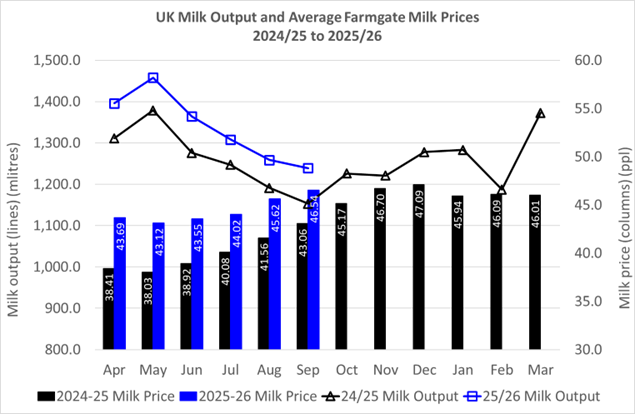
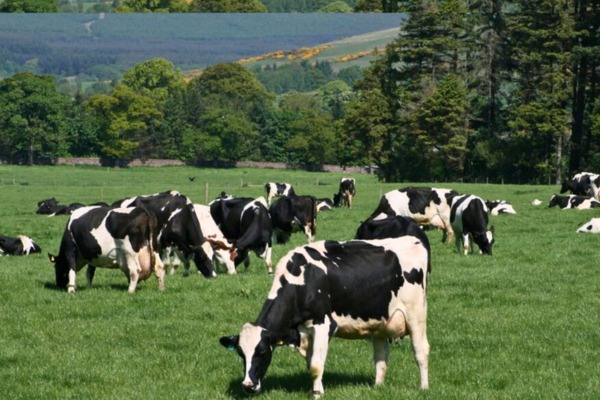
Globally, milk output from the key exporting regions is increasing and outstripping demand, which is negatively impacting on markets and resulting in some dramatic milk price cuts. Domestic milk production is not helping, with rain over the last couple of months benefiting grazing herds and UK production having increased by around 6.2% in September compared to the same month in 2024.
Daily GB production is currently 35.55 mlitres for the week ending 18th October, which is 0.9% more than the previous week and 7.3% more than the same week in 2024 (an extra 2.43 million litres daily). AHDB have recently updated their forecast for the 2025/26 milk year, with an estimated production of 12.89 billion litres. If realised, this would be a record high and 3.6% more than the 2024/25 milk year. September’s GB milk volume was estimated at 1,026 mlitres, 57 mlitres more than the previous September, up 5.9%. For the UK, September production was 1,239 mlitres, which is 1.5% less than the previous month but 7.4% more than September 2024.
Farm-gate prices
The Defra farm-gate milk price for September was 46.54ppl, up 1.4ppl from August price and 7% more than 12 months ago. Milk price drops are starting to come thick and fast, with a 1.25 ppl drop for Müller Direct suppliers and 1ppl less for First Milk suppliers from 1st of November and 6 pence per litre from the 1 December. Bigger price drops have been announced south of the border – the biggest ones so far are an 8ppl drop from Parkham Dairies (Devon) to 35.5ppl, and Meadow Foods and Freshways dropping 6ppl in response to the continued high milk volumes (November price 36ppl), with Lactalis/Fresh Milk Co dropping their price for November by 5 pence per litre.
| Milk Prices for Oct/Nov 2025 Scotland | Standard Ltr ppl | |||
|---|---|---|---|---|
| First Milk2 | Nov | 42.85 | ||
| Müller - Müller Direct - Scotland 1, 3 | Nov | 41.50 | ||
| Grahams1 | Nov | 42.00 | ||
| Arla Farmers2 | Nov | 41.74 | ||
| Lactalis / Fresh Milk Co.2 | Nov | 37.13 | ||
| 1 | Liquid standard litre – annual av. milk price based on supplying 1m litres at 4.0% butterfat, 3.3% protein, bactoscan = 30, SCC = 200 unless stated otherwise. | |||
| 2 | Manufacturing standard litre - annual av. milk price based on supplying 1m litres at 4.2% butterfat, 3.4% protein, bactoscan = 30, SCC = 200 unless stated otherwise. | |||
| 3 | Includes 1.00ppl Müller Direct Premium. Haulage deducted depending on band for 2023 vs 2021 litres, ranging from -0.25 to -0.85ppl. | |||
Dairy commodities & market indicators
The markets are well and truly reacting now to higher milk volumes, both domestically and globally. The average UK wholesale price for cream for October dropped a massive 23% from the previous month. Butter, mild cheddar and skim milk powder were also back 16%, 9% and 5% respectively. Markets are out of kilter with oversupply of products and weak demand.
EU production has been ramping up, especially in France and Germany, with their butter stocks building. There is increasing competitiveness in the global cheese market and, while sellers are reluctant to drop prices too much, with cheese having been made with expensive milk they are keen to clear the build-up of stocks by the end of the year. In addition to which there have been more dairy imports from the US and New Zealand on the back of free trade deals and their more competitively priced products compared to the EU, especially for butter and cheese. Not surprisingly, the market indicators AMPE and MCVE moved down again from last month, -5.4ppl and -3.83ppl respectively.
The Milk Market Value indicator also continued its downward trajectory, dropping significantly by 4.14ppl to 34.89ppl for September, a worrying trend given that this indicator is typically strongly correlated to movements in the farm-gate milk price in three months’ time. The GDT auction had its 5th consecutive drop of 1.4% at the latest auction on the 21st of October. The average price across all products fell to $3,881/t. The biggest fall was in mozzarella, down 5.3% to $3,230/t, and whole milk powder, down 2.4% to to $3,610/t.
| UK dairy commodity prices (£/tonne) | Oct | Sep | Apr |
|---|---|---|---|
| 2025 | 2025 | 2025 | |
| Butter | 4,680 | 5,540 | 6,050 |
| Skim Milk Powder (SMP) | 1,820 | 1,910 | 1,980 |
| Bulk Cream | 1,986 | 2,587 | 2,625 |
| Mild Cheddar | 3,110 | 3,420 | 4,020 |
| UK milk price equivalents (ppl) | Oct | Sep | Apr |
| 2025 | 2025 | 2025 | |
| AMPE | 35.87 | 41.27 | 42.09 |
| MCVE | 34.64 | 38.47 | 43.9 |
| UK milk price equivalents (ppl) | Oct | Sep | Apr |
|---|---|---|---|
| 2025 | 2025 | 2025 | |
| AMPE | 35.87 | 41.27 | 42.09 |
| MCVE | 34.64 | 38.47 | 43.9 |
© AHDB [2025]. All rights reserved.
How clean is your water?
Often referred to as the forgotten nutrient, water availability and its cleanliness has a huge impact on both milk production and cow health. There are new approaches available on the market for the treatment of both wastewater and drinking water for livestock, including chlorine dioxide, ozone and nanobubble technology. These treatments are effective in killing pathogens and removing slimy biofilms, which can be hard to penetrate with some biocides and kill the bacteria within them. Reported benefits include improved growth rates in youngstock, higher milk production and healthier animals. In addition, some of these technologies offer a chemical-free way to efficiently clean the milking plant.
Cost of production and outlook
With feed prices still relatively low, higher levels of concentrate feeding will likely continue to help make up for forage shortages in some areas, and high milk production is likely to be maintained. Any drop in domestic production is more likely to come from increased culling or exits from dairying.
Milk prices are predicted to be around 40ppl by the end of 2025 and dropping further heading into 2026, well below the cost of production. The Dairy Group forecast the cost of production for 2025/26 to be 49.2ppl, up from the 2024/25 figure of 48.5ppl on the back of higher feed costs and inflation, which means very challenging times ahead for dairy producers.

Sign up to the FAS newsletter
Receive updates on news, events and publications from Scotland’s Farm Advisory Service