
Prevalence of Heat Stress in Dairy Cows – A Summary of the A-SHED Project
The global climate is changing, with the UK experiencing warmer average summer temperatures and an increasing frequency of heatwaves. While Scotland and northern England are not traditionally regions associated with heat stress in dairy cows, high-yielding yielding dairy cows housed during the summer may still be at risk. Heat stress occurs when cows produce more heat than they can lose from their body surface. Air temperature and humidity are the main climatic factors influencing heat stress. These are combined in the temperature-humidity index (THI), a widely used measure for assessing the risk and severity of heat stress, which has been used to define thresholds for mild, moderate and extreme heat stress conditions for dairy cows. A THI level of 72 has been considered as the point where heat stress begins to negatively affect milk yields. However, research indicates that health and fertility are affected at THI levels lower than this.
A Digital Dairy Chain funded project, known as ‘A-SHED’ and involving Galebreaker, SmartBell and SRUC is assessing the extent to which dairy cows in south-west Scotland and north-west England are affected by heat stress. The project involves 20 farms across this region, with an additional 3 farms further north for comparison. The project started in spring 2025.
Temperature-humidity monitors were installed on participating farms to collect environmental data, alongside data on daily milk yield, health and fertility. During the summer of 2025, the study found that THI levels in Scotland reached a maximum daily average of 74, with a daily average of 62, and peak of 84 across Scotland.
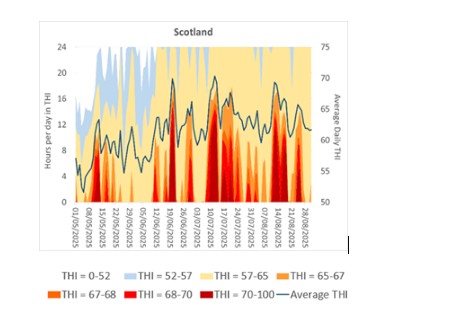
Figure 1. Graph showing daily average THI from May to August across all Scottish farms participating in the project
Analysis has shown that not every cow will experience heat stress, even in high THI periods. However, cows in early lactation, older cows, or those housed in sheds with sub-optimal ventilation are more likely to be affected by heat stress. Findings suggest that cows in Scotland may be more susceptible to heat stress at lower THI levels than previously recognised. A reduction in milk yield was observed at a THI of 68, compared to the published average threshold of 72. This indicates that cows are acclimatised to the cooler Scottish weather conditions and less able to cope when THI is high.
The data analysis also showed that the effects of a hot and humid day are not immediate, but that the effect of a hot/humid period on milk yield will be seen three days after the heat stress event. Importantly, results have shown that cooler night-time conditions can counteract the negative effects of hot and humid days. Cows respond to heat stress by reducing feed intake and increasing standing time, both of which can negatively affect productivity. A decrease of 5 THI points at night, compared to daytime average THI allows cows to feed, rest and recover, thereby reducing the impact of high daytime THI on milk yield. For instance, on one farm, there was a difference of ten THI points between day and night, which allowed a recoup of milk yield of 1.24 kg/cow.
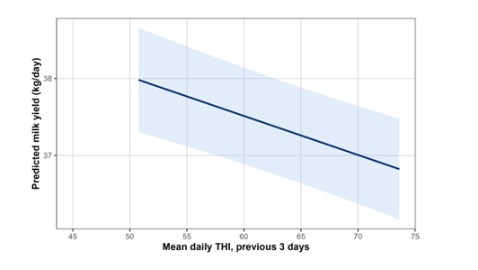
Figure 2. Graph showing negative effect of increasing THI on milk yield. Average loss of -0.25 kg/cow with an increase of 5 THI. Max THI increase above average THI observed in the project was by almost 20 THI units, a loss of 1 kg of milk per cow
Several strategies can be employed on farm to reduce heat stress, including improving natural ventilation by opening the sides of the cattle buildings and ensuring there is an open ridge, with upstands, along the roof. However, this is not always feasible, given that many Scottish buildings are designed primarily to keep the worst of the Scottish winter weather out. In these cases, mechanical solutions such as ventilation tubes or fans may be required to improve airflow.
The A-SHED study will continue across the summer of 2026 to allow more data to be collected. So far, the project has largely focused on the effects of THI levels on milk yield, but we also aim to examine the effects of heat stress on fertility.
Please contact Holly Ferguson (holly.ferguson@sruc.ac.uk) or Marie Haskell (marie.haskell@sruc.ac.uk) for further information.
Related Resources


Sign up to the FAS newsletter
Receive updates on news, events and publications from Scotland’s Farm Advisory Service