
Business and Policy August 2026 – Milk
Milk Production Data
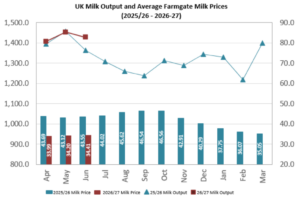
Milk production continues its seasonal decline, with lower milk prices, volume management schemes and recent heatwaves adding further pressure on output. The latest data from AHDB estimates GB milk production for June 2026 at 1,065 million litres, 40 million litres less than the previous June (-3.6%). Daily production is currently 33.19 million litres for the week ending 18th July, which is 2.5% less than the previous week and 2.6% less than the same week last year (900,000 litres less). For the UK, June 2026 production was estimated to be 1,321 million litres, which is 43 million litres less than June 2025.
Farm-gate Prices
The Defra farm-gate milk price for June 2026 was 34.41ppl, up 0.05ppl (0.1%) from the May price and 20% lower than 12 months ago. First Milk, Arla and Lactalis have announced price increases for August, whilst MÜller announced a price hold. The organic milk price is currently around 56.40ppl.
| Milk Prices for July/Aug 2026 Scotland | Standard Ltr ppl | ||
|---|---|---|---|
| First Milk2 | Aug | 32.85 | |
| Müller - Müller Direct - Scotland 1, 3 | Aug | 34.5 | |
| Grahams1 | July | 34.5 | |
| Arla Farmers2 | Aug | 38.15 | |
| Lactalis / Fresh Milk Co.2 | Aug | 34.87 | |
| 1 | Liquid standard litre – annual av. milk price based on supplying 1m litres at 4.0% butterfat, 3.3% protein, bactoscan = 30, SCC = 200 unless stated otherwise. | ||
| 2 | Manufacturing standard litre - annual av. milk price based on supplying 1m litres at 4.2% butterfat, 3.4% protein, bactoscan = 30, SCC = 200 unless stated otherwise. | ||
| 3 | Includes 1.00ppl Müller Direct Premium. Haulage deducted depending on band for 2023 vs 2021 litres, ranging from -0.25 to -0.85ppl. | ||
Dairy Commodities & Market Indicators
The markets are heating up as the recent heatwaves hit milk volumes across the UK and mainland Europe. In the UK, temperatures exceeded 35°C on several days in June and July, at one stage production fell 4.5% below the same period last year. In addition to lower milk volumes, heat stress has also reduced fat and protein content. This has tightened cream availability and created a ripple effect across dairy commodity markets, with concerns over limited supply prompting short-term buying and position covering.
Skimmed Milk Powder (SMP)
Skimmed milk powder prices have strengthened. With fewer butter churns operating, less skim milk was available for drying, resulting in reduced SMP production. Despite the firmer market, trading activity remained relatively quiet. The average price for the period rose by £70/t to £2,360/t.
Mild Cheddar
Similarly, with more milk diverted to fresh dairy production, cheese stocks have tightened slightly, providing upward support to prices. Buyer interest has increased, with many looking to secure product at previous price levels, while sellers have generally been reluctant to release stocks in anticipation of further price rises. Nevertheless, opportunities remained for buyers to secure favourable deals where sellers were motivated to move stock. Prices rose by £150/t to £3,050/t.
Bulk Cream
The bulk cream market has seen the most positive recovery due to diminishing milk supplies. The average price shot up from £1.30/kg to £1.70/kg at times, this has since slid back as milk volumes have recovered slightly. The average price for the period was £1,530/t.
Butter
The high cream prices made it uneconomical to turn on butter churns beyond contracted volumes, putting some tightening on markets. However, stocks remain plentiful, with reports suggesting stores are still full, although some product is beginning to age. The market remains relatively quiet, but pockets of buying activity emerged as purchasers sought to secure supplies ahead of anticipated price increases. This provided some upward momentum, resulting in a modest strengthening of butter prices. Prices rose by £80/t to £3,320/t.
As a result, there was a positive change in both the AMPE and MCVE. The Milk Market Value indicator increased by 1.32pppl to 34.92ppl for July. The latest GDT auction on 21st July shows a rise of 1.5% in price when compared to the previous auction, with the average price across all products reaching $3,815/t.
| UK dairy commodity prices (£/tonne) | July 2026 | June 2026 | January 2026 |
|---|---|---|---|
| Butter | 3,320 | 3,240 | 3,600 |
| Skim Milk Powder (SMP) | 2,360 | 2,290 | 1,810 |
| Bulk Cream | 1,530 | 1,387 | 1,185 |
| Mild Cheddar | 3,050 | 2,890 | 2,860 |
| UK milk price equivalents (ppl) | July 2026 | June 2026 | January 2026 |
|---|---|---|---|
| AMPE | 33.90 | 32.93 | 30.1 |
| MCVE | 35.17 | 33.77 | 31.8 |
© AHDB [2026]. All rights reserved.
Dairy Profits Masking Volatility
The latest Milk Cost of Production report from Old Mill and the Farm Consultancy Group highlights strong returns for some dairy businesses in 2025/26, with average profits reaching 12.43ppl from income of 54.81ppl and costs of 42.38ppl. Milk income rose to 46.38p/litre, while non-milk income from calf and cow sales contributed a further 8.43p/litre. However, profits are forecast to fall by around two-thirds in 2026/27 to 3.96ppl as milk prices weaken, production costs remain under pressure, and extreme weather continues to challenge businesses. The report found that higher yields alone did not always translate into higher profits, with cost control and technical performance key drivers of success. The top 10% of farms achieved profits of 24.31ppl, compared with a loss of 2.56ppl among the bottom 10%, as they generated stronger milk returns while maintaining lower production costs. Those businesses that have invested in technology, genetics and efficiency improvements are seeing the rewards through improved performance and cashflow. As margins tighten, farmers are encouraged to review costs, cashflow, and longer-term business plans to ensure they remain resilient and well positioned for the future.
Scientists Detect Johne’s-Linked Antibodies In Newborn Calves
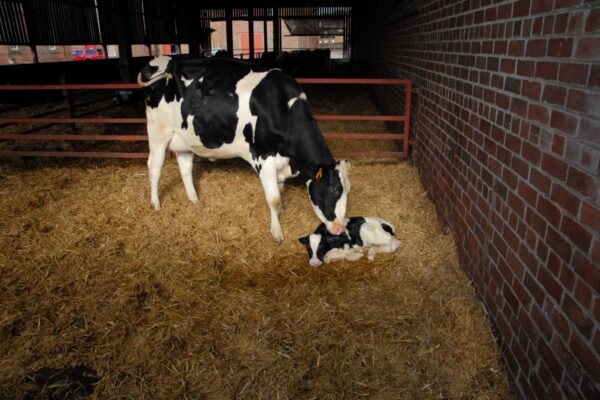
Researchers at the Royal Veterinary College (RVC) have identified a potential new way to study early-life exposure to Johne’s disease using blood samples already collected from newborn calves. The study found that antibodies linked to Mycobacterium avium subspecies paratuberculosis (MAP), the bacteria responsible for Johne’s disease, could be detected in calves after receiving colostrum from their mothers. However, researchers stressed that the test cannot diagnose Johne’s disease or confirm infection. The findings could help improve understanding of when calves are most at risk and support future herd surveillance. The study, involving 38 dairy calves and their mothers, found calves born to cows with detectable MAP antibodies had higher levels of MAP-specific antibodies, consistent with transfer through colostrum. Researchers highlighted that most current monitoring focuses on adult cattle, leaving gaps in understanding early-life exposure. Further work is needed, but the approach could provide a practical way to investigate calf risk without requiring additional blood sampling.
Keira Sannachan, Keira.Sannachan @sac.co.uk





Sign up to the FAS newsletter
Receive updates on news, events and publications from Scotland’s Farm Advisory Service