
Business and Policy October 2026 – Milk
Milk Production Data
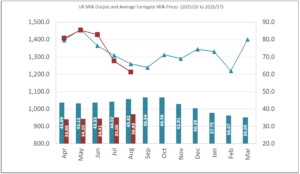
Milk production is beginning to rise as we head into the autumn months, on the back of some much-welcomed rain in September for those south of the border, and the increasing trend towards autumn calving herds. Daily production is currently 33.02 million litres for the week ending 19th September, which is 1.5% more than the previous week and 3.4% less than the same week in 2025 (equivalent to 1.16 million litres less). In June 2026, AHDB forecast that GB milk production for the 2026/27 milk year would reach 12.91 billion litres, 0.9% below the record 13.02 billion litres produced in 2025/26. Milk production has since fallen below the previous year, with August GB production estimated at 992 million litres, 46 million litres lower than August 2025. UK production for August was estimated at 1,209 million litres, down from 1,276 million litres in July.
Farm-gate Prices
The Defra farm-gate milk price for August 2026 was 36.89ppl up 1.4ppl (4%) from the July price and 17% lower than 12 months ago. First Milk(+3.15ppl), Grahams(+1ppl), Lactalis(+2ppl), Arla(+1.76ppl) and Müller(+2.00ppl) have announced price increases for October.
| Milk Prices for Oct 2026 Scotland | Standard Ltr ppl | ||
|---|---|---|---|
| First Milk2 | Oct | 39 | |
| Müller - Müller Direct - Scotland 1, 3 | Oct | 37 | |
| Grahams1 | Oct | 36 | |
| Arla Farmers2 | Oct | 40.86 | |
| Lactalis / Fresh Milk Co.2 | Oct | 39.02 | |
| 1 | Liquid standard litre – annual av. milk price based on supplying 1m litres at 4.0% butterfat, 3.3% protein, bactoscan = 30, SCC = 200 unless stated otherwise. | ||
| 2 | Manufacturing standard litre - annual av. milk price based on supplying 1m litres at 4.2% butterfat, 3.4% protein, bactoscan = 30, SCC = 200 unless stated otherwise. | ||
| 3 | Includes 1.00ppl Müller Direct Premium. Haulage deducted depending on band for 2023 vs 2021 litres, ranging from -0.25 to -0.85ppl. | ||
© AHDB [2026]. All rights reserved.
Dairy Commodities & Market Indicators
Milk volumes have remained weak across the UK, with August GB milk volumes back 4.4% on the previous year. The picture is reportedly quite regional, with areas less impacted by the summer drought seeing better milk production. However, while grass growth has now returned to normal for the time of year, winter forage supplies could still prove tight, while concerns around bluetongue are also creating some nervousness.
This means the UK and Ireland are operating quite differently to mainland Europe, where milk is still flowing and markets are feeling more pressured. Tight UK supplies are providing some support to commodity prices, although perhaps not enough yet to justify the level that milk prices need to reach to encourage a recovery to milk production.
Skimmed Milk Powder (SMP)
SMP prices have continued to strengthen, supported by good global demand for protein. Availability is also relatively limited, with lower production and strong export volumes during the first half of the year keeping supplies fairly tight. In Ireland, milk volumes are also moving into the quieter part of the season, further reducing availability at a time when supplies have already been challenging. While some dryers remain seasonally quiet, there is still fresh milk moving into the spot market, with prices currently in the 40s. Demand has remained positive, with some buyers potentially looking to cover requirements earlier than usual ahead of expected higher costs, particularly with energy prices increasing. The average price for the period was £2,730/t, up £260/t.
Mild Cheddar
Cheddar has remained strong in the UK, despite a weaker global picture, with prices around £3,400/t currently, although there are some signs of the market easing. Tighter milk supplies across the key cheddar producing regions in the UK, Ireland and Poland have helped support prices. However, recent cheddar price increases are still not enough to cover higher milk costs observed by cheese makers for October, leaving margins under pressure. Demand has picked up from the summer, but remains mixed. Global cheese supply has grown significantly during 2026 but prices have remained relatively steady, with strong Middle Eastern demand helping to support the market. Cheaper US supply remains a potential cap on further price rises. The average price for the period was £3,330/t, up £270/t.
Bulk Cream
Bulk cream has continued to strengthen, gaining around 10ppl over the reporting period despite weaker prices on the continent. There are now some signs of the market levelling off, with improved grass growth and easing concerns around milk supply reducing some of the pressure. The average price for the period was £1,708/t.
Butter
High cream prices have continued to discourage butter production beyond contracted volumes, keeping the market relatively tight. However, high stocks are still weighing on the market, although prices have started to edge up as some seasonal demand returns. The market remains fairly quiet for September. Prices increased by £90/t to £3,540/t.
As a result, there was a positive change in both the AMPE and MCVE. The Milk Market Value indicator increased by 3.5ppl to 39.00ppl for September. The latest GDT auction on 18th August shows a rise of 2.3% in price when compared to the previous auction, with the average price across all products reaching $3,873/t.
| UK dairy commodity prices (£/tonne) | Sep-26 | Aug-26 | Mar-26 |
|---|---|---|---|
| Butter | 3,540 | 3,450 | 3,980 |
| Skim Milk Powder (SMP) | 2,730 | 2,470 | 2,340 |
| Bulk Cream | 1,708 | 1,607 | 1,556 |
| Mild Cheddar | 3,330 | 3,060 | 3,080 |
| UK milk price equivalents (ppl) | Sep-26 | Aug-26 | Mar-26 |
|---|---|---|---|
| AMPE | 38.69 | 35.62 | 37.35 |
| MCVE | 39.08 | 35.48 | 34.89 |
Dairy Farms Trial New Ways To Reduce Greenhouse Gas Emissions
More than 50 dairy farms across the UK are trialling over 200 measures to reduce greenhouse gas emissions as part of the UK Dairy Carbon Network (UK-DCN). The project is testing approaches including improving nutrition and forage use, fertility and youngstock health, genetics, nutrient planning and slurry management under real farm conditions. Some farms are combining several measures to assess how they work together and whether this can deliver greater reductions. The project is also assessing the potential financial benefits, with many measures expected to improve farm efficiency alongside reducing emissions. The findings will help identify practical measures that can be adopted across the wider dairy sector.
Summer Heat Cuts UK Milk Production By 240 Million litres
Extreme heat and drought during summer 2026 resulted in UK dairy farmers producing around 240 million fewer litres of milk than expected between May and August, equivalent to around four days of normal milk production. The Energy and Climate Intelligence Unit (ECIU) estimated the lost milk was worth more than £83 million to farmers, with poor grazing conditions, reduced grass growth and heat stress on cows contributing to lower production. Some farmers have been forced to house cattle and start using winter forage earlier than planned, increasing feed, housing and labour costs. Despite the summer shortfall, UK milk production could still reach near record levels in 2026 due to stronger production earlier in the year. The ECIU warned that the effects of the dry summer could continue, with farmers facing higher feed costs as winter forage is used earlier than planned.
Keira Sannachan, Keira.Sannachan@sac.co.uk

Sign up to the FAS newsletter
Receive updates on news, events and publications from Scotland’s Farm Advisory Service