
EnviroCow Index Yielding Results
This article provides an overview of a recent study commissioned by AHDB and undertaken by Promar International, which found that herds using targeted breeding could reduce the carbon footprint associated with milk production by up to 16% over five years.
The study looked at herds that selected bulls with higher EnviroCow scores and monitored their carbon footprints over a five-year period. The herds using EnviroCow saw steady improvements over the course of the study as the genetics introduced using EnviroCow worked their way into the herd. These improvements in environmental efficiency were achieved without compromising production, demonstrating that breeding for lower emissions can go hand in hand with productive and efficient cows. On average, this reduced the carbon footprint per unit of milk produced by between 8.5 and 16% over the five-year period.
What is EnviroCow?
EnviroCow is a Genetic Index, which incorporates traits such as cow lifespan, milk production, fertility and Feed Advantage, allowing producers to incorporate environmental efficiency into their breeding policy. Breeding for environmental efficiency doesn’t mean sacrificing profit or production. EnviroCow is closely correlated with the Profitable Lifetime Index (£PLI). Whereas £PLI is designed to breed cattle that are more profitable over their lifetime, EnviroCow is designed to breed cattle that produce milk with lower emissions through improvements in production, longevity, and feed efficiency.
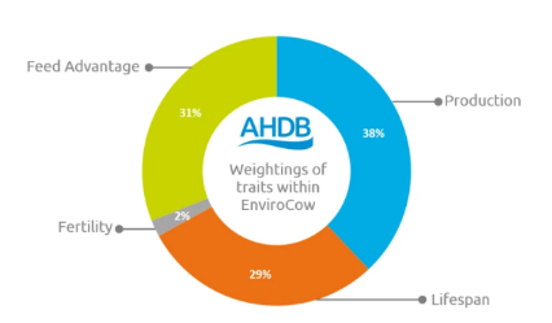
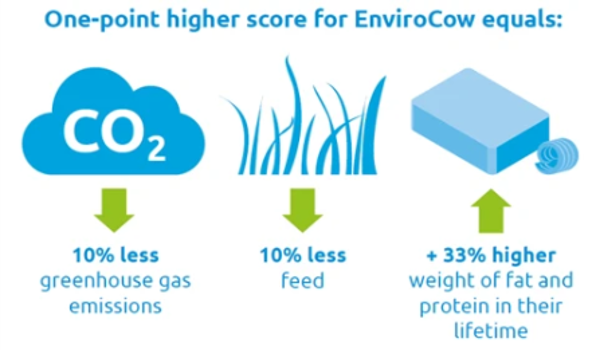
Figure 1 - EnviroCow trait weightings and the real-world effect of a one-pointer higher score in the index. (AHDB, 2026)
As stated above, the EnviroCow index is closely related to £PLI. The study found that producers using £PLI, which is the most widely used genetic index, were also reducing their carbon footprint year on year through breeding more productive and efficient cattle. This suggests that the UK dairy herd is already moving in the right direction through genetic selection.
Does EnviroCow work?
Findings from the Promar International study demonstrate the potential for genetic selection to improve environmental efficiency of dairy herds over time. A separate study published in 2023 provides further insight into how differences in EnviroCow scores translate to real-world animal performance. The study examined 475,000 dairy cows born between 2008 and 2011, comparing their EnviroCow Index scores with key measures of lifetime performance, including:
- lifetime milk
- fat and protein production
- age at first calving
- number of lactations
- mature weight
- stature
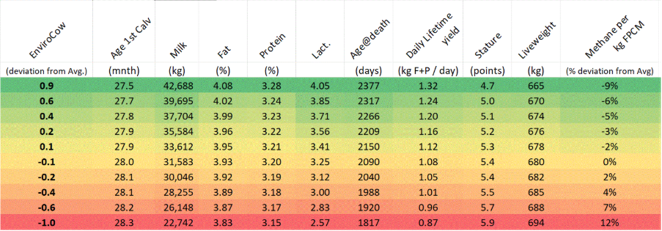
Figure 2 - Deciles (10% groups) of EnviroCow and the average lifetime performance of animals in each group, including methane production.
This study found that, on average, each point increase in EnviroCow was associated with animals producing 10% less methane per kg of milk, and consuming 10% less feed, while producing 33% more fat and protein over their lifetime. In figure 2, we can see the difference between animals with higher and lower EnviroCow scores. A cow with an EnviroCow index of 0.9, compared with a cow with an index of -1.0, calved 0.8 months earlier, produced 19,946 kgs more milk with 0.25% greater fat content and 0.13% greater protein content. In addition, she had 1.48 more lactations, lived 560 days longer and produced 19% less methane per kg FPCM (Fat and Protein Corrected Milk).
Key Points:
- Take a balanced approach to breeding selection. A breeding policy should be well-rounded with a range of important traits considered. EnviroCow should be used alongside other breeding indexes, such as £PLI, to help identify the most suitable animals for the herd.
- The EnviroCow index can deliver real reductions in emissions. Incorporating EnviroCow into your breeding policy can help reduce the environmental impact of the herd over time.
- Breeding more environmentally efficient cows means breeding more efficient cows overall. These cows can live longer, produce more, higher-quality milk, and consume less feed while doing so.
Further Information
https://breedingdairy.ahdb.org.uk/learn/traits-and-indexes/envirocow/
https://journal.interbull.org/index.php/ib/article/view/1904/1886
https://ahdb.org.uk/news/it-s-time-to-run-a-genetic-carbon-audit
https://ahdb.org.uk/news/study-shows-breeding-can-help-cut-dairy-farm-emissions

Sign up to the FAS newsletter
Receive updates on news, events and publications from Scotland’s Farm Advisory Service