
Business and Policy November 2026 – Milk
Milk production data
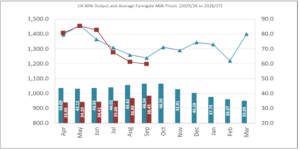
As we move further into the housed period and cattle settle into their winter rations, milk production is expected to continue to rise at a modest rate. Overall supply is forecast to remain below last year. Tight forage availability, a shrinking dairy herd, and higher production costs remain key concerns for the winter ahead. While stronger milk prices are helping support production, output is expected to remain highly variable between farms depending on individual circumstances. Daily production is currently 34.08 million litres for the week ending 17th October 2026, which is 3.9% less than the same week in 2026 (equivalent to 1.38 million litres less). The latest data from AHDB estimated the GB milk production for September at 998 million litres, 28 million litres lower than September 2025. For the UK, September production was estimated at 1,195 million litres.
Farm-gate prices
The Defra farm-gate milk price for September 2026 was 38.45ppl up 1.8ppl (4.8%) from the August price and 16% lower than 12 months ago. First Milk and Grahams have announced a price hold whilst Lactalis(+0.57ppl) and Müller(+0.5ppl) have announced price increases for November. Arla announced a decrease (-0.45ppl).
| Milk Prices for Nov 2026 Scotland | Standard Ltr ppl | ||
|---|---|---|---|
| First Milk2 | Nov | 39.00 | |
| Müller - Müller Direct - Scotland 1, 3 | Nov | 37.50 | |
| Grahams1 | Nov | 35.00 | |
| Arla Farmers2 | Nov | 40.41 | |
| Lactalis / Fresh Milk Co.2 | Nov | 39.59 | |
| 1 | Liquid standard litre – annual av. milk price based on supplying 1m litres at 4.0% butterfat, 3.3% protein, bactoscan = 30, SCC = 200 unless stated otherwise. | ||
| 2 | Manufacturing standard litre - annual av. milk price based on supplying 1m litres at 4.2% butterfat, 3.4% protein, bactoscan = 30, SCC = 200 unless stated otherwise. | ||
| 3 | Includes 1.00ppl Müller Direct Premium. Haulage deducted depending on band for 2023 vs 2021 litres, ranging from -0.25 to -0.85ppl. | ||
Dairy commodities & market indicators
Although milk supplies remain below last year, with October to date volume down 3.2%, regional differences persist. Reports suggest supplies in the southwest remain under pressure, reflecting the impacts of both drought and Bluetongue virus, while those further north have been less affected. However, industry sentiment is less concerned about milk availability compared with a month ago. Attention has instead turned back to weaker market fundamentals, with high stocks and strong global supplies returning to the forefront. Questions are emerging over the sustainability of some of the recent autumn milk price increases. The extent to which processors can maintain these rises is likely to be dependent on product mix for the individual processors.
Skimmed Milk Powder (SMP)
SMP prices continued to strengthen, supported by growing consumer demand for protein and relatively tight product availability. Production remains subdued, helping to underpin market values. Demand is reported to be strong across both food and feed sectors, with some manufacturers reformulating away from higher priced whey derivatives and increasing SMP usage. Feed demand has remained firm, providing additional support to the market. Looking ahead, rising energy costs are expected to increase manufacturing expenses, particularly for the drying sector. The average price over the period was £2,930/t, an increase of £200/t.
Mild Cheddar
Cheddar prices remained stable over the period. Whilst several manufacturers increased milk prices during the previous quarter to secure supplies, underlying market conditions have not justified these higher returns, and recent market movements have continued to disappoint. The UK cheddar market is reportedly well balanced, although mild cheddar has eased amid competitive pressure from Ireland. As seen in the butter market, many buyers are delaying future commitments and waiting to see how the market develops. The average price for the period was £3,290/t, a reduction of £40/t.
Bulk Cream
Bulk cream prices came under more pressure during the period, falling sharply from the £1.70s down to the high £1.30s. Continental cream markets are weaker still, offering little export opportunities. Despite lower milk supplies, milk fat output has remained strong. Improved grass growth and recovering production in some regions has seen supplies increase. The average price for the period was £1,528/t.
Butter
Butter markets remained under significant pressure during the period, weighed down by abundant stocks in both domestic and international markets. Buyers are generally well covered through the current quarter and have no urgency to return to the market. Weak retail demand for spreadable butter has not been outweighed by good consumer block demand, resulting in prices surrendering the gains made earlier in the autumn. With no clear floor established, market sentiment has remained cautious. Additional pressure has come from competitive international markets. Irish butter has been available below UK values, while heavily discounted US product continues to influence global trade and weigh on market confidence. A strong global demand for protein ingredients has encouraged increased SMP production, generating additional butter as a co-product and further contributing to ample fat supplies. Prices reduced by £240/t to £3,300/t.
There was a positive change in the AMPE and the MCVE moved down against last month. The Milk Market Value indicator decreased by 0.25ppl to 38.8 for October. The latest GDT auction on 20th October shows a rise of 2.5% in price when compared to the previous auction, with the average price across all products reaching $4,021/t.
| UK dairy commodity prices (£/tonne) | October 2026 | September 2026 | April 2026 |
|---|---|---|---|
| Butter | 3,300 | 3,540 | 3,540 |
| Skim Milk Powder (SMP) | 2,930 | 2,730 | 2,360 |
| Bulk Cream | 1,528 | 1,708 | 1,238 |
| Mild Cheddar | 3,290 | 3,330 | 2,980 |
| UK milk price equivalents (ppl) | October 2026 | September 2026 | April 2026 |
|---|---|---|---|
| AMPE | 39.26 | 38.69 | 35.25 |
| MCVE | 38.63 | 39.08 | 34.82 |
© AHDB [2026]. All rights reserved.
Case in Innovation Opens New Opportunities for Dairy
A project involving grouse fibre and Scotland’s Rural College (SRUC) has demonstrated a potential new market for milk proteins by converting casein into fibres and other advanced materials. Supported by the Digital Dairy Chain, the collaboration used milk processed at SRUC’s Dairy Research and Innovation Centre to develop and scale up production, moving from laboratory trials to kilogram-scale output. While still at an early stage, the technology highlights how surplus or waste milk could be used to produce higher value products for sectors such as textiles, manufacturing and horticulture, creating additional value from dairy by-products and supporting a more efficient use of resources across the supply chain.
UK Dairy Sector Extends Lead in Sexed Semen Uptake
The use of sexed dairy semen continues to increase across the UK, now accounting for more than 86% of all dairy semen used, with Holsteins leading the way at 91%. This trend is helping producers breed replacements from their highest performing cows, accelerating genetic progress and improving herd efficiency. At the same time, beef semen usage has risen to 53.5% of all semen used in dairy herds, with Aberdeen Angus (42%) and British Blue (41%) remaining the most popular breeds. Increased uptake of sexed semen is giving producers greater flexibility to use beef sires on cows not required for dairy replacements, supporting the supply of high-quality dairy beef calves. Combined, the increased use of sexed and beef semen is creating opportunities to improve herd performance, boost calf value and support greater efficiency across the livestock sector.
Keira Sannachan, Keira.Sannachan @sac.co.uk




Sign up to the FAS newsletter
Receive updates on news, events and publications from Scotland’s Farm Advisory Service